
Print it or save it
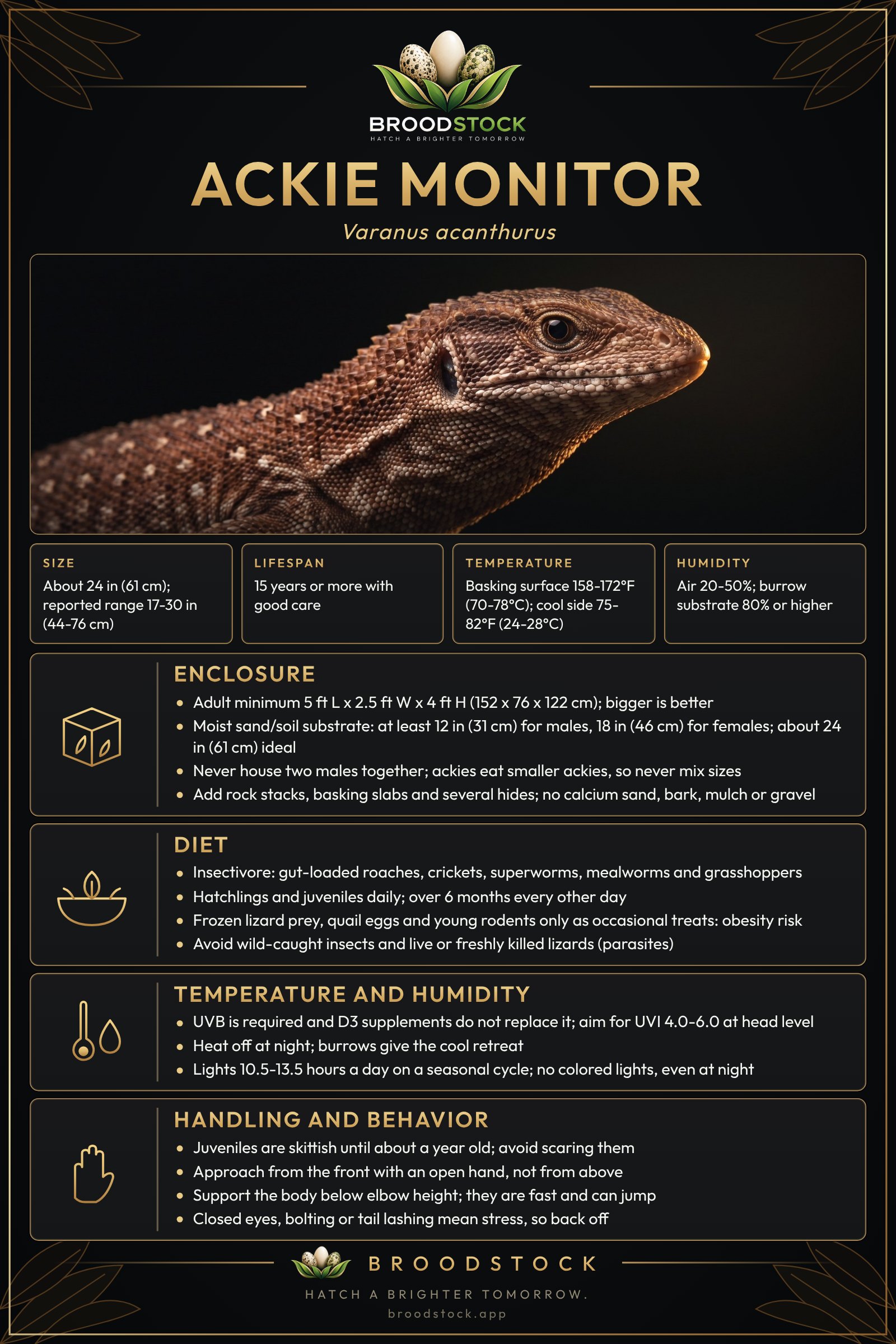
The care sheet is a one-page summary you can print or keep on your phone. The full care text is below.
Keeping Ackie Monitor? Broodstock tracks feeding, weights, sheds, enclosures and equipment for every animal you keep, and it is free to start.
Scientific name
Varanus acanthurus
Adult size
A typical adult measures about 24 in (61 cm) overall, and reports run from roughly 17-30 in (44-76 cm). Males are usually larger than females and have a broader head. The tail is about 1.3-2.3 times as long as the snout-vent length.
Lifespan
With good care, expect at least 15 years. Records of long-term captive lifespans are limited, which means the upper limit is not well documented.
Enclosure
The adult minimum is 5 ft L x 2.5 ft W x 4 ft H (152 x 76 x 122 cm), and more space is better. Juveniles can go directly into the adult enclosure. Choose a front-opening design with good ventilation.
Fill it with deep substrate the monitor can burrow in: at least 12 in (31 cm) for males, at least 18 in (46 cm) for females, and about 24 in (61 cm) is ideal. A moist sand and soil blend holds tunnels well, for example 2 parts additive-free topsoil to 1 part play sand, and up to 20% clay helps. Do not use calcium sand, bark, mulch, coco fiber, walnut shell, gravel or carpet. Add rock stacks, basking slabs and several hides.
Keep ackies alone by default. Never put two males together, females may fight too, and ackies eat smaller ackies, so never mix sizes. A male and female pair is only for experienced keepers, in a much larger enclosure and under close supervision.
Temperature
The basking surface should read 158-172°F (70-78°C) on an IR thermometer aimed at the basking rock. Air in the basking area runs 84-100°F (29-38°C), and the cool side 75-82°F (24-28°C). Turn heat off at night. A normal drop to room temperature is fine, though a specific night target is not well documented. Burrows serve as the cool retreat.
Humidity
Ambient air averages 20-50%, and short dips or spikes are fine. Humidity inside the burrow and substrate matters more: 80% or higher. Pour water into the substrate until it clumps and holds a burrow shape, and track it with a second hygrometer probe buried in the substrate.
UVB
UVB is required, and D3 supplements do not replace it. This is Ferguson Zone 3 (open or partial sun basker). Aim for UVI 4.0-6.0 at the monitor's head level in the basking area and lower elsewhere, checked with a Solarmeter 6.5.
Use a T5 HO tube covering about half the enclosure over the basker, in an Arcadia or Vivarium Electronics reflector fixture. Arcadia Desert 12% or Zoo Med ReptiSun 10.0 goes 9-11 in (23-27 cm) above the basking head through mesh, or 14-17 in (35-42 cm) with no mesh. Arcadia Dragon 14% goes 10-12 in (25-30 cm) through mesh, or 14-18 in (35-45 cm) without.
Lighting
Provide 10.5-13.5 hours of light daily on a seasonal cycle, from about 10 h 40 min in midwinter to about 13 h 30 min in midsummer in the Northern Hemisphere (reversed in the Southern Hemisphere). Run lights on timers. Add bright 6400-6500K daylight lighting (T5 HO or LED bars). Do not use colored lights, even at night.
Heating
Place several heat lamps over a large basking area. IR-A lamp units work best, and white halogen flood bulbs (at least two side by side) also do well. Use ceramic-socket dome fixtures rated for the wattage, and guard them if the monitor can reach them. Adjust output with a lamp dimmer or dimming thermostat, and recheck the surface with an IR gun often; expect it to fall about 5°F (3°C) after the first days. Heat stays off at night. Avoid red and blue bulbs.
Diet
Ackies eat insects. Build the menu around a varied mix of gut-loaded roaches (dubia etc.), crickets, superworms, mealworms and grasshoppers/locusts, and use commercial insectivore diets for variety. Pre-killed frozen lizard prey, quail eggs, button quail chicks or young rodents are occasional treats only, because they are energy-dense and carry an obesity risk.
Hatchlings and juveniles (0-6 months) eat daily, as much as they want. Subadults and adults (over 6 months) eat every other day, offering what they finish in 5-10 minutes. Size prey about as big as the head or a little larger.
Avoid wild-caught insects and live or freshly killed lizards, because of parasites. Keep a shallow bowl of fresh tap, spring or filtered water available at all times, never distilled or softened.
Supplements
For most insect meals, a light coating of plain calcium without D3 is right (for example Repashy SuperCal NoD, Zoo Med Repti Calcium without D3). Hornworms, isopods, whole prey, eggs and commercial diets go undusted.
With proper UVB, the monitor produces its own D3. To top up reserves, you can occasionally use a calcium with low D3 or a multivitamin with D3 (for example Repashy Calcium Plus LoD, or Arcadia Revitalise D3 from another brand). Pick a multivitamin containing preformed vitamin A (retinol/retinyl), not just beta-carotene. Follow the label, use these only now and then, and give less when unsure, since D3 and vitamin A overdose happens easily.
Feed the insects a commercial gutload (for example Repashy SuperLoad) plus water crystals for no less than 24 hours before offering them.
Shedding
Ackies shed in pieces. Burrow humidity of 80%+ in moist substrate supports clean sheds, and they rub against rocks and decor to remove skin. Look over the toes and tail tip for retained shed. Repeated problems usually trace back to low humidity. See a reptile vet if stuck shed persists after humidity is corrected, or if a toe or tail tip looks constricted.
Handling
Juveniles stay skittish until about a year old, so concentrate on not frightening them. Earn trust by spending quiet time near or inside the enclosure, not staring, and approaching from the front with an open hand rather than from above. Let adults come to you.
Support the body and stay below elbow height, since they are fast and can jump. Minor scratches are normal. Closed eyes, bolting and tail lashing signal stress, so back off. Bites are rare and come from fear.
Brumation
True brumation does not occur. A yearly winter cool-down is optional but common. To do it, ease basking heat down to about 4 hours a day alongside the shorter winter photoperiod, and leave food available.
Health signs to watch
Watch for egg binding or retention in females (often from shallow or dry substrate with nowhere to dig), metabolic bone disease (no UVB or calcium), obesity, gout, impaction, mites, internal parasites, prolapse, respiratory infection (open-mouth breathing) and retained shed.
Signs that call for a vet: sudden weight loss, eating less, cloudy eyes, thin tail, weak or loose body, crooked limbs or spine, stiff or labored movement, lethargy and abnormal droppings. Weigh regularly, keep records, and book an annual check with a reptile vet (ARAV).
Welfare
Australia bans commercial export of its native reptiles, so ackies elsewhere come from closed captive-bred lines and no legal new wild stock exists. Keep good lineage records. The whole monitor genus is on CITES Appendix II, and commercial sale in the EU requires proof of legal origin.
Females lay eggs even without a male and can become egg-bound, so every adult female needs deep, moist substrate she can dig in, bred or not. Because ackies prey on smaller ackies, never mix sizes, and rear hatchlings alone or watch them closely.
Keep every animal's care in one place
Log feedings, weights and sheds, set reminders, and let Ranger, the built-in AI manager, help with the rest. Free to start, no card needed.