
Broodstock / Care sheets / African Fat-Tailed Gecko
African Fat-Tailed Gecko Care Sheet
Hemitheconyx caudicinctus
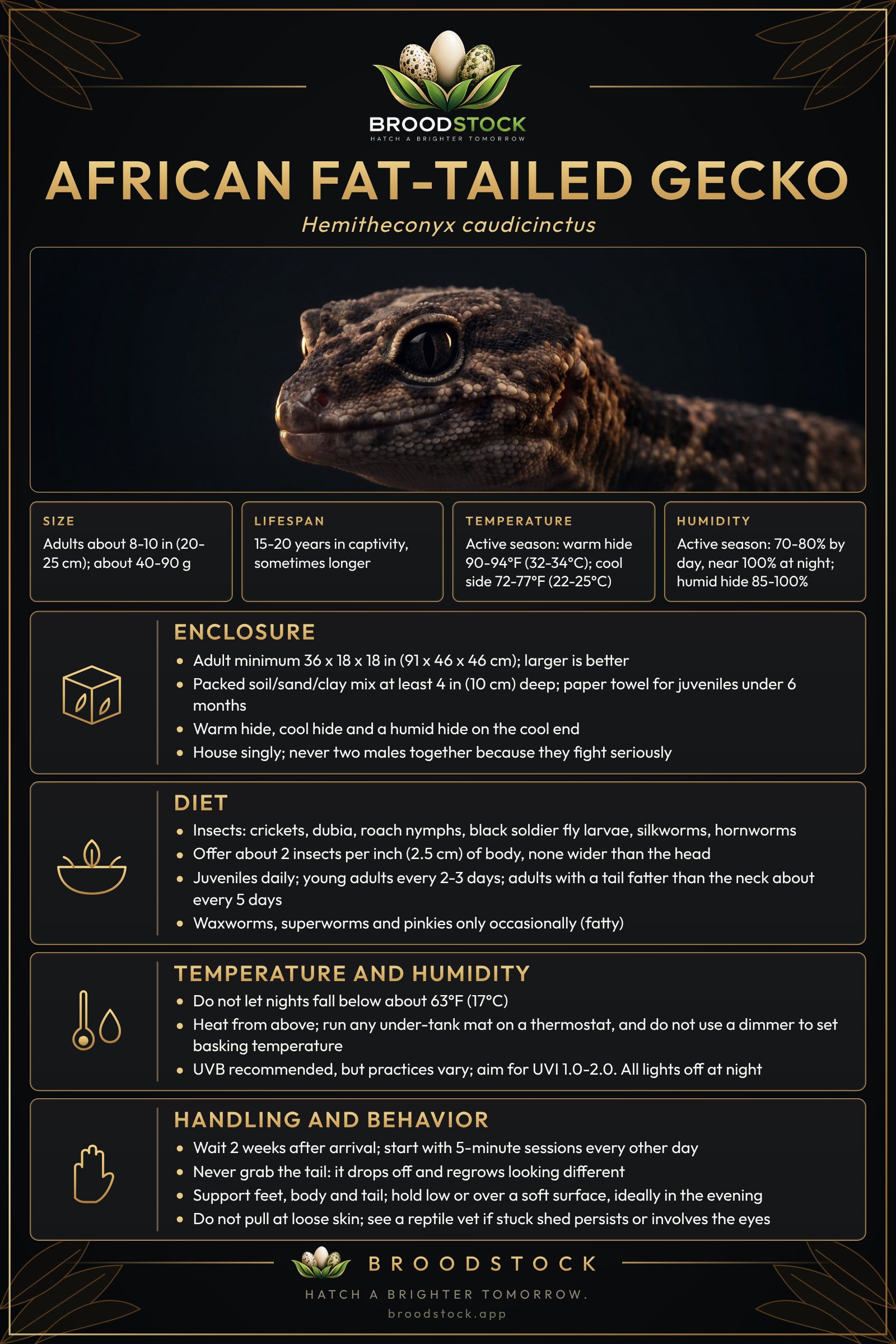
Print it or save it
The care sheet is a one-page summary you can print or keep on your phone. The full care text is below.
Keeping African Fat-Tailed Gecko? Broodstock tracks feeding, weights, sheds, enclosures and equipment for every animal you keep, and it is free to start.
Scientific name
Hemitheconyx caudicinctus
Adult size
Adults measure about 8-10 in (20-25 cm) and weigh roughly 40-90 g, with most between 50-75 g. Males are usually larger and have wider heads.
Lifespan
Captive geckos live 15-20 years, and sometimes more.
Enclosure
These geckos live on the ground and burrow. For an adult, 36 x 18 x 18 in (91 x 46 x 46 cm) is the minimum, and larger is better. Keep each one alone, and never house two males together, because they fight seriously.
Use paper towel for juveniles under 6 months and during quarantine. Adults need a packed soil/sand/clay mix at least 4 in (10 cm) deep so they can burrow. Provide a warm hide, a cool hide and a humid hide at the cool end.
Temperature
In the active season (about April-October, and all year for juveniles), the warm hide or basking surface should be 90-94°F (32-34°C), the cool side 72-77°F (22-25°C) and nights 72-77°F (22-25°C).
Adults can optionally get a cool, dry season (about November-March): basking about 79°F (26°C), cool side 68-74°F (20-23°C) and nights 63-64°F (17-18°C). Do not let nights fall below about 63°F (17°C).
Humidity
This species needs more humidity than leopard geckos. In the active season, aim for about 70-80% by day and near 100% at night, misting thoroughly every night. In the cool, dry season, drop to about 50% by day and 70-75% at night. A humid hide on the cool end with moist substrate should sit at about 85-100%.
UVB
UVB is recommended, although some care sheets call it unnecessary for this nocturnal gecko, so practices vary. Aim for UVI 1.0-2.0 at the basking spot, measured with a Solarmeter 6.5. Use a T5 HO tube such as Arcadia ShadeDweller 7% or Zoo Med ReptiSun 5.0, covering no more than half the enclosure over the warm side.
Measure distance from the gecko's back to the lamp. ShadeDweller 7% needs 8-12 in (20-30 cm) over mesh or 10-16 in (25-40 cm) under mesh. ReptiSun 5.0 needs 14-20 in (35-50 cm) over mesh. Replace the tube every 12 months. The Ferguson zone is not well documented for this species; it is usually treated as a shade-dweller (Zone 1).
Lighting
Give 12 h of light and 12 h of dark, or follow the seasons: about 13 h in summer shrinking to 11 h in winter, with gradual changes. Switch all lights off at night.
Heating
Heat from above using one or two low-wattage halogen flood bulbs over the warm hide (start with about 50 W PAR30), or an incandescent spot bulb in a cage if it is mounted inside. An under-tank mat is optional: place it below the warm hide, covered by under 1 in (2.5 cm) of substrate, always run it through a thermostat with the probe in the warm hide, and turn it off a few hours after lights out. Do not set basking temperature with dimmers; change the wattage or height instead.
Diet
Geckos eat insects. Rotate feeders: crickets, dubia, discoid and red runner roach nymphs, black soldier fly larvae, mealworms, silkworms and hornworms. Each insect should be no wider than the gecko's head. Offer about 2 insects per inch (2.5 cm) of body length, or whatever it finishes in 15 minutes.
Feed juveniles daily and young adults every 2-3 days. Adults whose tail is fatter than the neck eat about every 5 days. Fatty foods (waxworms, superworms, pinkies) are for occasional use only.
Supplements
Coat feeders with a light dusting of calcium at most meals.
If the gecko has UVB, you can follow the directions on a low-D3 all-in-one (such as Repashy Calcium Plus LoD, which also supplies vitamins). Another route is plain calcium without D3 (such as Repashy SuperCal NoD, Zoo Med Repti Calcium without D3 or Arcadia CalciumPro Mg), with a D3-free multivitamin now and then (such as Zoo Med Reptivite without D3). With no UVB, switch to calcium with D3 (such as Repashy Calcium Plus or Zoo Med Repti Calcium with D3) and do not add a second D3 product.
How much vitamin A this species needs has not been well documented. A multivitamin with preformed vitamin A (retinol), as used for leopard geckos, is a common choice. Gut-load the feeders as well (such as Repashy SuperLoad or Arcadia InsectFuel). Females that are laying need more calcium to build eggshells.
Shedding
The gecko looks dull before a shed and normally eats its old skin. A humid hide kept moist all the time, along with the right seasonal humidity, prevents most trouble. Stuck shed on the toes or tail tip usually means the setup is too dry. Do not pull at loose skin. Treat stuck shed as you would for a leopard gecko (warm, damp tub, short sessions), and see a reptile vet if it lingers or touches the eyes. Shedding frequency is not well documented; young geckos shed more often than adults.
Handling
Leave a new gecko alone for 2 weeks before handling. Begin with 5-minute sessions every other day and work up to daily. Support the feet, body and tail, and never grab the tail: it drops off and regrows looking different. Hold the gecko low or over a soft surface, ideally in the evening.
Brumation
A seasonal cool-down is optional and suits healthy adults only; it is not required. Two common approaches exist. One is a long cool, dry season (about November-March) with basking about 79°F (26°C), nights 63-64°F (17-18°C), daytime humidity about 50% and days shortened toward 11 h. The other is a brief cool-down of about 4-6 weeks in mid-fall (October-November) at about 68-72°F (20-22°C), or with the hotspot lowered to about 82°F (28°C), with food withheld, water available and no misting, then a gradual warm-up. Young geckos remain on the warm-season settings.
Health signs to watch
See a reptile vet if the gecko: refuses food within 2 weeks of arrival; has a thin tail or loses weight (a healthy adult tail is thick, about 1.25 in, 3 cm, or more); has stuck shed on toes, tail tip or eyes; shows metabolic bone disease signs (soft jaw, kinked limbs, trouble walking); is lethargic; may have internal parasites (get a fecal test); or is a gravid female unable to pass eggs.
Geckos can get cryptosporidiosis (stick-tail disease), which spreads between animals. Isolate any gecko whose tail is wasting and that is losing weight.
Welfare
Wild-caught imports, now mostly from Benin, still sell cheaply and often show up stressed, thin or with regrown tails. Captive-bred animals are strongly preferred. Do not grab or hold a gecko by the tail. The tail is its fat store, and it drops off as a defense. Keep males in separate housing.
Some morphs have reported problems: light sensitivity and infertility in some amelanistic, caramel albino and ghost females, and Super Whiteout hatchlings dying within hours.
Keep every animal's care in one place
Log feedings, weights and sheds, set reminders, and let Ranger, the built-in AI manager, help with the rest. Free to start, no card needed.