
Print it or save it
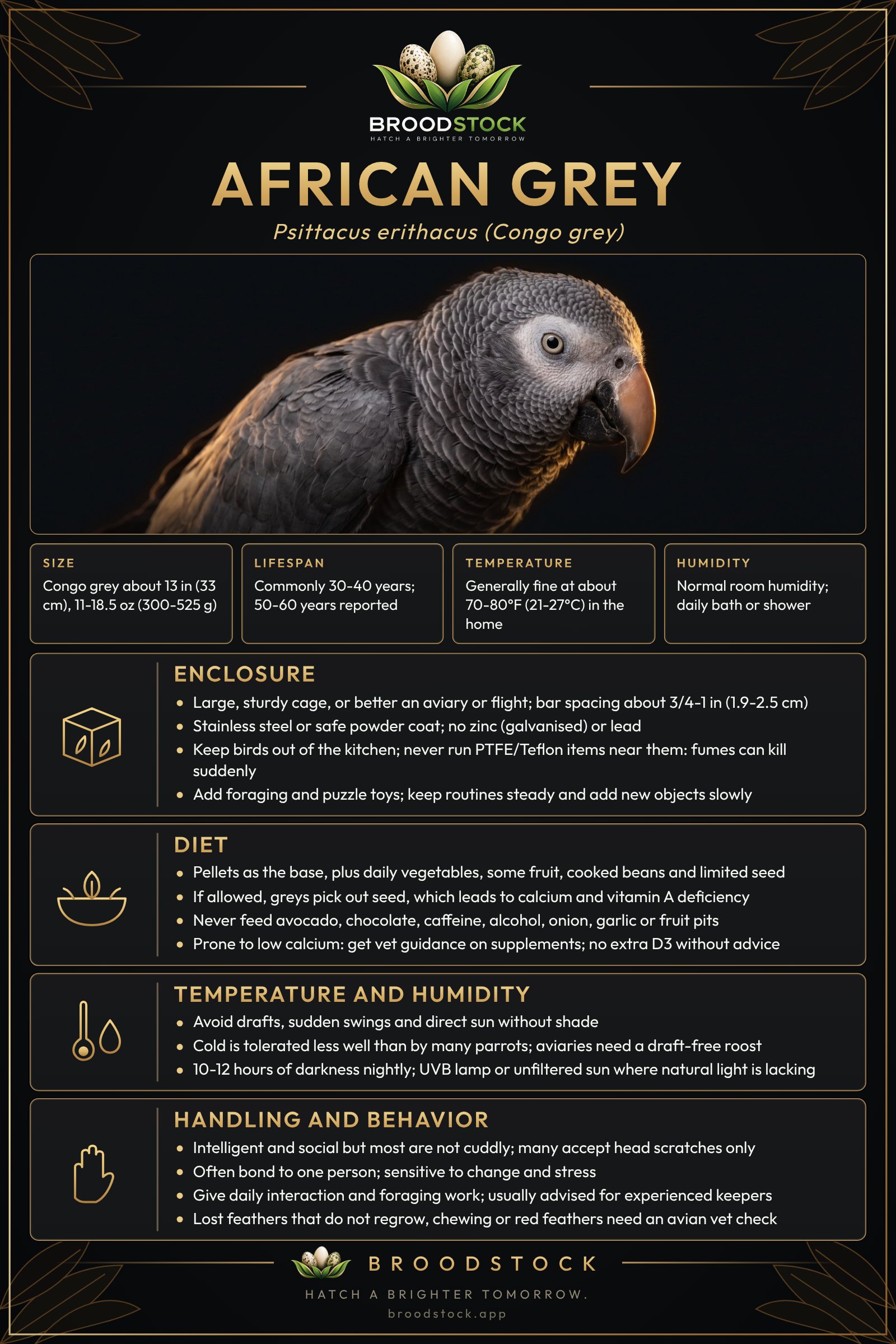
The care sheet is a one-page summary you can print or keep on your phone. The full care text is below.
Keeping African Grey? Broodstock tracks feeding, weights, sheds, enclosures and equipment for every animal you keep, and it is free to start.
Scientific name
Psittacus erithacus (Congo grey). The Timneh grey is now usually treated as its own species, Psittacus timneh.
Adult size
The Congo grey is about 13 in (33 cm) long and roughly 11-18.5 oz (300-525 g), commonly about 14 oz (400 g). The smaller Timneh grey measures about 11-13 in (28-33 cm) and weighs 9.7-13.2 oz (275-375 g).
Lifespan
Captive greys commonly reach 30-40 years, and 50-60 years has been reported with good care. Plan on the bird outliving its first owner.
Enclosure
Choose a large, sturdy cage, or better an aviary or suspended flight. Bar spacing should be about 3/4-1 in (1.9-2.5 cm), and perches about 1 in (2.5 cm) of varied natural wood. Pick stainless steel or safe powder coat, with no zinc (galvanised) or lead.
Greys react badly to commotion. Set one side of the cage against a wall, keep routines steady and bring in new objects slowly. Supply plenty of foraging and puzzle toys.
Keep birds out of the kitchen. Never run PTFE/Teflon-coated items (non-stick pans, some heat lamps, heaters, irons) near them, because the fumes can kill birds suddenly, even from another room.
Temperature
Household temperatures of about 70-80°F (21-27°C) are generally fine, and healthy birds cope with a wider range. Avoid drafts, sudden swings and direct sun with no shade. Greys originate in tropical forest and tolerate cold less well than many parrots. Outdoor aviaries need a sheltered, draft-free roost, and a safe outdoor minimum is not well documented.
Humidity
Greys produce a lot of powder down, so daily baths or showers (spray or shallow dish) help skin and feathers and control dust. Normal room humidity is otherwise fine. In aviaries a misting system is useful.
UVB
UVB is recommended where natural light is lacking, since greys are prone to low calcium and vitamin D3. Unfiltered sunlight, with shade available, is best, through an outdoor flight or open window (glass blocks UVB). Indoors, avian vets advise a bird-specific full-spectrum/UVB lamp used at the maker's distance on the normal day cycle and replaced on the maker's schedule. Practices vary on lamps, but greys are the species for which they are most often advised.
Lighting
Give about 10-12 hours of darkness each night.
Heating
If a bird is sick or having seizures, move it to a warm hospital cage and get an avian vet involved. Use thermostat-controlled heat, and never put PTFE (Teflon)-coated heaters, heat lamps or appliances near birds.
Diet
Base the diet on formulated pellets, plus daily vegetables (especially beta-carotene sources such as cooked sweet potato, kale and other dark greens), some fruit, cooked beans and pulses, and a limited amount of seed. Greys are fussy and pick out seed if allowed, which leads to calcium and vitamin A deficiency. In the wild they eat fruit and seeds, especially oil palm fruit.
Never feed avocado, chocolate, caffeine, alcohol, onion, garlic, fruit pits or apple seeds, or any human food that is salty, fatty or sugary.
Supplements
Calcium is the main concern. Greys are prone to hypocalcemia, so laying hens and birds on poor diets need a dependable calcium source and supplements guided by a vet. Birds eating a good pellet diet usually need no extra vitamins. Vitamin D3 comes from pellets and UVB, so do not add more D3 without vet advice. Grit is unnecessary, and sick birds may eat too much of it.
Shedding
Moulting is gradual, mostly once a year, and tail feathers are replaced over time. The iris changes from dark in young birds to pale yellow by about 4 years. Feathers that are lost and do not regrow, chewed or barbered feathers, or abnormal (red) feathers in grey areas need an avian vet check, as plucking and PBFD are both common in greys.
Handling
Greys are highly intelligent and social, but most are not cuddly, and many accept only head scratches. They often bond to a single person even when the whole household socialises them. They are sensitive to change and stress, so keep routines steady, introduce new things slowly and provide daily interaction and foraging work. They mimic household sounds noisily. Experienced keepers are usually the recommended owners.
Health signs to watch
Conditions to know: hypocalcemia (weakness, falling off the perch, seizures; an emergency), feather-destructive behaviour (affects a large share of captive greys), vitamin A deficiency, aspergillosis and other respiratory infections, PBFD, avian bornavirus (proventricular dilatation disease), psittacosis (Chlamydia, which can infect people), polyomavirus, oral abscesses and rhinoliths.
Sudden breathing trouble or collapse can point to PTFE (Teflon) fume poisoning. Quarantine new birds.
Welfare
Both greys and Timnehs are Endangered in the wild (IUCN), largely because of trapping for the pet trade. Both moved to CITES Appendix I at CoP17 (2016), in force from 2 January 2017. International trade in wild birds is effectively banned, and international commercial trade in captive-bred birds needs CITES permits (and, for Appendix I, registered breeding operations). Never buy birds of unclear origin.
Greys are long-lived, demanding birds and are prone to plucking when under-stimulated.
Keep every animal's care in one place
Log feedings, weights and sheds, set reminders, and let Ranger, the built-in AI manager, help with the rest. Free to start, no card needed.