
Broodstock / Care sheets / Argentine Black and White Tegu
Argentine Black and White Tegu Care Sheet
Salvator merianae
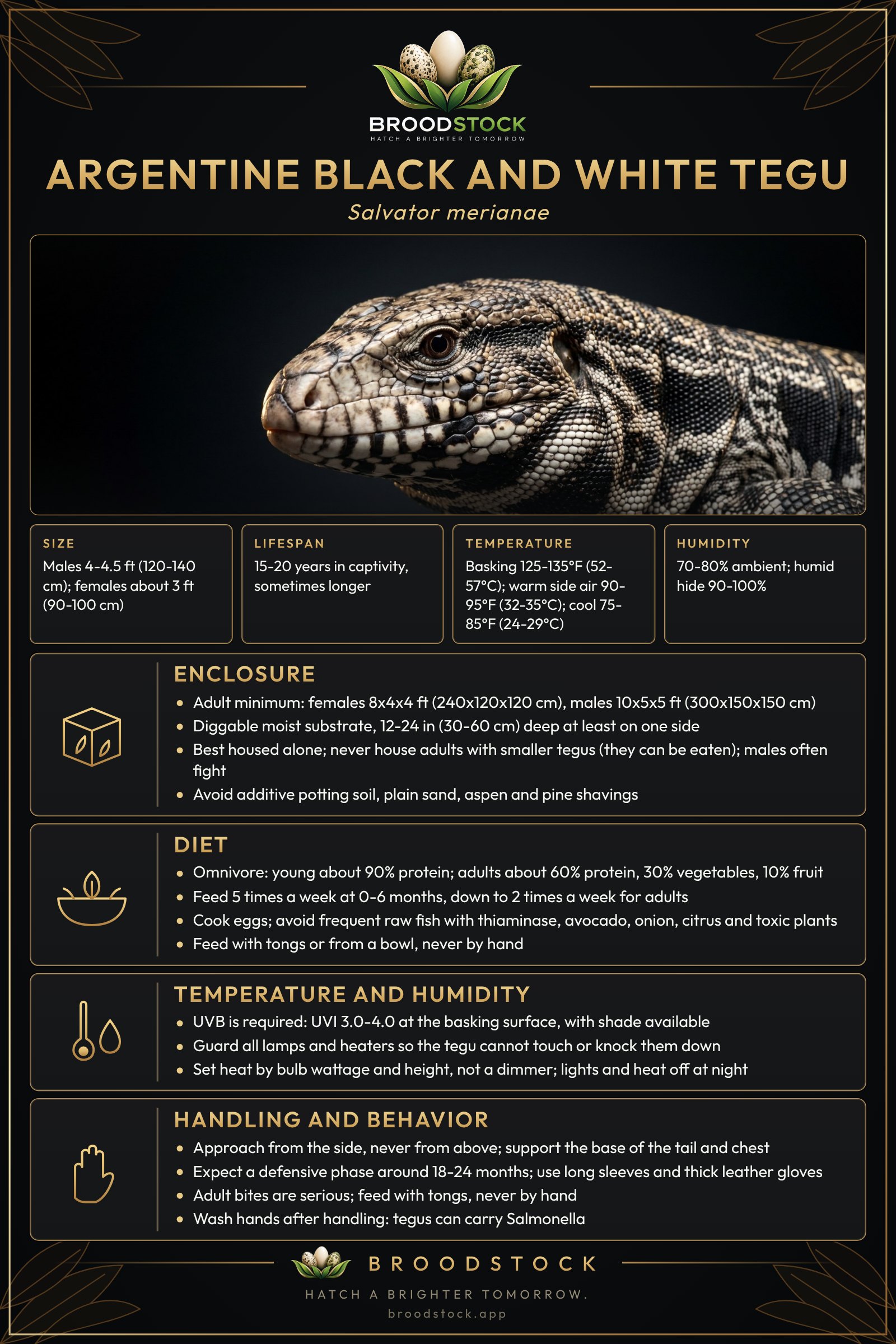
Print it or save it
The care sheet is a one-page summary you can print or keep on your phone. The full care text is below.
Keeping Argentine Black and White Tegu? Broodstock tracks feeding, weights, sheds, enclosures and equipment for every animal you keep, and it is free to start.
Scientific name
Salvator merianae
Adult size
Males reach about 4-4.5 ft (120-140 cm), sometimes close to 5 ft (150 cm), and have heavy jowls. Females are clearly smaller at about 3 ft (90-100 cm). Adults usually weigh 8-15 lb (3.6-6.8 kg), with males heavier.
Lifespan
Captive tegus live 15-20 years, sometimes longer.
Enclosure
Adult minimums are 8x4x4 ft (240x120x120 cm) for females and 10x5x5 ft (300x150x150 cm) for males, and larger is better. Hatchlings can begin in a 20-40 gallon tank but outgrow it within months. Use a front-opening enclosure with a mesh top for ventilation and safe lamp mounting.
Provide deep substrate to dig in, 12-24 in (30-60 cm) at least on one side. A moist mix of topsoil, coco fiber and play sand works, as do cypress mulch or coconut chips, covered with leaf litter. Avoid aspen and pine shavings, plain sand, and potting soil that has additives. Put a hide or burrow box at each end of the gradient, and keep one damp.
Housing alone is best. Do not house a male with a female outside of supervised breeding, and never keep adults with smaller tegus, which may be eaten. Practices vary here: some keepers house same-sex adults together in a double-size enclosure with visual barriers, though males often fight.
Temperature
Measure the basking surface with an IR thermometer on a small spot: 125-135°F (52-57°C). Warm-side air should be 90-95°F (32-35°C) and the cool side 75-85°F (24-29°C). At night, 68-75°F (20-24°C) is the target, reached by switching off lights and heat if the room allows.
Humidity
Aim for 70-80% ambient, using one hygrometer on each side, since the warm side is naturally drier. The humid hide or burrow should be 90-100% with damp sphagnum, which you should replace regularly to prevent mold. The substrate should be damp throughout without turning to mud. Mist every day, preferably in a few short rounds.
UVB
UVB is required. This is Ferguson Zone 3, with a target of UVI 3.0-4.0 at the basking surface. Use a reflector fixture covering about half the enclosure over the basking area. T5 HO 10.0/12% tubes (Zoo Med ReptiSun 10.0, Arcadia Desert 12%) sit about 17-21 in (43-53 cm) above the tegu's back with no mesh; Arcadia Dragon 14% sits at 18-22 in (45-55 cm). Screen mesh cuts UVB output, so if lamps sit over a screen, verify the reading with a Solarmeter 6.5.
Run UVB 12-14 h a day, and give natural unfiltered sunlight outdoors when weather allows, with shade. Replace bulbs on the maker's schedule (often 6-12 months) and verify output with a Solarmeter 6.5.
Lighting
During the active season, provide 12-14 h of light a day, with a bright daylight LED bar covering at least half the enclosure. Turn all lights and heat off at night. If you allow brumation, shorten the day in fall and reduce heat.
Heating
Hang a cluster of halogen flood bulbs over the basking area: 1-2 for tegus under a year, and a larger cluster for yearlings and adults to create a wide basking zone. A high-output radiant infrared unit such as the Reptile Systems Infrared Gold is an alternative. Roughly 100 W halogen floods are typical for a 4 ft (120 cm) tall enclosure, but the right wattage depends on distance, room temperature and mesh.
Set temperature by bulb wattage and height, not a dimmer, which cuts the useful infrared. Use lightless heat (ceramic heat emitter, radiant panel) on a thermostat only if nights drop below range. Use an IR thermometer and probes for readings. Guard all fixtures so the tegu cannot touch or knock them down.
Diet
Tegus are omnivores, and young ones eat mostly animal food. In the first year, feed about 90% protein and 10% vegetables, with occasional fruit; insects suit the young best, then small whole prey as they grow. Adults get about 60% protein, 30% vegetables and 10% fruit. Protein sources include insects (roaches, black soldier fly larvae, crickets, silkworms, snails), whole prey (mice, rats, chicks; better than plain meat), eggs, fish, shrimp, and lean meat with calcium added.
Meals per week: 5 times at 0-6 months, 4 times at 7-12 months, 3 times at 1-2 years, and 2 times for adults, with a portion about the size of the head. Adjust to body condition. Some vet sheets feed young tegus daily and adults every 3 days, so practices vary.
Cook eggs, since raw egg white blocks biotin. Avoid frequent raw fish containing thiaminase (bass, catfish, goldfish, herring, mackerel, smelt, tuna). Also avoid avocado, onion, eggplant, rhubarb, citrus, spinach, lettuce, broccoli, fruit seeds and pits, wild hornworms and toxic plants. Offer food with tongs or from a bowl, never by hand.
Supplements
With good UVB, dust insects and boneless meat with calcium that has no D3 or low D3 (examples: Repashy SuperCal NoD or SuperCal LoD, Zoo Med Repti Calcium without D3, Arcadia CalciumPro Mg; Miner-All Indoor contains some D3). Add a multivitamin with vitamin A about once a week (examples: Repashy SuperVite, Nekton-Rep). Other options are an all-in-one low-D3 powder (Repashy Calcium Plus LoD), or Arcadia's EarthPro system (CalciumPro Mg, EarthPro-A and RevitaliseD3 rotated on the maker's schedule).
Little or no added powder is needed when feeding whole prey (mice, chicks). Insects should be gut-loaded for 24 h or longer (Repashy SuperLoad, Arcadia InsectFuel). Choose a single system and do not stack products, because of the risk of D3 and vitamin A overdose. Practices vary on frequency: vet sheets range from calcium at every meal to 1-2 times a week, and from a multivitamin weekly to 1-2 times a month.
Shedding
Tegus shed in pieces. Keep humidity in range and provide a water bowl big enough to soak in. During a shed, brief shallow, lukewarm soaks of 10-15 minutes help. Check toes and tail tip for retained shed, which can constrict and kill tissue, and see a reptile vet if it does not come off.
Handling
Tame a tegu with short, frequent, calm sessions; daily contact from a young age helps. Come in from the side, where the tegu can see you, and never from above. Slide one hand under the base of the tail and up to the chest, then tuck the tail under your arm and keep the animal close to your body. Leave a tegu alone while it is in its hide.
Around 18-24 months, expect a defensive phase (called guberty) that can last several months. Keep up care, give space, and wear long sleeves and thick leather gloves if you must handle. Warning signs are an arched back with head down and heavy breathing, or erratic tail twitching (it may charge or tail whip). Rapid tongue flicking shows it smells food, so rinse any food smell from your hands first.
A bite from an adult is a serious injury, so use tongs for feeding and never hand-feed. Hands need washing after every handling session because of Salmonella, E. coli and Campylobacter.
Brumation
Argentine tegus naturally brumate in fall and winter, often for several months from around mid-September to October in the Northern Hemisphere, resting in a burrow without eating. In captivity they usually try to brumate once enclosure temperatures drop into the low 70s°F (about 21-23°C). Allowing this is usual for healthy adults.
Get a vet check first. Cut back feeding as appetite fades and stop offering food once meals are refused, so the gut is empty. Provide deep substrate or a burrow box and fresh water, shorten the day, and turn the basking heat down or off. Weigh regularly, and see a reptile vet for noticeable weight loss or if the tegu seems sick rather than sleepy.
Exact brumation temperatures are not well documented; keepers commonly switch off the basking lamp and let the enclosure sit at room temperature.
Health signs to watch
Weigh regularly and log weight, feeding, behavior and shedding; sudden weight loss signals illness. Get an annual vet exam. Book a reptile vet visit if you see: twitching or tremors (early metabolic bone disease, often from low calcium or poor UVB); firm lumps over joints, ribs or spine (calcium deposits or gout); obesity; straining, or no stool along with lethargy and poor appetite (impaction); weight loss; loose stool or lethargy outside brumation (parasites; run a fecal test yearly); or stuck shed on toes or tail. Tegus are able to carry Salmonella.
Welfare
Escaped and released pets founded invasive tegu populations in Florida and Georgia that raid the nests of native birds and reptiles. Never release one, and sell only to informed buyers who can legally keep it. Florida lists tegus as prohibited, and South Carolina banned their import and breeding in 2021, so check state law before selling or shipping.
Adults reach about 2.5-4 ft and can live 20+ years, so they need large enclosures they can dig in and long-term homes. Salmonella can be carried by tegus.
Keep every animal's care in one place
Log feedings, weights and sheds, set reminders, and let Ranger, the built-in AI manager, help with the rest. Free to start, no card needed.