Print it or save it
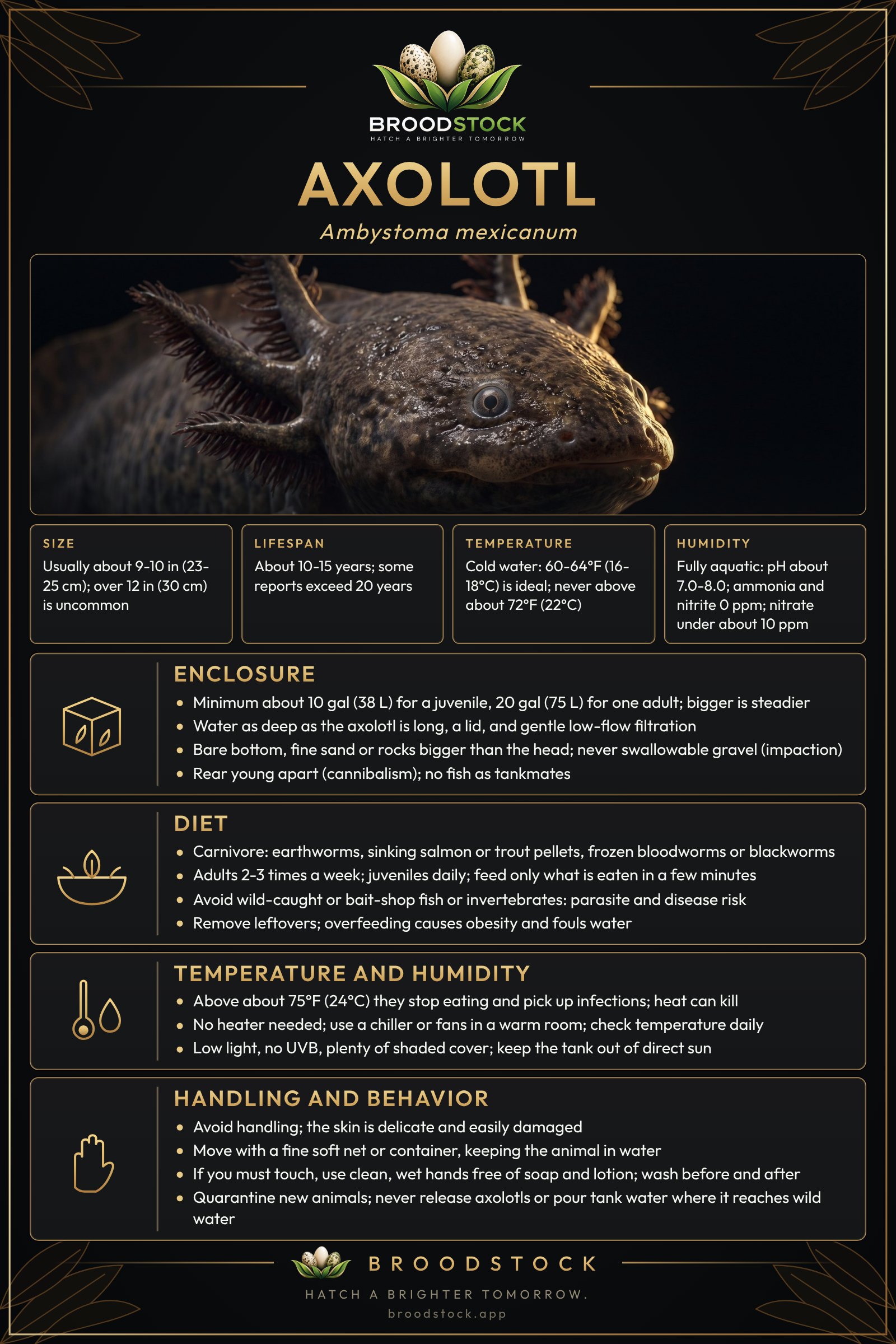
The care sheet is a one-page summary you can print or keep on your phone. The full care text is below.
Keeping Axolotl? Broodstock tracks feeding, weights, sheds, enclosures and equipment for every animal you keep, and it is free to start.
Scientific name
Ambystoma mexicanum
Adult size
Axolotls are usually about 9-10 in (23-25 cm) long. Most adults land between 6 and 12 in (15-30 cm), and anything over 12 in (30 cm) is uncommon. They reach full size at about 2-3 years.
Lifespan
In captivity with good water quality, axolotls live about 10-15 years, and some reports exceed 20 years. The wild lifespan is similar, roughly 10-15 years.
Enclosure
Axolotls are fully aquatic for life. A juvenile needs at least about 10 gal (38 L), and one adult needs at least 20 gal (75 L). Bigger tanks keep water quality steadier, and some guides suggest about 40 gal (150 L) per adult. Lab colonies use much smaller tubs with very frequent water changes, so practices vary. Keep water at least as deep as the axolotl is long, and fit a lid, since they can jump.
Use gentle, low-flow filtration, baffling or spraying the outflow, because strong current stresses them. Run the tank through its nitrogen cycle for several weeks before any animals go in. For substrate, choose a bare bottom, fine sand (grains under about 1 mm) or rocks larger than the head. Never use gravel small enough to swallow, as impaction is a common cause of death.
Rear young separately because of cannibalism. Adults may share a large tank that has hides, but pull apart any that bite. Do not keep them with fish. Place the tank in a quiet, low-traffic spot out of direct sun.
Temperature
Axolotls need cold water. About 60-64°F (16-18°C) is ideal (San Diego Zoo reports best health at about 60°F (16°C)), and about 57-72°F (14-22°C) is tolerated. Do not let water rise above about 72°F (22°C). Above about 75°F (24°C) they stop eating, float abnormally and pick up infections, and prolonged heat can kill. A normal home needs no heater.
Humidity
This is about water quality, since axolotls are fully aquatic. Keep ammonia at 0 ppm, nitrite at 0 ppm and nitrate under about 10 ppm; high nitrate is linked to bulging eyes. The pH should be about 7.0-8.0 (San Diego Zoo prefers 7.4-8.0 and tolerance runs about 6.5-8; ammonia is more toxic at high pH).
Keep water moderately hard, because very soft or distilled water damages the skin; some keepers and labs add Holtfreter's solution salts. Treat tap water with a conditioner that removes both chlorine and chloramine. Change about 30% weekly, more if nitrate climbs, since filtration does not replace water changes. Use a liquid test kit, especially while a new tank is cycling.
UVB
UVB is not needed. Axolotls are aquatic, seek shade and prefer dim light. No UVB requirement is documented (a vet hospital care sheet notes they are sensitive to UVB and sudden light changes), and evidence for UVB in aquatic amphibian life stages is thin (one study on tadpoles found no measurable benefit). If live plants need a light, give plenty of shaded cover.
Lighting
Keep light low; ambient room light is often enough. A lab colony runs about 14 hours of light daily. Avoid bright lighting unless there are hides.
Heating
There is no heat source. The challenge is keeping water cool, so keep the tank out of direct sun and away from heaters. In a warm room, keepers use an aquarium chiller or fans blowing across the water surface (practices vary). Read a thermometer every day to track water temperature.
Diet
Axolotls are carnivores. Adults eat earthworms (nightcrawlers, cut to size), sinking salmon or trout pellets, and frozen bloodworms or blackworms as part of the diet. Avoid wild-caught or bait-shop fish and invertebrates, which carry parasites; feeder fish are a disease and parasite risk.
Feed adults about 2-3 times a week (about 3-4 times for 1-year-olds), giving only what they finish in a few minutes (about 5 pellets per adult per feed). Juveniles eat daily. Remove leftovers, since overfeeding causes obesity and fouls water.
Supplements
Routine powder supplements are unnecessary; a varied diet of earthworms and a quality sinking pellet covers needs. Metabolic bone disease is reported in poorly fed axolotls, so do not depend on bloodworms alone. Holtfreter's solution (mineral salts) in the water is optional and used by labs, and hard, clean tap water makes it unnecessary.
Shedding
Shedding is not well documented for axolotls. Thin skin and slime layers come off normally. Persistent white fuzzy patches (fungus), or sloughing skin with redness, point to poor water quality or infection and are not normal shedding.
Handling
Avoid handling, as their skin is delicate and easily damaged. Move them in a fine soft net or a container, keeping them in water. When touching cannot be avoided, use clean, wet hands free of soap and lotion, and wash your hands before and after.
Brumation
Axolotls do not hibernate.
Health signs to watch
See an amphibian vet for: refusing food; gills shrinking, losing filaments or turning pale; involuntary floating; bloating or fluid swelling; red patches, sores or bleeding (bacterial infection, often Aeromonas or Pseudomonas after stress or poor water); white cotton-like growths (fungal infection); bulging eyes (often prolonged high nitrate); and straining or not passing waste after swallowing gravel or other objects (impaction can need surgery). Heat stress above about 75°F (24°C) is also a concern. Very young larvae and animals nearing maturity at about one year are most vulnerable.
Biosecurity: axolotls can carry chytrid fungus (Bd) without showing disease, and ranavirus is another serious amphibian disease. Quarantine new animals in a separate tank with separate equipment, disinfect nets and buckets, never pour tank water or waste where it can reach wild water, and never release axolotls. A yearly vet check with a fecal test is recommended.
Welfare
Axolotls are critically endangered in the wild (Lake Xochimilco, Mexico) and listed on CITES Appendix II. Captive axolotls must never be released. Do not try to force metamorphosis with hormones or iodine, which often kills them.
Legal status is restricted or permit-only in some places. California classes the non-native tiger salamander group of Ambystoma, which includes axolotls, as detrimental (14 CCR 671), which puts them out of reach for private keepers. In New Jersey, possessing any exotic amphibian takes a state permit (N.J.A.C. 7:25-4.2), and keepers say axolotl pet permits are not issued. Maine treats the axolotl as a restricted species, allowing only captive-bred animals and requiring a permit. Keepers report that Hawaii requires a permit to bring them in. Virginia's predatory and undesirable species list takes in all other mole salamanders but expressly leaves out the axolotl (4VAC15-30-40), so no Virginia permit applies. New Brunswick (Canada) does not include axolotls among permitted pets. Rules shift over time, so confirm the current state or provincial requirements before you buy, sell or ship.
Keep every animal's care in one place
Log feedings, weights and sheds, set reminders, and let Ranger, the built-in AI manager, help with the rest. Free to start, no card needed.