
Print it or save it
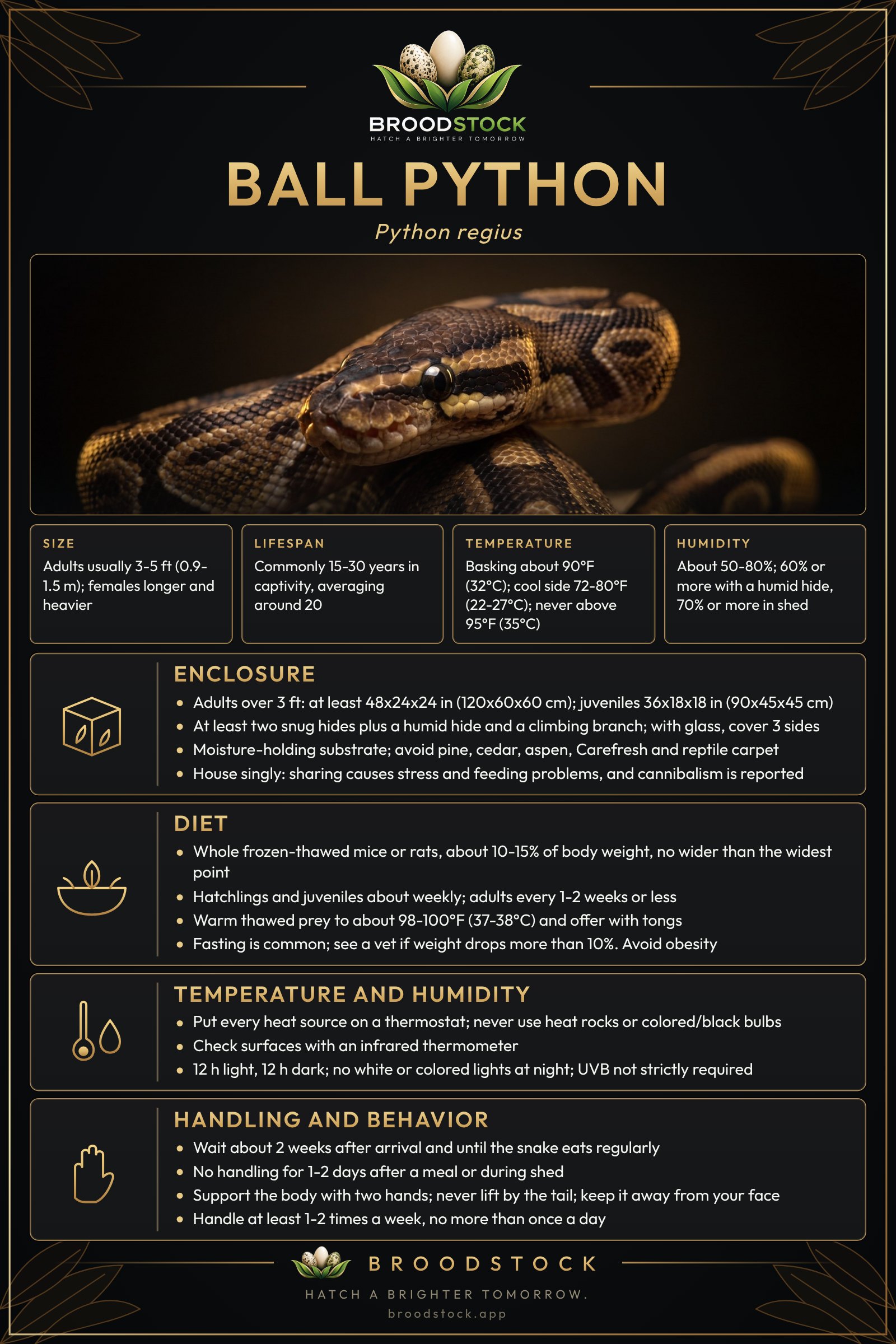
The care sheet is a one-page summary you can print or keep on your phone. The full care text is below.
Keeping Ball Python? Broodstock tracks feeding, weights, sheds, enclosures and equipment for every animal you keep, and it is free to start.
Scientific name
Python regius
Adult size
Adults usually measure 3-5 ft (0.9-1.5 m), with females somewhat longer and heavier than males. The wild record is about 6 ft (1.83 m). Hatchlings are 10-17 in (25-43 cm) and 65-103 g. Adult weight is not well documented: wild adults top out near 1.6 kg (3.5 lb), and well-fed captive females are often heavier.
Lifespan
Captive ball pythons commonly live 15-30 years, averaging around 20. Zoo records reach about 48-50 years. The oldest known ball python lived about 62 years, 59 of them at the Saint Louis Zoo.
Enclosure
Adults over 3 ft need at least 48x24x24 in (120x60x60 cm), about 8 sq ft of floor, and the enclosure should be as long as the snake at minimum. Juveniles under 3 ft can have 36x18x18 in (90x45x45 cm). Hatchlings up to about 300 g fit a tub or 10-gallon-size enclosure (about 20x11x13 in). Front-opening PVC is the best choice, and a glass tank needs 3 of its sides covered. Breeders widely use rack tubs.
Use a moisture-holding substrate (coconut husk, sphagnum, or a topsoil, coco fiber and sand mix). Avoid pine, cedar, aspen, Carefresh and reptile carpet. Provide at least two snug hides (warm and cool), a humid hide and a climbing branch.
Keep each snake alone. Sharing causes stress and feeding problems, and cannibalism has been reported.
Temperature
The basking surface (top of the warm hide) should be about 90°F (32°C), and inside the warm hide 86-90°F (30-32°C). The cool side runs 72-80°F (22-27°C) and nights 70-78°F (21-26°C). Air in the enclosure must never exceed 95°F (35°C). Use an infrared thermometer for surfaces and a digital probe for the warm hide.
Humidity
The overall range is about 50-80%. Many keepers target 60% or higher, with a humid hide (moist sphagnum) toward the cool side, and around 70% or more during shed. Some current care guides advise higher (60-80% by day, 80-100% at night), so practices vary. Ventilate enough that substrate stays damp but not soggy, and replace moss before it molds.
UVB
UVB is not strictly required. Ball pythons eat whole prey, and the one ball python study found UVB did not change vitamin D3 or calcium levels. Many keepers and some reptile vets still recommend low-level UVB. This is Ferguson Zone 2 (partial sun / occasional basker), with a target of UVI about 2.0-3.0 at the basking spot only, dropping to 0 in shade.
Use a low-strength 22 in T5 HO bulb (ShadeDweller-type, or 5.0/6%) on the warm side. Mount lamps this far from the snake's back: for 5.0/6% T5 HO, 10-14 in over mesh or 14-18 in with no mesh; for ShadeDweller MAX, 4-6 in over mesh or 6-8 in without. Replace every 12 months, and never mount behind glass or plastic. If you use no UVB, any calcium supplement should contain D3.
Lighting
Run 12 hours of light and 12 of dark on a timer. A slight seasonal shift is optional (about 12.5 h in summer, 11.75 h in winter). Use no white or colored lights at night.
Heating
In display enclosures, overhead heat should be the main source: an infrared lamp unit, or a halogen or incandescent flood (two or more bulbs over 36 in), caged if mounted inside. A heat mat is only a backup for the warm hide, buried about 1 in under the substrate so the snake cannot touch it. Rack systems built by breeders usually put heat tape beneath the tubs.
Put every heat source on a thermostat, with the probe in the warm hide at substrate level. If the room falls below 70°F (21°C) at night, add a ceramic emitter, radiant panel or deep heat projector. Heat rocks and colored or black bulbs must never be used.
Diet
Feed whole frozen-thawed rodents (mice or rats), sized at about 10-15% of the snake's weight and no wider than its widest point. Hatchlings and juveniles typically eat about weekly, and adults every 1-2 weeks or less often, adjusted to body condition. Thaw in the fridge, warm in a sealed bag in hot water to about 98-100°F (37-38°C), and offer with tongs.
Weigh weekly. Fasting is common and only worrying if weight drops more than 10% or the snake looks unwell. Frozen-thawed is the usual recommendation, though some keepers feed live, so practices vary; never leave live prey unattended, and remove it after 15-30 minutes. Keep the snake from becoming obese.
Supplements
Routine supplements are unnecessary, since whole prey from well-fed rodents covers the diet. Optionally, dust thawed prey lightly with an all-in-one calcium plus multivitamin now and then, not at every meal. With UVB, pick a low-D3 product (e.g. Repashy Calcium Plus LoD or Arcadia RevitaliseD3); without UVB, pick one with standard D3 (e.g. Repashy Calcium Plus). Do not stack D3 products. Separate vitamin A and gut-loading are not needed; give prey rodents a good diet. Swap out supplement powders every 6 months.
Shedding
A shed typically comes every 4-6 weeks. Growing juveniles shed more often, and some adults only a few times a year. Signs include dull color, blue or cloudy eyes, hiding, poor appetite and defensiveness. Keep humidity up, offer a humid hide and a water bowl, and do not handle or peel the skin.
For stuck shed, skip soaking (stressful, with a drowning risk). Put the snake instead in a ventilated container with a warm, damp towel at about 85°F (29°C) for up to 1 hour. Retained eye caps or repeated bad sheds call for a reptile vet and a husbandry check.
Handling
Wait about 2 weeks after arrival, and until the snake eats regularly. Do not handle for 1-2 days after a meal or while it is in shed. Handle at least 1-2 times a week, and no more than once a day. Let it know you are there first with a gentle tap from a paper towel tube, then wait until its tongue flicks are calm and slow. Use both hands under the body to lift it, never the tail, and keep its head away from your face. If the snake curls into a ball, put it back. Hatchlings may strike defensively, but they tame with patience.
Brumation
Ball pythons do not truly brumate.
Health signs to watch
See a reptile vet for: wheezing, clicking, open-mouth breathing or mucus (respiratory infection); mites (moving dots near eyes or chin, soaking a lot); burns; dehydration (wrinkled skin, sunken eyes); retained eye caps or repeated bad sheds; regurgitation; fasting with more than 10% weight loss or lethargy; obesity; and neurological signs (head tremors, stargazing, poor striking: possible IBD or nidovirus; the spider morph has an inherited 'wobble'). Egg binding in a female needs prompt vet care. New snakes should be quarantined, and every snake should be weighed weekly.
Welfare
The spider morph carries wobble syndrome (inner-ear malformation, head tremors, poor striking). Welfare scientists rate it moderate-high impact, and the IHS banned spider sales at its events from 2018. The market is saturated with common morphs, so line up buyers first.
Keep every animal's care in one place
Log feedings, weights and sheds, set reminders, and let Ranger, the built-in AI manager, help with the rest. Free to start, no card needed.