
Print it or save it
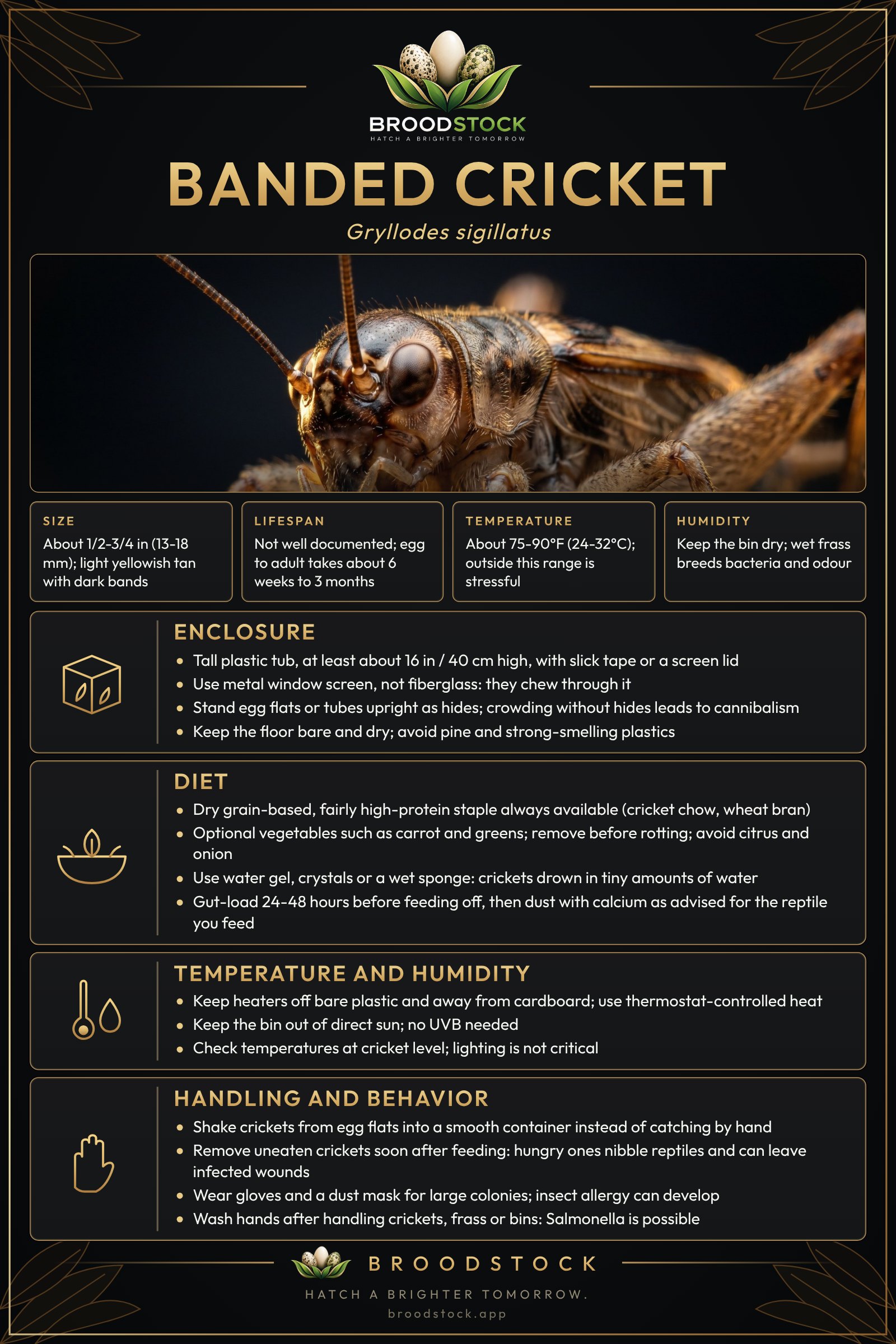
The care sheet is a one-page summary you can print or keep on your phone. The full care text is below.
Keeping Banded Cricket? Broodstock tracks feeding, weights, sheds, enclosures and equipment for every animal you keep, and it is free to start.
Scientific name
Gryllodes sigillatus, also called the tropical house cricket, decorated cricket or Indian house cricket. It is probably native to southwestern Asia and has spread through commerce to warm regions worldwide, usually living around buildings and pavement. Farming in North America has been widespread since about 2010, where it replaced the house cricket after densovirus die-offs.
Adult size
Adults measure about 1/2-3/4 in (13-18 mm), a bit smaller and flatter than house crickets. They are light yellowish tan, with dark bands across the thorax and abdomen and one dark band between the eyes.
Lifespan
Lifespan is not well documented. Going from egg to adult takes about 6 weeks to 3 months, depending on temperature, and sellers report adults live somewhat longer than house crickets.
Enclosure
Use a tall plastic tub (at least about 16 in / 40 cm high helps stop jumpers) with a slick tape band around the top inside edge, or a lid with a large opening covered in metal window screen, because they chew through fiberglass. Stand egg flats or paper towel tubes upright as hides. Crickets need tight, dark hiding spots, and crowding without hides leads to cannibalism during molts.
Leave the floor bare and the bin dry. Avoid pine and plastics that smell strongly. They jump better and move more nimbly than house crickets, so work over a tub when sorting.
Temperature
The range is about 75-90°F (24-32°C). The warm end speeds growth, and the cooler end extends life. Research colonies run at about 86-90°F (30-32°C). Temperatures outside this range are stressful.
Humidity
Keep the main bin dry (one research colony ran at about 30% humidity), because wet frass breeds bacteria and odour. Pinheads need slightly more humidity than adults.
UVB
UVB is not needed. Research colonies use ordinary lighting, and a 2021 study on another cricket species found UVB exposure gave the crickets no measurable vitamin D3, so UVB does not make them better food.
Lighting
Lighting is not critical. Research colonies use a 14 hour light, 10 hour dark cycle or 16:8. Do not put the bin where direct sun reaches it.
Heating
Place a reptile heat mat under one side of the tub on a thermostat, or just keep the room warm. Keep heaters off bare plastic and away from cardboard, and choose thermostat-controlled products to limit fire risk. Take temperature readings down where the crickets are.
Diet
Keep a grain-based, fairly high-protein dry staple available at all times (commercial cricket or roach chow, wheat bran, or chicken scratch blended with some dry dog or cat food). Fresh vegetables are optional, such as carrot, sweet potato, squash and collard or mustard greens; take them out before they rot, and avoid citrus, onion and very watery fruit.
Crickets drown in tiny amounts of water. Provide water gel or crystals, a wet sponge or damp pebbles in a textured dish, and replace it every couple of days.
Supplements
Gut-load for about 24-48 hours before feeding off, using a calcium-rich diet. Crickets have a very low calcium-to-phosphorus ratio, gut-loading raises calcium only part way, and the gain is gone within about a day of fasting. Feed them out promptly and still dust with calcium as advised for the reptile you feed. According to sellers, banded crickets contain less chitin than house crickets do.
Shedding
A 2024 study counted eight instars including the adult, with early molts every 3-4 days in the first two weeks. Fresh molts are soft, and crickets often eat them if hides are scarce or the bin is crowded.
Handling
They are fast and jumpy, so shake them from egg flats into a smooth container instead of catching them by hand. Take uneaten crickets out of the enclosure soon after feeding (or offer them in a smooth dish). Hungry crickets nibble reptiles and amphibians, particularly at night or when the animal is shedding or sick, and the wounds can become infected.
People who rear insects can develop allergy, and frass dust is a source of exposure, so wear gloves and a dust mask for large colonies. Cricket cultures carry high bacterial loads (Salmonella and other bacteria are possible), so wash hands after handling crickets, frass or bins.
Brumation
None. The species has no diapause or overwintering stage at any life stage. Cooler temperatures within the safe range slow growth.
Health signs to watch
Banded crickets are much less affected than house crickets by the densovirus (AdDNV), but they can carry it without signs. Cricket iridovirus has caused heavy losses in reared banded crickets (signs: deaths of large nymphs and adults, a rotten smell, milky-white body fluid, fragile bodies), and it can also infect reptiles and amphibians that eat infected insects. Protect colonies by buying from healthy suppliers, holding new stock apart, avoiding crowded, hot, humid bins, and cleaning and drying bins between batches. Other killers include drowning, wet bins, moldy food and cannibalism.
Welfare
Never release feeders. This species already lives outdoors in Florida and other warm areas, mostly around buildings, but escapes add to local pest populations, and singing males are a nuisance indoors.
In Florida, FDACS places it on the commonly permitted feeder list (July 2026). Most people buy from a vendor already permitted for the species, whereas importing it from another state requires a permit, so confirm current terms with the FDACS Division of Plant Industry. USDA APHIS requires a permit for moving it between states and bars imports; the house cricket, by contrast, needs no interstate permit. Buy from established US suppliers who hold the required permits.
Oregon approves it as pet food with no state permit (OAR 603-052-1320, 2026). California's current no-permit shipping list for insects omits it, though a 2026 proposed amendment would add it, so check with CDFA before ordering there. Hawaii bars imports of animals, insects included, that are missing from its approved lists. Because rules change, confirm with your state agriculture department before you buy or ship.
Keep every animal's care in one place
Log feedings, weights and sheds, set reminders, and let Ranger, the built-in AI manager, help with the rest. Free to start, no card needed.