
Broodstock / Care sheets / Black Soldier Fly Larvae
Black Soldier Fly Larvae Care Sheet
Hermetia illucens (black soldier fly), family Stratiomyidae
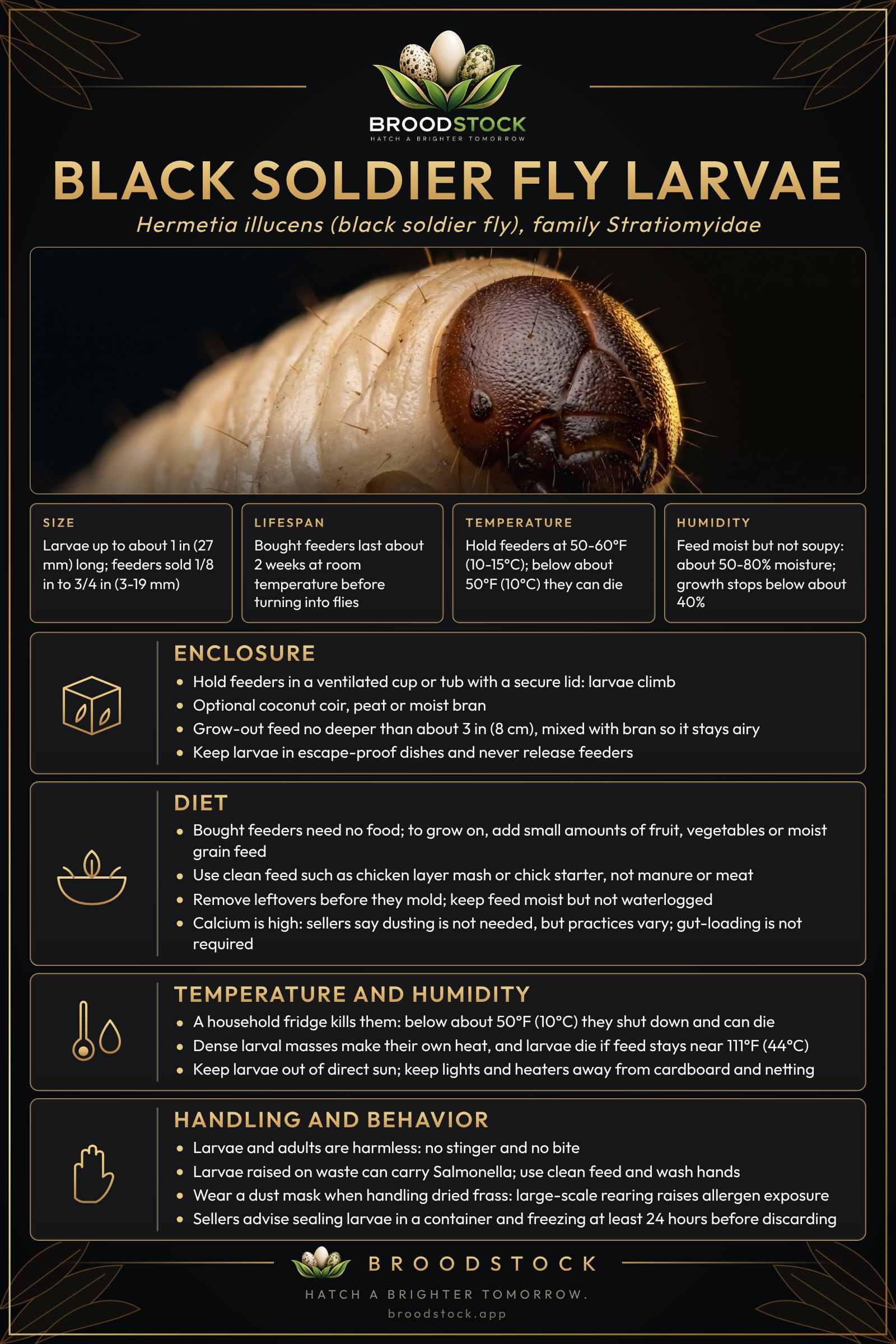
Print it or save it
The care sheet is a one-page summary you can print or keep on your phone. The full care text is below.
Keeping Black Soldier Fly Larvae? Broodstock tracks feeding, weights, sheds, enclosures and equipment for every animal you keep, and it is free to start.
Scientific name
Hermetia illucens (black soldier fly), in the family Stratiomyidae. Trade names include Phoenix Worms, ReptiWorms, CalciWorms and soldier worms. The species is common across the Americas and now turns up in warm and temperate regions worldwide.
Adult size
Larvae reach about 1 in (27 mm) long and 0.25 in (6 mm) wide. Feeders are sold from about 1/8 in to 3/4 in (3-19 mm). The adult flies measure about 0.6-0.8 in (15-20 mm).
Lifespan
Under good conditions, larvae feed for about 2-3 weeks, followed by a prepupal stage of about a week or more and about 1-2 weeks as a pupa. Adults live only about a week (longer with sugar water). At about 86°F (30°C), the whole cycle from egg to adult runs roughly 4-5 weeks. Feeder larvae you buy hold out about 2 weeks at room temperature, or about 4-6 weeks at 50-60°F (10-15°C), before they become flies.
Enclosure
To hold feeders, use a ventilated cup or tub with a secure lid, since larvae climb, with optional coconut coir, peat or moist bran.
To grow larvae on, keep them in a bin of moist feed no deeper than about 3 in (8 cm), mixed with bran or a similar bulking material to keep it airy. Prepupae, the mature larvae, wander off in search of a dry place, so a ramp leading into a dry collection tub means they gather themselves.
Temperature
For holding feeders, 50-60°F (10-15°C) slows growth and keeps them as larvae for weeks. A household fridge will kill them, since below about 50°F (10°C) they shut down and can die.
Growing larvae do best at about 80-86°F (27-30°C), and about 79-81°F (26-27°C) is often cited as ideal. Development and survival fall off below about 59°F (15°C) and above about 104°F (40°C). Dense masses of larvae generate their own heat, and they die if the feed stays near 111°F (44°C) for a few hours.
Humidity
Larval feed should be moist but not soupy, with about 50-80% moisture (roughly 60-70% is typical). Growth stops below about 40%.
UVB
UVB is not needed for larvae. Studies show the flies see UV, blue and blue-green light, but no source calls for UVB lamps.
Lighting
Larvae shy away from light, and they should be kept out of direct sun.
Heating
No heat is needed for feeder cups. For a rearing setup, warm the room or use heat mats or cables on a thermostat under part of the larval bin, and check feed temperature, since large larval masses make their own heat. Keep lights and heaters away from cardboard, netting and dry bedding, and use fixtures rated for the purpose.
Diet
Feeders you buy do not need feeding. To grow them on, add small amounts of fruit, vegetables or moistened grain feed, and remove leftovers before they mold. Larvae will eat almost any decaying organic matter, but for feeder colonies use clean feed such as moistened chicken layer mash or chick starter, bran and produce scraps, not manure or meat. Keep feed moist but not waterlogged, and loose enough for air to reach the larvae.
Adult flies do not eat.
Supplements
Calcium is high in these larvae: the calcium to phosphorus ratio is above 1, with published figures from about 1.5:1 to 2.6:1. Sellers therefore say dusting is unnecessary, although some keepers dust anyway (practices vary). There is no need to gut-load them. What the larvae were raised on determines their nutrient makeup.
Shedding
Six instars make up the larval stage. In the last instar they turn dark brown to black, stop eating and empty the gut, then wander off to find a dry, sheltered spot and pupate inside their own last larval skin.
Handling
Both larvae and adults are harmless: adults have no stinger, do not bite and do not feed. Adults are not known to spread disease but could carry germs mechanically. Larvae raised on waste can carry Salmonella and other bacteria from their feed, so raise feeder larvae on clean feed and wash hands after handling. Large-scale rearing raises insect allergen and dust exposure, so wear a dust mask when handling dried frass.
Brumation
Feeder keeping does not make use of diapause. Cool storage at about 50-60°F (10-15°C) slows growth and delays pupation for several weeks, but anything colder than about 50°F (10°C) is fatal.
Health signs to watch
Watch for grain mites. They often arrive with grain feed, so heat-treat or ferment feed first; raising the feed above about 104°F, 40°C, clears them. Other problems are mold on the feed, foul smells and ammonia from feed that is too wet or rotting, phorid flies (a sign of an unhealthy colony), parasitic wasps, and sudden larval deaths, which can be viral. Larvae die when deep, dense feed overheats.
Welfare
Escaped larvae pupate and become flies. Adults are not pests, but keep larvae in escape-proof dishes and never release feeders. Sellers recommend that you seal larvae in a container and freeze them for at least 24 hours before you throw them out. Hermetia illucens was not on the USDA APHIS exemption list that was checked, so check federal and state rules before shipping or moving live larvae across state lines.
Keep every animal's care in one place
Log feedings, weights and sheds, set reminders, and let Ranger, the built-in AI manager, help with the rest. Free to start, no card needed.