
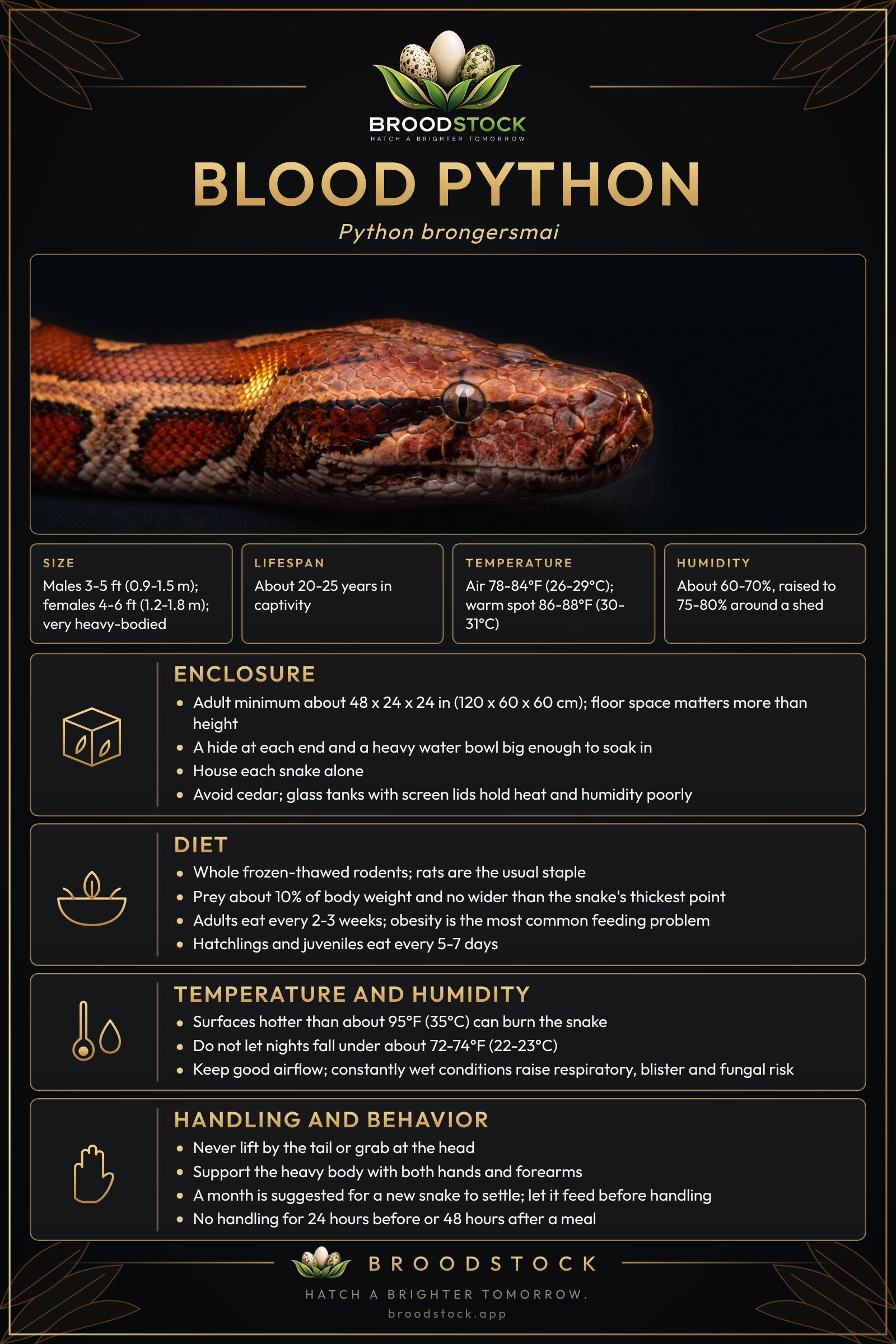
Print it or save it
The care sheet is a one-page summary you can print or keep on your phone. The full care text is below.
Keeping Blood Python? Broodstock tracks feeding, weights, sheds, enclosures and equipment for every animal you keep, and it is free to start.
Scientific name
Python brongersmai. Up to about 2000-2001, all the short-tailed pythons were classed as subspecies of Python curtus. Older books, care sheets and dealers may therefore still list blood pythons as "Python curtus" or "P. curtus brongersmai".
The hobby now works with three names. P. brongersmai is the blood python, found in red, orange or yellow forms in peninsular Malaysia, eastern Sumatra, nearby islands and Thailand. P. curtus is the Sumatran short-tailed python from western and southern Sumatra. P. breitensteini is the Borneo short-tailed python. People often use "short-tail" or "blood python" loosely for all three, so confirm which species you actually have.
Adult size
A short snake with a very heavy body. Males usually reach 3-5 ft (0.9-1.5 m), while females run 4-6 ft (1.2-1.8 m) and only rarely approach 8 ft (2.4 m). Typical captive adults weigh roughly 10-15 lb (4.5-7 kg). Large old females can top 20 lb (9 kg), and a few sources quote 30 lb (14 kg) or more. Hatchlings measure about 10-17 in (25-43 cm).
Lifespan
Expect roughly 20-25 years in captivity. Some sources report animals reaching about 30 years.
Enclosure
Bloods live on the ground and keep out of sight, so floor area counts for more than height. The adult minimum is about 48 x 24 x 24 in (120 x 60 x 60 cm). Dubia recommends 72 x 24 x 24 in (180 x 60 x 60 cm), and an adult heavier than about 20 lb needs roughly 6 x 2.5 ft (180 x 75 cm) of floor space.
Rack tubs are common among breeders: about 10 x 6 x 4 in (25 x 15 x 10 cm) for hatchlings, about 18 x 10 x 7 in (46 x 25 x 18 cm) through the first year, and about 52 x 20 x 12 in (132 x 51 x 30 cm) for adults. Glass tanks with screen lids lose heat and humidity easily, so they work poorly.
Substrate choices differ. Many breeders layer kraft paper or newspaper, and the snakes hide between the sheets. Others use cypress mulch or aspen, or in display cages roughly 4 in (10 cm) of a soil or coco mix that holds moisture. Hatchlings do well on paper towel. Avoid cedar.
Put a hide at each end and a heavy water bowl large enough for the snake to soak in. Each snake should live alone.
Temperature
Keep the general air temperature at about 78-84°F (26-29°C). The warm spot should reach about 86-88°F (30-31°C) and the cool end about 76-80°F (24-27°C). At night, aim for about 75-80°F (24-27°C), and do not let it fall under about 72-74°F (22-23°C). Any surface hotter than about 95°F (35°C) can burn the snake. Bloods handle excess heat badly, so a snake that soaks a lot may be in a cage that runs too warm.
Humidity
Aim for about 60-70% (Dubia gives 60-75%), and raise it to about 75-80% around a shed. Sheds begin to go wrong once humidity sits under about 50-60%. Do not let the cage stay wet all the time, though. Ventilation must stay adequate, since soggy conditions give wet, wrinkled-looking skin and raise the risk of respiratory, blister and fungal problems. A humid hide or damp moss helps, with misting as required.
One UK retailer sheet advises keeping blood pythons dry. Most specialist sources disagree, so practices vary, but the usual advice is moderate to high humidity with good airflow.
UVB
Because you feed whole prey, UVB isn't required, though it is considered beneficial and keepers differ on it. Ferguson Zone 1 applies (listed under Python curtus; crepuscular or shade dweller, basking-zone UVI about 0.6-1.4).
Dubia suggests a 22 in (56 cm) Zoo Med ReptiSun 5.0 or Arcadia Forest 6% T5 HO on the warm side. Mount it about 9-11 in (23-28 cm) above the snake's back over mesh, or 12-14 in (30-36 cm) without mesh. To hit a Zone 1 target, mount it further away and check with a Solarmeter 6.5. Offer plenty of shade, and replace the lamp every 12 months.
Lighting
Run the lights on a timer for about 12 hours on and 12 off, and keep them off at night.
Heating
In breeder racks, run heat tape under one end of each tub, controlled by a thermostat, to give 86-88°F (30-31°C) at that end. Display cages can use two heat bulbs side by side over the basking spot, or a heat mat or ceramic heat emitter, always on a thermostat. Guard any bulbs so the snake cannot touch them. Measure surfaces with an infrared thermometer and air with probes.
Diet
Feed whole frozen-thawed rodents. Rats are the normal staple, with mice and the odd quail or chick added for variety. Hatchlings often begin on hopper mice or pink rats before moving up to rats. Shy feeders frequently accept prey warmed to a surface temperature of about 100-105°F (38-41°C).
Size each prey item at about 10% of the snake's body weight, and no wider than its thickest point. Hatchlings and juveniles typically eat every 5-7 days and young adults every 10-14 days. Adults eat every 2-3 weeks, or every 3 weeks or with smaller meals if they gain weight easily. Dubia suggests gaps as long as 6-8 weeks for mature adults. In winter, many adults stop eating.
Bloods combine slow metabolisms with big appetites, so obesity is the most frequent feeding problem. Frozen-thawed is the usual advice. Some keepers feed live, so practices vary.
Supplements
Supplements are optional because whole prey covers the diet. If you use one, dust prey lightly and only now and then with an all-in-one calcium plus multivitamin. When UVB is provided, pick a low-D3 product such as Repashy Calcium Plus LoD. Stick to one D3 product rather than several. Gut-loading does not apply.
Shedding
Low humidity is the leading cause of incomplete sheds in bloods. A day or two before a shed is due, raise humidity by dampening the paper or misting, and keep a large water bowl in the cage. Most snakes refuse food around a shed, so offer a meal about a week afterward.
For stuck shed, soak the snake in water at about 80°F (27°C), no deeper than mid-body, for 30-60 minutes, then help the skin off gently. Stuck shed left on a hatchling for days can be fatal.
Handling
Temperament depends on where the snake came from. Captive-bred bloods that are handled gently from a young age usually become calm, predictable adults, though hatchlings are often defensive and may strike repeatedly at first. Wild-caught animals, especially Malaysian ones, are often flighty or defensive and some never settle. Sumatran-origin animals tend to be calmer.
About a month is suggested for a new snake to settle, and it should feed before you handle it. Keep early sessions short and finish while the snake is calm. Lift from underneath or from the side, supporting the heavy body with both hands and forearms. Never lift by the tail or grab at the head. Huffing and puffing is normal, and the snake may musk. Leave it alone for 24 hours before and 48 hours after a meal.
Brumation
Blood pythons do not truly brumate.
Health signs to watch
Obesity is the main concern. A fit blood has a slight ridge down the spine with the sides sloping gently away, not a rounded back. Obesity is linked with liver and heart disease and slower recovery from respiratory infection.
Respiratory infection is common and can kill if untreated, so take open-mouth breathing, gurgling or mucus to a reptile vet. Other problems include mites (black specks in the water bowl or around the eyes, or heavy soaking), retained shed, and burns from unregulated heat.
Constipation is rare and usually comes from dehydration, wrong temperatures or overfeeding. Healthy adults fed every 10-14 days may pass waste only every 30-45 days, and up to 4 months without defecating can be normal.
A female straining for more than about 48 hours after starting to lay needs a vet (egg binding). Quarantine and fecal-test any new arrival, especially imports.
Welfare
All three short-tailed species are on CITES Appendix II, so imports and exports require permits, and Indonesia and Malaysia set export quotas. Check the rules for your state or country before buying or selling. Large numbers of short-tailed pythons are taken from the wild for the leather trade. Imported adults are often stressed, parasitized and defensive, so captive-bred animals are the better welfare choice.
Obesity is the most common captive problem. These snakes need much less food than their appetite suggests, so feed according to body condition. Keep humidity moderate to high with real airflow, because both dry and soggy cages cause trouble.
Like all reptiles, they can carry Salmonella. Wash your hands after handling snakes, prey or cage items.
Keep every animal's care in one place
Log feedings, weights and sheds, set reminders, and let Ranger, the built-in AI manager, help with the rest. Free to start, no card needed.