
Broodstock / Care sheets / Blue Tongue Skink
Blue Tongue Skink Care Sheet
Tiliqua scincoides intermedia (Northern) and Tiliqua gigas (Indonesian types)
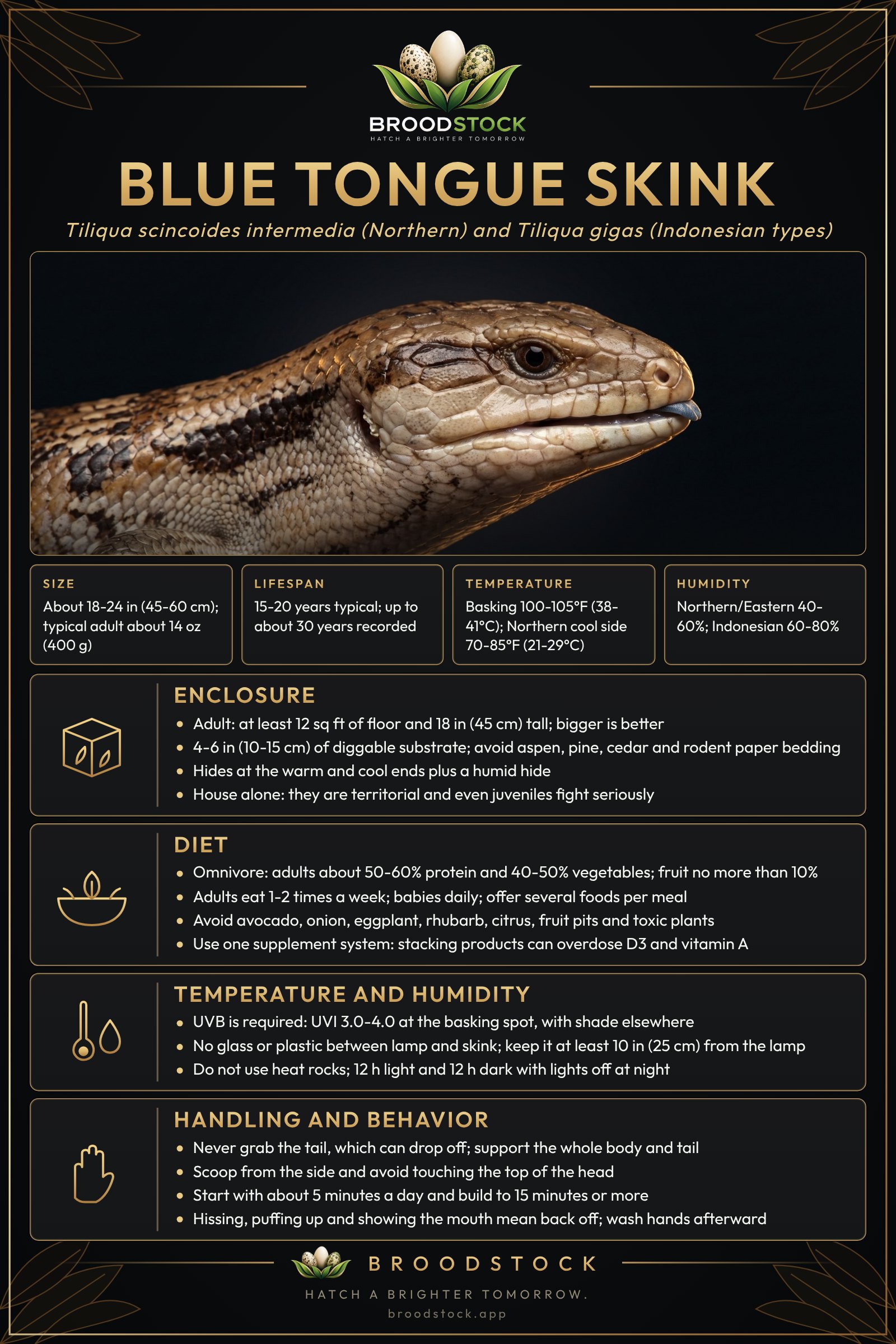
Print it or save it
The care sheet is a one-page summary you can print or keep on your phone. The full care text is below.
Keeping Blue Tongue Skink? Broodstock tracks feeding, weights, sheds, enclosures and equipment for every animal you keep, and it is free to start.
Scientific name
Northern types are Tiliqua scincoides intermedia, and Indonesian types are Tiliqua gigas
Adult size
Total length is about 18-24 in (45-60 cm). The Northern type (T. s. intermedia) is the largest and heaviest, up to about 24 in (60 cm). Indonesian (T. gigas) types measure about 18-20 in (45-50 cm), and Merauke have the longest body and tail. A typical adult weighs about 14 oz (400 g), while big Northerns can weigh more.
Lifespan
Typical captive lifespan is 15-20 years. Many live beyond 20 with good care, and up to about 30 years has been recorded.
Enclosure
An adult needs at least 12 sq ft of floor (for example 6x2x2 ft or 4x3x2 ft, about 180x60x60 cm), at least 18 in (45 cm) tall, or 24 in (60 cm) if lamps are mounted inside. Extra space is always welcome. Today the older 4x2x2 ft (8 sq ft) standard counts as too small. Established juveniles can live in an adult enclosure if it offers plenty of cover. Choose front-opening and well ventilated.
Fill it with 4-6 in (10-15 cm) of loose, diggable material: a topsoil/coco fiber/play sand mix, coco fiber or coconut chips, wetter for Indonesians and drier for Australians. Avoid aspen, pine, cedar and rodent paper bedding. Provide hides at the warm and cool ends plus a humid hide.
House each skink alone. They are territorial, and even juveniles fight seriously.
Temperature
The basking surface should be 100-105°F (38-41°C), though Eastern/Northern T. scincoides tolerate up to 105-115°F (40-46°C). The cool side is 70-85°F (21-29°C) for Northern and 75-85°F (24-29°C) for Indonesian. At night, Northern skinks want 65-75°F (18-24°C) and Indonesian 70-75°F (21-24°C). An infrared thermometer is the tool for checking the basking surface.
Humidity
Northern and Eastern skinks need 40-60%. Indonesian types (T. gigas, including Merauke, Kei, Classic and Halmahera) need 60-80%. Halmahera often need the top of that range; if they struggle to shed, raise it toward 80% or more. Read humidity on the cool side using a digital hygrometer.
Give the skink a humid hide of damp sphagnum, renewed often so mold does not form, and mist each day. Run any fogger or humidifier only part of the time so the enclosure can dry between cycles, and clean it weekly.
UVB
UVB is required for best health. This is a Ferguson Zone 2 species, with a target of UVI 3.0-4.0 at the basking spot and plenty of shade elsewhere so the skink can pick its exposure. Reflector fixtures such as Arcadia ProT5 are assumed for the distances below.
T5 HO 10.0/12% (Zoo Med ReptiSun 10.0, Arcadia Desert 12%) goes about 12-15 in (31-38 cm) above the skink's back through mesh, or 17-18 in (43-45 cm) without mesh. T5 HO 5.0/6% (Zoo Med ReptiSun 5.0, Arcadia Forest 6%) goes about 6-9 in (16-23 cm) through mesh or 11-12 in (28-30 cm) without.
The lamp should cover about half the enclosure on the warm side, with the skink kept at least 10 in (25 cm) away from it. Put no glass or plastic between lamp and animal. Change the bulb every 12 months, or test its output with a Solarmeter 6.5.
Lighting
Give about 12 h of light and 12 h of dark, with a bright daylight LED (about 6500K) alongside the UVB. Switch lights off at night. If the skink is brumating, reduce daylight to about 6 h.
Heating
Heat from above with halogen flood bulbs in a ceramic-socket dome (a cluster of two makes an even basking zone), or a radiant infrared unit, over a light-colored flat stone or paver. Add night heat only if the room falls below range, using lightless sources such as a ceramic heat emitter or radiant heat panel on a thermostat. Do not use heat rocks. A dimmer or dimming thermostat controls output, and an IR thermometer plus a probe thermometer confirm the results.
Diet
Blue tongues are omnivores. Under 12 months, feed about 70-80% protein and 20-30% vegetables. Adults get about 50-60% protein and 40-50% vegetables and leafy greens, with fruit at no more than 10%.
Protein options: gut-loaded insects (dubia and other roaches, black soldier fly larvae, silkworms, hornworms, snails; superworms as treats), eggs, lean ground meat, quality wet dog or cat food (cat food for juveniles, dog food from about 1 year; no fish formulas or artificial colors), and occasional pinky rats or fuzzy mice. Variety matters, so offer several foods at each meal.
Babies up to 3 months eat daily, 3-8 months 3 times a week, and 8 months and older 1-2 times a week, with a portion about the size of the head. Practices vary on dog food and meal frequency: some vets advise using little or no dog food and feeding adults more often in smaller amounts.
Avoid avocado, onion, eggplant, rhubarb, citrus, fruit seeds and pits, fireflies, and toxic plants (azalea, buttercup, daffodil, tulip, lily of the valley).
Supplements
With good UVB, dust insects and boneless meat at every feeding with calcium that has no D3 or low D3 (examples: Repashy SuperCal NoD or SuperCal LoD, Arcadia CalciumPro Mg, Zoo Med Repti Calcium without D3; Miner-All Indoor contains some D3). Without UVB, use calcium with D3 instead (Repashy SuperCal HyD or Zoo Med Repti Calcium with D3), and add UVB as soon as possible. Practices vary on how often to dust: some vets dust adults with calcium only 2-3 times a week.
Give a multivitamin (Repashy SuperVite or Zoo Med Reptivite) about once a week for juveniles and twice a month for adults. An all-in-one low-D3 powder such as Repashy Calcium Plus LoD can stand in for the separate calcium and multivitamin. Complete commercial diets come without any need for extra powder. Insects should spend 2-3 days on a gutload (Repashy SuperLoad, Arcadia InsectFuel, Mazuri Better Bug). The Ca:P ratio should be 2:1 or higher.
Stick to one system rather than several, since stacking products can cause D3 or vitamin A overdose.
Shedding
Blue tongues shed in patches, not in one piece. Low humidity is the usual cause of stuck shed, which can squeeze toes and the tail tip and cut off their blood flow. Raise humidity with a more moisture-holding substrate, more misting, a larger water bowl and a humid hide. Rough branches or rocks help the skink rub off old skin. Take the skink to a reptile vet if shed is squeezing toes or the tail tip.
Handling
Captive-bred skinks usually tame easily, while wild-caught animals (many Indonesians are imported) can stay nervous or defensive. Begin with about 5 minutes a day and build up to 15 minutes or more. Scoop from the side and support the whole body and tail along your forearm. Never grab the tail, which can drop off, and avoid touching the top of the head. When the skink hisses, puffs up or shows its mouth and tongue, give it space. After handling, wash your hands with soap.
Brumation
Northern and Indonesian skinks are tropical and normally need no brumation; do not force it, though some slow down in winter for 1-4 months. Temperate types (Eastern, Blotched, Shingleback) generally brumate about 4-6 months.
If a skink brumates, start with a reptile vet exam and parasite check, and never do it under 1 year old. Stop feeding about 2 weeks before lowering heat. Tropical types keep a basking spot of about 80°F (27°C); temperate types can go to room temperature but never below 55°F (13°C). Keep UVB and LED on about 6 h a day and fresh water available. Weigh every 2 weeks and call a vet if it loses 10% or more of its starting weight.
Health signs to watch
Keep a log and weigh weekly, because a sudden loss of weight is a key warning sign. See a reptile vet for: soft or bent jaw, limbs or spine, twitching or weakness (metabolic bone disease), wheezing, bubbles or mucus at nose or mouth (respiratory infection), mites, scale discoloration or blisters (scale rot), retained shed constricting toes or tail, weight loss or diarrhea (parasites), mouth or dental problems, overgrown nails, bite wounds (usually from cohabitation) and obesity.
Quarantine new skinks at least 3 months (6 is safer) and have a fecal test. Have a vet check every 6-12 months.
Welfare
Indonesian blue tongues are usually wild-caught imports. They often carry intestinal parasites (amoebas and flagellates) that need prescription treatment from a vet, and many stay defensive for years. Australian types are captive-bred because Australia bans commercial export of native reptiles, so they cost more and are generally tamer. House blue tongues singly. They tolerate other skinks only briefly for pairing, and fighting causes bite wounds and mouth infections.
Keep every animal's care in one place
Log feedings, weights and sheds, set reminders, and let Ranger, the built-in AI manager, help with the rest. Free to start, no card needed.