
Broodstock / Care sheets / Boa Constrictor
Boa Constrictor Care Sheet
Boa imperator / Boa constrictor (as kept in the hobby)
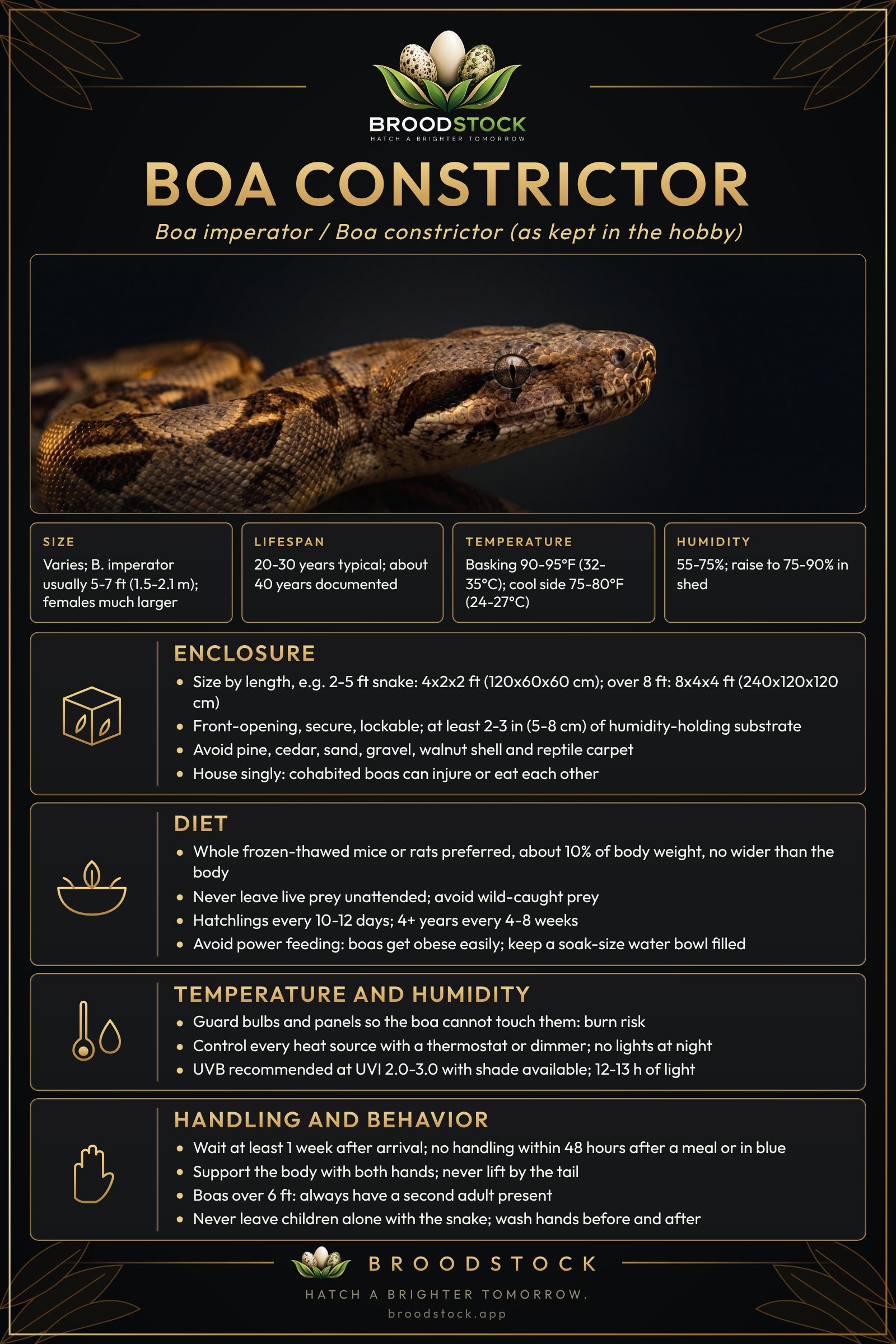
Print it or save it
The care sheet is a one-page summary you can print or keep on your phone. The full care text is below.
Keeping Boa Constrictor? Broodstock tracks feeding, weights, sheds, enclosures and equipment for every animal you keep, and it is free to start.
Scientific name
Boa imperator and Boa constrictor, as the hobby keeps them
Adult size
Size varies by species and locality. Boa imperator, most common in the US hobby, usually reaches 5-7 ft (1.5-2.1 m), while dwarf island and locality boas stay about 3-5 ft (0.9-1.5 m). B. c. constrictor (true red-tail) typically reaches 7-10 ft (2.1-3.0 m) and rarely 12 ft (3.7 m). Compared with males, females grow much larger and heavier. Most growth comes in the first 6 years, though some animals grow slowly until about 15. Adults of red-tail size weigh about 20-30 lb (9-14 kg), and smaller localities weigh less.
Lifespan
Expect 20-30 years in captivity; 30+ is possible with good care, and about 40 years has been documented.
Enclosure
Minimums by length: under 2 ft, 2x1.5x1 ft (60x45x30 cm); 2-5 ft, 4x2x2 ft (120x60x60 cm); 6-8 ft, 6x3x3 ft (180x90x90 cm); over 8 ft, 8x4x4 ft (240x120x120 cm). A snake between two sizes gets the larger one. At the very least, enclosure length plus width should equal the boa's length so it can stretch out, and bigger is better. The enclosure should open at the front and be secure and lockable.
Substrate should be at least 2-3 in (5-8 cm) of a humidity-holding mix (topsoil/coco fiber/play sand blend or plain coco fiber). Cypress mulch or coconut husk chips also work but carry some swallowing risk, especially for young snakes. Avoid pine, cedar, sand, gravel, walnut shell and reptile carpet. Provide at least two hides (warm and cool ends), cover, sturdy climbing branches and a water bowl big enough to soak in.
Keep each boa alone. Boas are solitary, and cohabited boas can injure or eat each other.
Temperature
The basking surface should be about 90-95°F (32-35°C), basking-side air 86-90°F (30-32°C) and the cool side 75-80°F (24-27°C). At night about 72-78°F (22-26°C) is typical. Healthy boas tolerate a dip to 68°F (20°C), but add thermostat-controlled lightless heat if the room gets colder. B. c. orophias and B. c. nebulosa should stay around 80°F (27°C) at night.
Humidity
Ambient humidity of 55-75% is right, and brief drier periods are fine and help prevent mold. Raise it to about 75-90% when the snake is in shed (blue eyes). Put a humid hide with damp sphagnum on the cool side. Read it on a digital hygrometer, not a stick-on dial.
UVB
UVB is recommended but not strictly required; boas survive without it but benefit. This is Ferguson Zone 2, with a target of UVI 2.0-3.0 at the basking spot and shade available. Mount it on the warm side over the basking area. T5 HO 5.0/6% bulbs (Zoo Med ReptiSun 5.0, Arcadia Forest 6%) sit about 10-14 in (25-35 cm) above the boa's back through mesh, or 14-18 in (35-45 cm) with no mesh. Arcadia ShadeDweller MAX goes at 4-6 in (10-15 cm) through mesh or 6-8 in (15-20 cm) without. Replace every 12 months and check with a Solarmeter 6.5.
Lighting
Provide about 12-13 h of light and 11-12 h of dark, shortening to about 11 h in winter. Use no lights at night, and choose white or clear bulbs rather than colored ones. B. c. constrictor may do better with a bigger seasonal swing of about 14 h days in summer and 8 h in winter.
Heating
For overhead heat, use at least two white or clear halogen or incandescent flood bulbs in a dual dome with ceramic sockets over mesh (or in bulb cages if inside), or a radiant infrared unit, with a flat basking surface (flagstone, concrete or wood) below. Lightless heat (radiant heat panel or deep heat projector) suits supplemental or night heat on a proportional thermostat.
Every heat source needs a thermostat or dimmer to regulate it. Heat mats and heat tape are unsuitable as primary heat and must always be on a thermostat. Guard bulbs and panels so the boa cannot touch them (burn risk). Surfaces are measured with an infrared thermometer, and air with digital probes.
Diet
Feed whole rodents (mice, rats), with occasional chicks or quail for variety. Frozen-thawed is preferred (thaw in the fridge, then warm to about 98-100°F (37-38°C)), and live prey must never be left unattended. Prey should be about 10% of body weight and no wider than the widest part of the body.
Feeding intervals run by age, starting at every 10-12 days from hatchling to 12 months; 12-18 months every 12-14 days; 18 months to 2.5 years every 2-3 weeks; 2.5-3 years every 3-4 weeks; 3-4 years every 4-6 weeks; 4+ years every 4-8 weeks. Tune the schedule to body condition, which should look squared off when viewed end-on, not round or with fat rolls. Avoid power feeding, as boas get obese easily. Keep fresh water in a soak-size bowl at all times.
Supplements
Routine supplements are unnecessary, since whole, well-fed prey is nutritionally complete. If you like, dust prey lightly once in a while, as feeder rodents can be low in vitamin D. With UVB use a low-D3 all-in-one such as Repashy Calcium Plus LoD; without UVB use one with standard D3 such as Repashy Calcium Plus. Arcadia RevitaliseD3 (calcium with D3 and vitamin A) is another option, used only every so often. Choose one product, not several, and replace powders every 6 months. Gut-loading does not apply to rodent prey. Avoid wild-caught prey.
Shedding
Young boas shed often and adults less. The eyes turn milky blue about 7-10 days before a shed; skip feeding and handling then, and raise humidity to about 75-90%. Once it finishes, confirm the eye caps and tail tip have come away. If shed sticks, put the boa in a secure tub of shallow warm water at about 85°F (29°C) for a soak, and then ease the loosened skin away gently. Humidity that is too low usually explains repeated bad sheds. See a reptile vet if other signs of illness appear with them.
Handling
Wait at least 1 week after arrival, longer if it is not eating. Do not handle within 48 hours after a meal (BGSU suggests 4-5 days for large boas) or while in blue. Tap with a hook first so it knows it is not feeding time. Support the body with both hands and let it move loosely; never lift by the tail. Begin with brief sessions every few days and lengthen them over time. For boas over 6 ft, always have a second adult present. Children should never be left alone with the snake. Wash your hands both before and after.
Brumation
True brumation does not occur in boas. Pet boas can stay on normal temperatures, though B. c. constrictor may benefit from a seasonal shift of shorter winter days and air around 75-78°F (24-26°C).
Health signs to watch
Weigh weekly and log weight, feeding, shedding and behavior. A sudden drop in weight is the main warning sign. Get a vet promptly for: regurgitation, weight loss, poor appetite with poor body condition, neurological signs (stargazing, head tremors, can't right itself, odd tongue flicking), wheezing, bubbles or mucus at mouth or nose, open-mouth breathing, mouth swelling or discharge (mouth rot), mites (black specks, soaking constantly), scale blisters or discoloration (scale rot), burns, and sunken eyes or wrinkled skin (dehydration).
Inclusion body disease (reptarenavirus) can be carried silently for months to years and spreads by body fluids, mating and likely mites. Quarantine new boas away from the collection. Pneumonia and mouth inflammation come from nidovirus, and obesity is also common.
Welfare
Boas live about 20-30 years. Check that buyers can offer a long-term home, and hand over lineage, health and feeding records. Inclusion body disease can be carried silently, so quarantine new boas.
Keep every animal's care in one place
Log feedings, weights and sheds, set reminders, and let Ranger, the built-in AI manager, help with the rest. Free to start, no card needed.