
Broodstock / Care sheets / Bobwhite Quail
Bobwhite Quail Care Sheet
Colinus virginianus (northern bobwhite)
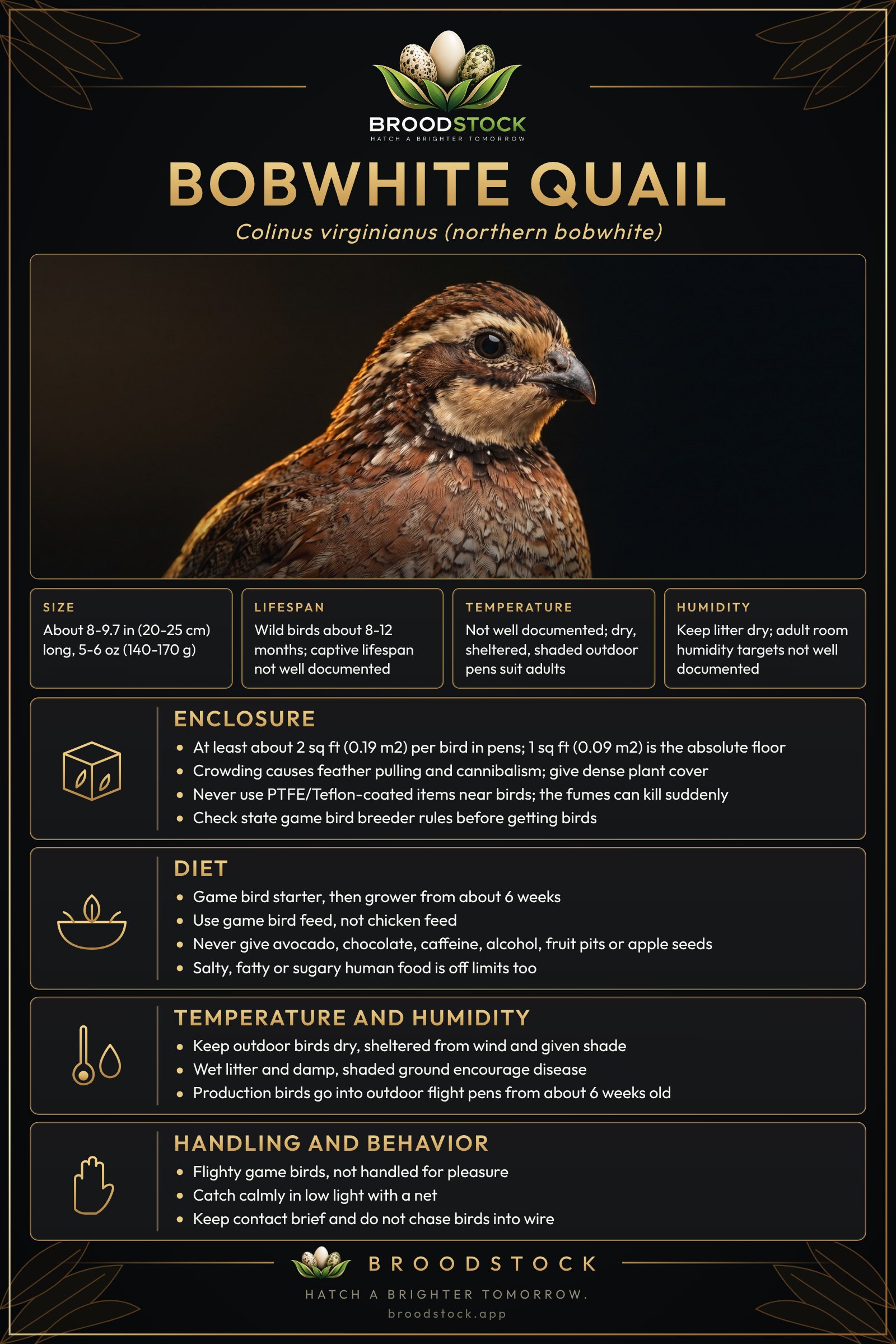
Print it or save it
The care sheet is a one-page summary you can print or keep on your phone. The full care text is below.
Keeping Bobwhite Quail? Broodstock tracks feeding, weights, sheds, enclosures and equipment for every animal you keep, and it is free to start.
Scientific name
Colinus virginianus, the northern bobwhite. It is a native North American game bird, so in many US states you need a state game bird breeder license or permit to keep or sell it. Coturnix, by comparison, is treated as non-game by most states.
Adult size
Wild-type birds measure roughly 8-9.7 in (20-25 cm) in length and weigh about 5-6 oz (140-170 g). Pen-reared meat strains can run heavier, though exact weights are not well documented.
Lifespan
In the wild, bobwhites typically live around 8-12 months. Few reach 5 years, and about 6 years is the recorded maximum. There is little solid information on captive lifespan. Breeding flocks are normally kept for production over a few seasons, not into old age.
Enclosure
For grow-out and holding flight pens, allow at least about 2 sq ft (0.19 m2) per bird. 1 sq ft (0.09 m2) is the absolute floor. Crowding leads to feather pulling and cannibalism. Plant dense cover so birds can get away from aggressive pen mates. Rest or rotate outdoor ground, since wet, shaded soil collects mold and parasites.
Contact your state wildlife agency before you get birds. Texas, for one, lists bobwhite among birds requiring a Commercial Game Bird Breeder License (Class 2 up to 1,000 birds, Class 1 above that), and holders must keep records of birds and eggs acquired, raised, sold and disposed of. California requires a Domesticated Game Breeder's License to raise game birds that live wild in the state, its own native quail included. The agency pages do not say whether bobwhite fall under this there, so ask. Rules on releasing pen-reared birds also differ between states.
Never use PTFE/Teflon-coated items near birds, such as non-stick pans, drip pans, irons, heating elements and some heat lamps. Fumes from overheated PTFE can cause sudden death, even when the bird is in a different room.
Temperature
Adult temperature ranges are not well documented. Production birds go into outdoor flight pens from about 6 weeks old, which suggests adults handle outdoor weather as long as they have shade, a wind break and stay dry.
Humidity
Wet litter and damp, shaded ground encourage disease, so keep litter dry. Target room humidity for adults is not well documented.
UVB
Little is documented for bobwhite. Production birds grow up in outdoor flight pens with natural light. Birds kept indoors depend on a complete game bird ration to supply vitamin D3.
Lighting
Birds that are still growing do well on roughly 10-11 hours of light a day.
Heating
Never use PTFE/Teflon-coated items near birds, such as non-stick pans, drip pans, irons, heating elements and some heat lamps. Fumes from overheated PTFE can cause sudden death, even when the bird is in a different room.
Diet
Feed game bird starter at the beginning and change to grower at about 6 weeks. Protein levels are not given in the production guides, so follow the label on a game bird feed (not a chicken feed).
Never give avocado, chocolate, caffeine, alcohol, fruit pits or apple seeds. Human foods high in salt, fat or sugar are also off limits.
Supplements
Water-soluble vitamins in the first week may help chicks get going. A game bird breeder ration supplies the calcium laying hens need, and whether to add extra oyster shell is not documented.
Shedding
Little is documented about molt timing in captive bobwhite.
Handling
Bobwhites are flighty, fast game birds and not pets to be handled for pleasure. When you must catch one, do it calmly in low light with a net, keep contact brief, and do not chase birds into wire.
Health signs to watch
Ulcerative enteritis ('quail disease', Clostridium colinum) hits bobwhite harder than any other species. Young birds die suddenly, sometimes with watery or bloody droppings, and losses can come close to 100% within 2-3 days. To prevent it, use cages or clean, dry litter, keep stocking low, control coccidiosis, remove sick and dead birds quickly, and avoid adding new birds to existing flocks. Treatment requires a vet.
Quail bronchitis (adenovirus) is worst in chicks under 4 weeks old. Signs are coughing, sneezing, rattling breathing and eye discharge. Anywhere from 10-100% may die, no licensed vaccine or treatment exists, and the virus stays on the premises.
Other problems include cannibalism and feather pulling, splay leg, and drowning in deep waterers. Buy birds from tested (NPIP) stock.
Sudden deaths, breathing trouble or a drop in laying may also point to avian influenza. Separate sick birds and call your vet, state animal health official or the USDA line (1-866-536-7593).
Welfare
As a native game bird, bobwhite fall under licensing in many states, which can also mean required records and limits on releasing pen-reared birds. Look up your state's law first.
Crowding, bright light and too little feed or water space cause cannibalism and feather pulling, the main welfare problems. Commercial producers beak-trim chicks and growers to cut down on cannibalism. Practices vary, and small breeders often depend on low stocking, cover and dim light instead.
Ulcerative enteritis and quail bronchitis can kill most of a young flock, so keep hygiene strict and keep chicks away from older birds.
Keep every animal's care in one place
Log feedings, weights and sheds, set reminders, and let Ranger, the built-in AI manager, help with the rest. Free to start, no card needed.