Print it or save it
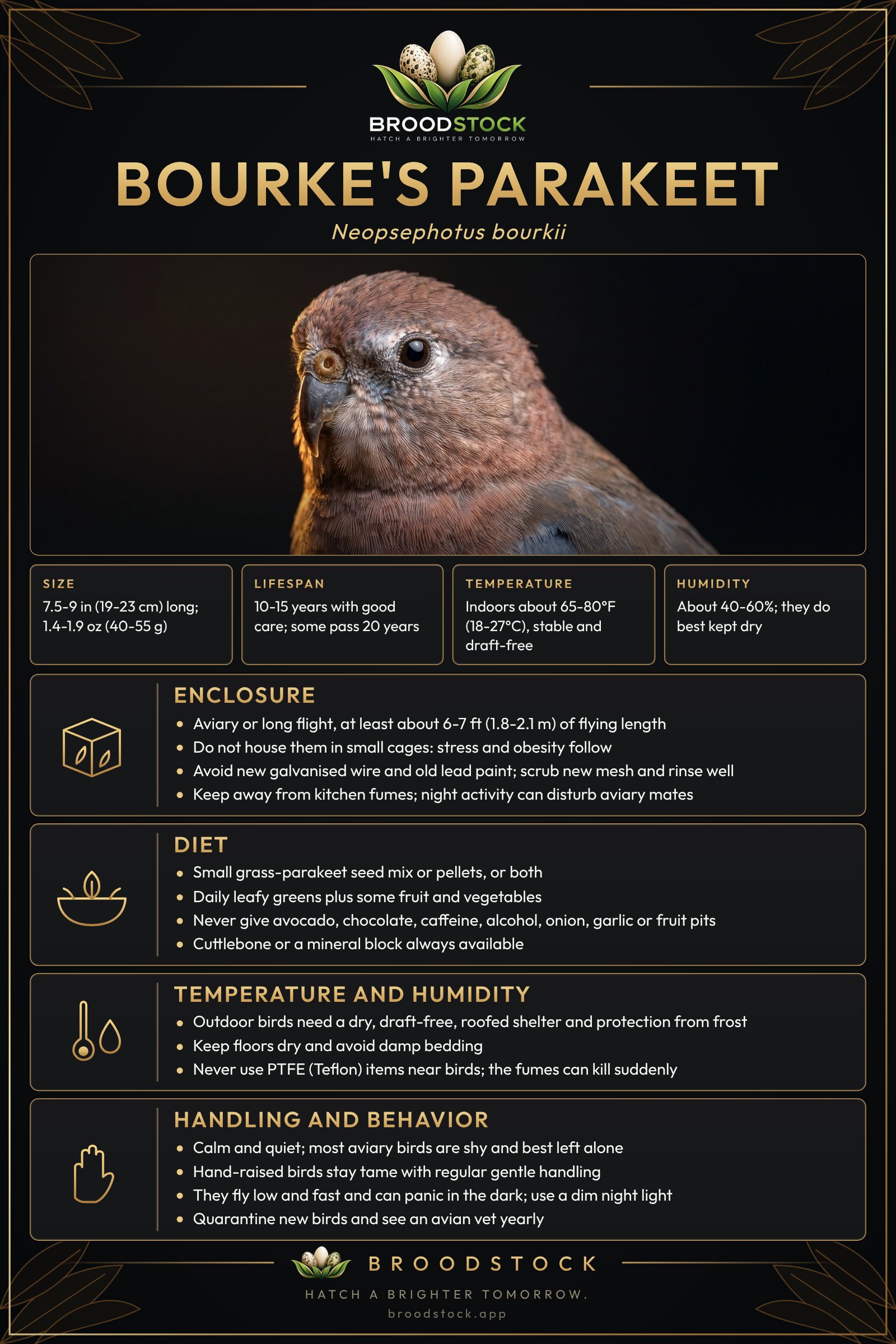
The care sheet is a one-page summary you can print or keep on your phone. The full care text is below.
Keeping Bourke's Parakeet? Broodstock tracks feeding, weights, sheds, enclosures and equipment for every animal you keep, and it is free to start.
Scientific name
Neopsephotus bourkii
Adult size
Roughly 7.5-9 in (19-23 cm) in length, tail included (the tail is about 3.5 in (9 cm)), and about 1.4-1.9 oz (40-55 g). Cocks run a little bigger than hens.
Lifespan
With good care, 10-15 years is typical in captivity, and some birds pass 20 years. Older or lower-quality captive records give 5-8 years.
Enclosure
An aviary or long flight is best, with at least about 6-7 ft (1.8-2.1 m) of clear flying length and a perch at each end so the birds have to fly. Bourke's rarely climb and do poorly in small cages, where stress and obesity follow.
They feed on the ground, so a regular aviary with a clean, dry floor is slightly better than a suspended flight. Rake or replace the floor often to keep worms down. They are not destructive, so planted aviaries work well. Shelter outdoor flights from harsh winter weather and keep birds away from kitchen fumes.
They are peaceful and can share space with finches, quail and other gentle small grass parakeets (such as Neophema). Still, their dusk and night activity can disturb roosting aviary mates.
Choose stainless steel, safe powder coat or well-scrubbed mesh. New galvanised (zinc-coated) wire, 'white rust' and old lead solder or paint can poison birds that chew them. Scrub new mesh with a wire brush and dilute vinegar, rinse well before birds go in, and repeat if white rust forms.
Temperature
Indoors, keep it stable and draft-free at about 65-80°F (18-27°C). Birds used to outdoor aviaries cope with cool weather, but they need a dry, draft-free, roofed shelter and protection from deep-winter cold and frost. A safe minimum outdoors is not well documented. On hot days, make sure shade and water are available.
Humidity
Normal room humidity of about 40-60% is fine. They come from arid inland Australia and do best dry, so avoid damp floors and wet bedding. Put out a shallow bath dish each day.
UVB
Unfiltered natural sunlight in an outdoor aviary is ideal, as long as shade is always available. Glass in windows stops UVB. For indoor birds, general avian vet guidance (not research specific to Bourke's) offers an option: an avian UVB fluorescent tube or compact bulb above the cage for at least 3-4 hours a day, replaced about every 6 months. Switch the lamp off if you see squinting, face rubbing or redness around the eyes.
Lighting
Bourke's are crepuscular, so expect most activity and calling at dawn and dusk, and often after dark, especially on moonlit nights. A dim night light helps stop night frights and crashes in the dark.
Heating
Put a sick bird in a warm hospital cage and get it to an avian vet.
Never use non-stick (PTFE/Teflon) cookware, drip pans, irons, heat lamps or heaters with a PTFE coating near birds. Overheated PTFE releases colourless, odourless fumes that can cause sudden death, even in another room.
Diet
Wild Bourke's eat mostly grass seeds, other small plant seeds, acacia seeds and green shoots, taken from the ground. In captivity offer a small grass-parakeet seed mix (canary seed and millets, with smaller amounts of oats, buckwheat, safflower and hemp) or pellets. Many keepers give both. They enjoy soaked or sprouted seed and fresh seeding grasses.
Add leafy greens daily (chard, kale, bok choy, endive, dandelion, chickweed), plus some fruit and vegetables (apple, pear, corn, carrot, broccoli). Keep sunflower and millet spray to a minimum.
Never give avocado, chocolate, caffeine, alcohol, onion or garlic, fruit pits or apple seeds. Human foods high in salt, fat or sugar are off limits too.
Supplements
Keep a cuttlebone or mineral block available at all times; laying hens need extra calcium. Birds on seed benefit from a bird vitamin and mineral supplement containing vitamins A and D3, used as the label directs. Pellet-fed birds seldom need one.
Keepers differ on whether grass parakeets should get fine grit. If you use it, offer only a small amount.
Shedding
Young birds look like hens and take on adult colouring at about 9 months. Adults molt once a year. Give extra protein (egg food, sprouted seed) during molt. Have an avian vet check any feather loss that is not part of a molt.
Handling
They are calm, quiet and gentle with a soft, mellow call, which suits apartments and mixed aviaries. They are not known as talkers. Hand-raised birds stay tame with regular gentle handling, even in pairs, but most aviary birds are shy and best left alone. Flight is low and fast in short bursts, and they can panic in the dark.
Health signs to watch
Because they forage on the ground, they pick up intestinal worms and other parasites from soiled floors. Keep floors clean and dry, and run regular worming and fecal checks with an avian vet.
Other concerns: obesity in small cages; night frights (crashes in the dark); psittacosis (Chlamydia), which can infect people and can be carried by birds showing no signs; and egg binding in hens (fluffed on the floor, tail bobbing, straining), which is an emergency. PTFE (Teflon) fume poisoning is a possible cause of sudden death or sudden breathing trouble. The species is generally considered hardy, with no special disease susceptibility reported. Keep new birds in quarantine and book an avian vet visit every year.
Welfare
Do not house them in small cages. Without room to fly, the birds become obese and stressed. Their night activity can stress other aviary birds, so pick aviary mates with care. In the wild the species is rated Least Concern, and it is listed on CITES Appendix II.
Keep every animal's care in one place
Log feedings, weights and sheds, set reminders, and let Ranger, the built-in AI manager, help with the rest. Free to start, no card needed.