
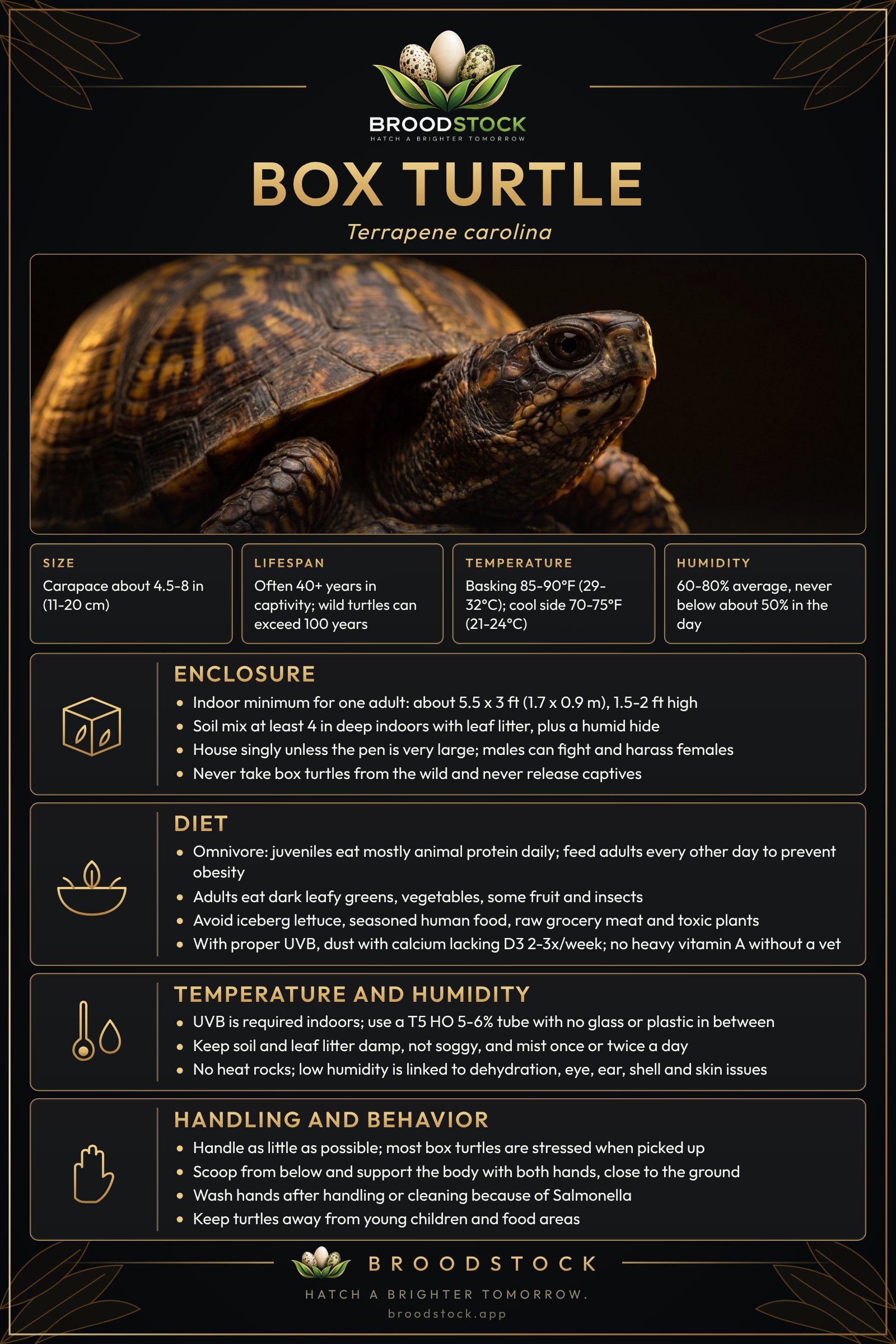
Print it or save it
The care sheet is a one-page summary you can print or keep on your phone. The full care text is below.
Keeping Box Turtle? Broodstock tracks feeding, weights, sheds, enclosures and equipment for every animal you keep, and it is free to start.
Scientific name
Terrapene carolina
Adult size
Carapace length runs about 4.5-8 in (11-20 cm). Eastern (T. c. carolina) turtles measure about 4.5-6.5 in, occasionally 8 in, and three-toed (T. c. triunguis) about 5-7 in. Growth is around 0.6 in (1.5 cm) a year for the first 5 years, then very slow for 20+ years.
Lifespan
Captive box turtles often reach 40+ years with good care (reports run 30-50+). Wild ones can exceed 100 years, with a record of about 138 years. Be ready for a commitment that lasts a lifetime.
Enclosure
Box turtles are land animals. For one adult, the indoor minimum is a floor of about 5.5 x 3 ft (about 16.5 sq ft; 1.7 x 0.9 m) and 1.5-2 ft of height, and more space is better. Juveniles under about 4-6 in can manage with 4 x 2 ft. In a suitable climate, a secure outdoor pen is ideal: walls at least 2 ft high, buried 8-12 in (20-30 cm) or deeper in the soil, and a top to keep predators out.
For substrate use a moisture-holding soil mix (topsoil, coconut fiber, cypress) at least 4 in deep indoors (12 in outdoors), under 1+ in of leaf litter, so they can burrow. Some vet handouts prefer paper, carpet or wood-chip bedding to avoid impaction from swallowed substrate, so practices vary. Add several hides including a humid hide, plants, and a shallow water dish no deeper than the knees, changed daily. A 4-5 in opaque barrier along the lower front stops pacing at the glass. House turtles singly unless the pen is very large, because males can fight with and harass females.
Terrapene is CITES Appendix II (international trade needs permits), and T. carolina is rated Vulnerable by the IUCN. Many US states ban or restrict collecting, possessing or selling native box turtles (Connecticut, for example, bans wild collection), so check state wildlife rules before keeping or selling. Never take box turtles from the wild, and never release captives, because of disease risk. Home ranges are small and relocated turtles rarely survive.
Federal rule 21 CFR 1240.62 prohibits selling, holding for sale or offering for any commercial or public distribution turtles under 4 in (10 cm) carapace length and viable turtle eggs. The exceptions are narrow: genuine scientific, educational or exhibition purposes, non-business transfers, and shipments labeled for export only.
Temperature
Aim for a basking spot of about 85-90°F (29-32°C), a warm side of about 80-85°F (27-29°C) and a cool side of 70-75°F (21-24°C). Turn the heat off at night. Indoors, a drop to about 65-70°F (18-21°C) is fine, and outdoor adults handle nights near 50°F (10°C). Move outdoor turtles inside once days stay below about 60-65°F (16-18°C), unless they are brumating.
Humidity
Average 60-80%, and never below about 50% during the day. Keep soil and leaf litter damp but not soggy, mist once or twice a day, and provide a humid hide on the cool end. Low humidity is linked to dehydration, eye and ear problems, and shell and skin issues.
UVB
UVB is required indoors. The target is Ferguson zone 2 (peak basking-zone UVI about 1.1-3.0). Many keepers aim a little higher, about 3.0-4.0 right at the basking spot, with most of the enclosure far lower. Practices vary, so measure with a Solarmeter 6.5, give plenty of shade, and raise the lamp if the reading is high.
Use a linear T5 HO 5-6% tube (Arcadia Forest 6%, ReptiSun 5.0) in a reflector over the warm side. Mount it about 17-18 in (43-46 cm) above the turtle's back with no mesh, or 13-14 in (33-36 cm) through mesh. Nothing made of glass or plastic should sit in between. Sunlight outdoors can stand in for UVB lamps. Change bulbs as the manufacturer directs: T5 HO tubes about once a year, other UVB bulbs every 6-12 months.
Lighting
Run about 14 hours of light in summer, tapering to about 10 hours in winter; 12-14 h year-round is a fine baseline if the turtle is not brumating. A 6500K daylight LED over most of the enclosure is a good addition. Outdoors, natural light does the job.
Heating
Use halogen flood bulbs of about 50W each (one for juveniles, two or more for adults) in ceramic-socket domes over the basking area, run through a dimmer or thermostat to hold the basking temperature. Add a ceramic heat emitter only if the room drops below about 65°F (18°C) at night. Do not use heat rocks. Sun is normally enough outdoors.
Diet
Box turtles are omnivores. Juveniles eat mostly animal protein, fed daily, as much as they will take. For adults, keeper care guides often use about half animal protein and half plants, while vet handouts lean toward more plants (about 60-80% vegetables, 10-20% fruit, about 10% insects). Practices vary. Feed adults every other day to prevent obesity.
Protein options: earthworms, snails, slugs (captive-raised), crickets, roaches, black soldier fly larvae, and occasional pinkies. Plant options: dark leafy greens (collard, dandelion, turnip greens), squash, berries, melon and mushrooms (non-toxic store types), with fruit at about 10-20%. Serve food on a plate, cut to bite size.
Avoid iceberg lettuce, raw grocery meat, toxic plants, processed or seasoned human food and wild insects from treated areas.
Supplements
With proper UVB, dust food lightly with plain calcium lacking D3 (e.g. Repashy SuperCal NoD, Zoo Med Repti Calcium without D3) 2-3x/week. Alongside that, and again only with proper UVB, add a reptile multivitamin that has preformed vitamin A (not only beta-carotene) about once a week. Examples are Repashy Calcium Plus LoD (a low-D3 all-in-one with vitamin A, made for animals with UVB) or Zoo Med Reptivite without D3.
Leave a cuttlebone in the enclosure. Feed insects a gut-load diet beforehand, such as Repashy SuperLoad or another commercial one. Box turtles are prone to vitamin A deficiency, so dark leafy greens, orange vegetables and the multivitamin matter. Never give vitamin A injections or heavy doses without a vet, since overdose is possible. If there is no UVB (not recommended), switch to calcium with D3.
Shedding
Box turtles shed skin in small flakes and thin layers of scute, a little at a time; details are not well documented. Do not peel it. Flaky skin or scutes that stay on usually reflect husbandry, so recheck humidity, diet and UVB. See a reptile vet about any shell area that looks or smells wrong: soft spots, pits, ulcers or discoloration, which can mean shell infection.
Handling
Handle as little as possible; most box turtles are stressed when lifted and shut their shells. Scoop from underneath, support the body with both hands and stay close to the ground. A healthy turtle feels heavy and pulls in when held. Wash your hands after handling or cleaning (Salmonella), and keep turtles away from young children and food areas.
Brumation
Healthy adult eastern and three-toed box turtles hibernate naturally (October/November to April), and many keepers brumate them. Only brumate healthy, normal-weight adults, after a vet check and fecal test. First stop feeding for about 2 weeks while keeping the turtle warm, soak it to hydrate, then cool it gradually.
Hold it at about 40-50°F (5-10°C) in a hibernaculum of deep soil and leaf litter, or a fridge setup. Never let it go above about 55-60°F (13-16°C), and never near freezing. Weigh at least every 1-2 weeks. Expect about 1-2% loss per month; wake the turtle if it loses faster, reaches about 5% total loss, or looks unwell.
Turtles that are young, sick, underweight or newly acquired should stay active instead. Florida box turtles and the far-southern Gulf Coast box turtles are normally not hibernated. Brumation is optional for pets, and keeping them warm all year is acceptable.
Health signs to watch
Eyes, ears and breathing: eyelids that are swollen or shut, with discharge; ear swellings (aural abscess); open-mouth breathing; and bubbles or discharge from the nose or mouth. Body and shell: legs or shell that are soft or deformed (MBD), pitting, ulcers or odor on the shell, cheesy lumps, weight loss, diarrhea and flystrike in wounds. Also see a vet for lethargy or not eating outside brumation, straining or failure to lay, and prolapsed tissue.
Respiratory infection (herpesvirus included, which is often fatal), vitamin A deficiency, abscesses, parasites (common in wild-caught turtles), retained eggs and MBD (from missing UVB or low calcium) are the usual causes. Have a vet check a new turtle, with a fecal test, within about 48 hours. Hand washing matters because of Salmonella.
Welfare
These are native wildlife, protected in many US states, where taking them from the wild is banned. Heavy export of wild-caught turtles for the pet trade led to the genus being placed on CITES Appendix II in 1994. Wild populations are unusually vulnerable to losing adults, maturity takes about 7-10 years, and a turtle moved away from its home range often fails to settle. For these reasons, never collect one from the wild, and never release a captive turtle.
Lifespans of 20 years or more are possible. Under the US federal rule, hatchlings must grow past 4 in (10 cm) before any sale, and state law may ban selling native box turtles at any size.
Keep every animal's care in one place
Log feedings, weights and sheds, set reminders, and let Ranger, the built-in AI manager, help with the rest. Free to start, no card needed.