
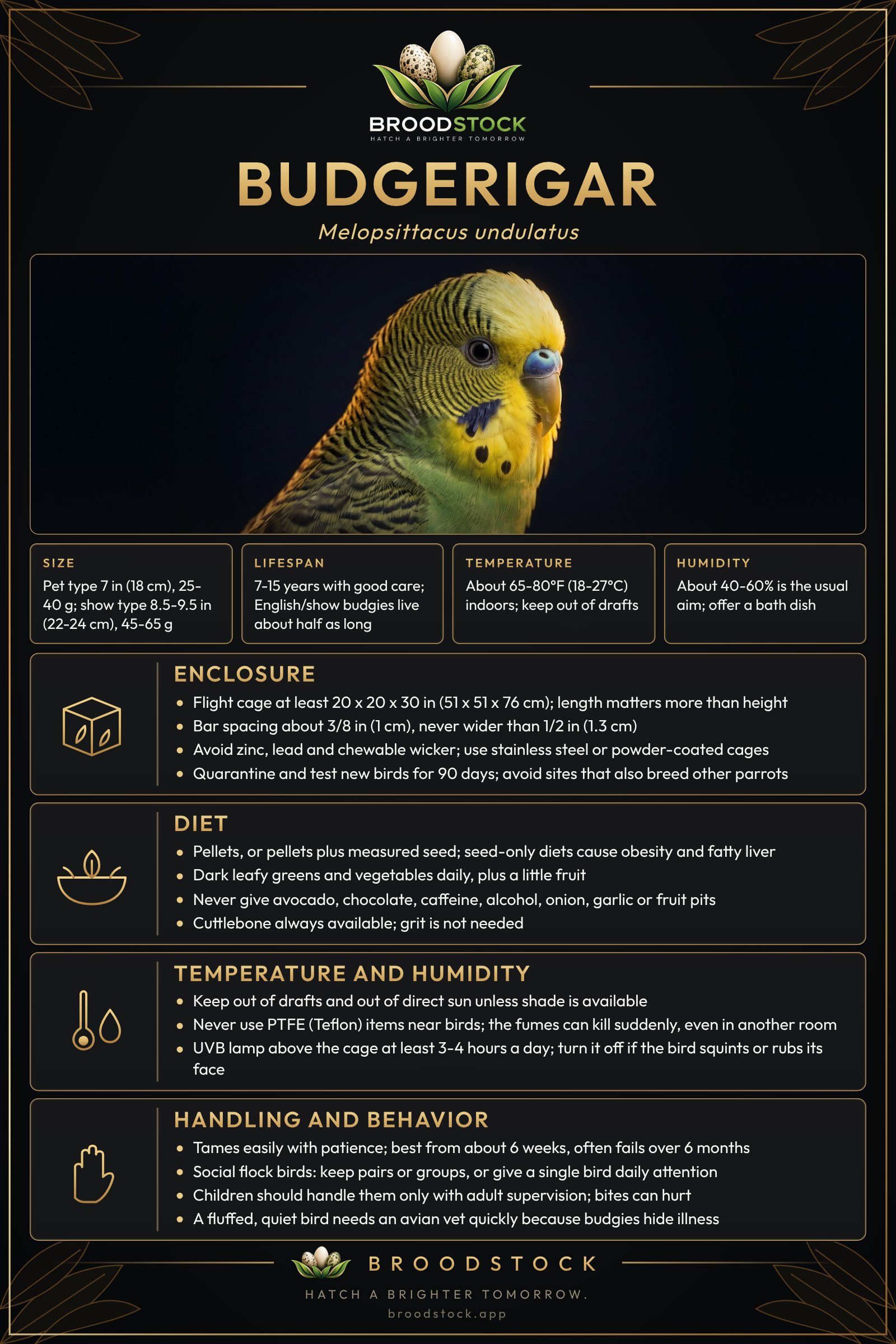
Print it or save it
The care sheet is a one-page summary you can print or keep on your phone. The full care text is below.
Keeping Budgerigar? Broodstock tracks feeding, weights, sheds, enclosures and equipment for every animal you keep, and it is free to start.
Scientific name
Melopsittacus undulatus
Adult size
A standard (pet-type) budgie measures about 7 in (18 cm) and weighs 25-40 g. English or show budgies are about 8.5-9.5 in (22-24 cm) and 45-65 g.
Lifespan
With good care, 7-15 years is usual, and 10-15 years is common in captivity. Many die younger because of a poor diet or accidents. English or show budgies live only about half as long as pet-type birds.
Enclosure
A pet or flight cage should be at least 20 x 20 x 30 in (51 x 51 x 76 cm), and larger is better. Budgies fly side to side, so length counts for more than height.
Bar spacing should be about 3/8 in (1 cm) and no wider than 1/2 in (1.3 cm). Use natural wood perches of mixed thickness, sized so the toes wrap about three-quarters of the way round, and no sandpaper covers. The cage should be stainless steel or powder-coated. Avoid zinc (galvanised wire, old cages), lead (old paint) and chewable wicker.
Avoid housing budgies at sites that also breed other kinds of parrot, because of polyomavirus risk. Quarantine and test new birds for 90 days before they join an aviary.
Temperature
Indoors, about 65-80°F (18-27°C) works, and most budgies do well at household temperatures of 70-80°F (21-27°C). Healthy birds put up with some heat and cold. Keep them out of drafts, and out of direct sun unless shade is available. Outdoor aviaries need a sheltered, draft-free sleeping area, shade on sunny days and winter heating in cold climates. A safe minimum temperature outdoors is not well documented.
Humidity
Not well documented; ordinary household humidity suits most budgies, and keepers commonly aim for about 40-60%. Put out a shallow bathing dish and change the water daily.
UVB
UVB is recommended. It helps budgies make vitamin D and use calcium, and it matters most for birds on seed-heavy diets and for chronic layers, which benefit year round. Use an avian linear or compact fluorescent UVB bulb above the cage, never to the side, for at least 3-4 hours daily with shade available. Keep to the maker's distance (about 6-12 in (15-30 cm) from the bird's head for most bulbs) and replace the bulb every 6 months. Turn it off immediately if you notice squinting, face rubbing or reddened skin around the eyes. Glass in windows stops UVB. Supervised outdoor sun is ideal: 20-30 minutes 2-3 times a week at 65-85°F (18-29°C).
Lighting
Keep a regular day and night cycle. A hen that lays continually needs an avian vet, who may shorten her day to about 8 hours of light.
Heating
A sick or egg-bound hen goes into a warm hospital cage at about 85-90°F (29-32°C) on the way to an avian vet.
Never put non-stick pans, heat lamps, heaters or other appliances with a PTFE (Teflon) coating near birds. Overheated PTFE releases fumes that can cause sudden death, even in another room.
Diet
Base the diet on formulated pellets, or on pellets plus measured portions of seed rather than free-fed seed. Seed-only feeding leads to obesity, fatty liver, fatty tumours, goitre and shortages of vitamin A and calcium. Give dark leafy greens and vegetables daily and a little fruit.
Never give avocado, chocolate, caffeine (coffee, tea), alcohol, onion or garlic, fruit pits or apple seeds. Human foods high in salt, fat or sugar are also off limits.
Supplements
Calcium: leave a cuttlebone or mineral block out at all times. Give extra calcium to laying hens only on an avian vet's advice.
Iodine: budgies need it, and seed-only diets cause goitre. Feed pellets or iodine-fortified seed, and use iodine drops only if an avian vet recommends them.
Vitamin A comes mostly from pellets and orange or dark green vegetables, and seed-based diets run short of it. Pellets supply some vitamin D3. If UVB lighting is provided, do not add oral D3 unless a vet advises.
Grit is unnecessary because budgies hull their seed, and sick birds may eat too much of it and become impacted.
Shedding
Feathers are replaced gradually through the year, with one or two heavier moults annually. Young birds lose their forehead barring at about 3-4 months. In young birds, feather loss or malformed feathers ('French moult') may mean polyomavirus or PBFD, and an avian vet should examine the bird.
Handling
Budgies tame easily with patience. Taming works best from about 6 weeks old and often fails with adults over about 6 months. They are social flock birds, so keep them in pairs or groups, or give a single bird lots of attention each day. Children should only handle them with adult supervision, as a bite can hurt small fingers.
Health signs to watch
Egg binding is an emergency: the hen sits fluffed on the floor, bobs her tail, strains and has a swollen vent. Chronic laying is also a concern.
Seed diets bring obesity, fatty liver and fatty tumours (lipomas). Iodine shortage causes goitre, with wheezing or clicking. Other problems: scaly face and leg mites (Knemidokoptes), seen as crusts on the cere, beak and legs; avian gastric yeast ('going light': weight loss with a sharp keel, regurgitation, undigested seed); budgerigar fledgling disease, caused by polyomavirus, with sudden deaths among chicks and feather problems in survivors; PBFD; trichomoniasis; psittacosis (Chlamydia, can infect people); and kidney and gonad tumours (cere colour change in cocks).
Sudden breathing trouble or collapse can mean PTFE (Teflon) fume poisoning. Get the bird into fresh air and phone an avian vet immediately. Budgies hide illness, so any fluffed, quiet bird needs an avian vet quickly.
Welfare
English or exhibition budgerigars are larger and live only about 7-9 years.
Keep every animal's care in one place
Log feedings, weights and sheds, set reminders, and let Ranger, the built-in AI manager, help with the rest. Free to start, no card needed.