Broodstock / Care sheets / Button Quail
Button Quail Care Sheet
Synoicus chinensis (king quail, Chinese painted quail, blue-breasted quail)
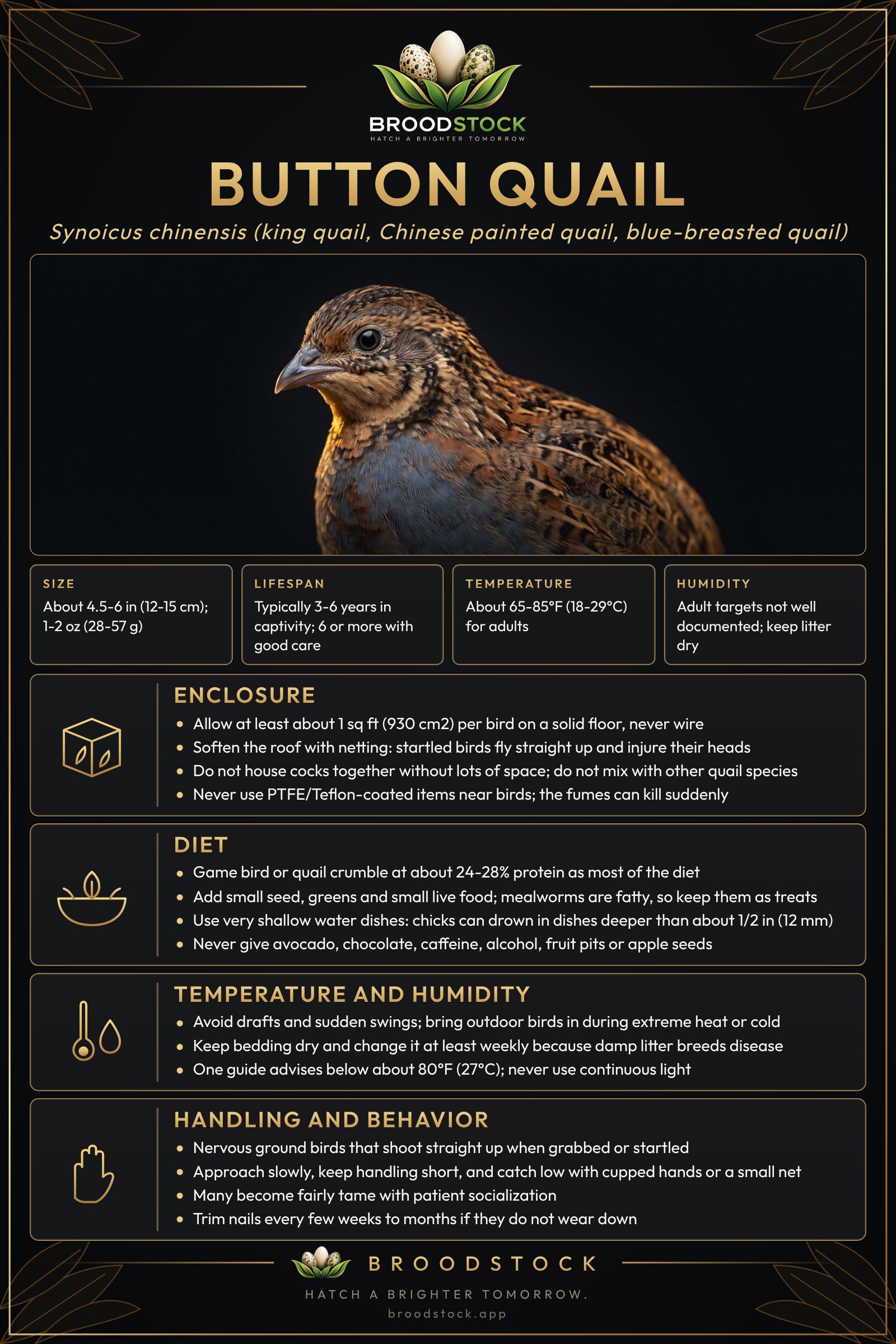
Print it or save it
The care sheet is a one-page summary you can print or keep on your phone. The full care text is below.
Keeping Button Quail? Broodstock tracks feeding, weights, sheds, enclosures and equipment for every animal you keep, and it is free to start.
Scientific name
Synoicus chinensis, also called king quail, Chinese painted quail and blue-breasted quail. The species has been placed in Coturnix, Synoicus and Excalfactoria at various times and now sits in Synoicus again, so older books and dealers often use Excalfactoria chinensis or Coturnix chinensis. Despite the hobby name, it is not a true buttonquail (Turnix).
Adult size
This is one of the smallest quail, about 4.5-6 in (12-15 cm) from head to tail and about 1-2 oz (28-57 g). Wild birds weigh about 1-1.4 oz (28-40 g), and captive lines are often heavier. Hens tend to be a little larger and plumper than cocks (cocks about 4.5 in, hens about 5 in).
Lifespan
Captive birds typically live about 3-6 years, 6 or more with good care, and some have reportedly reached 13 years.
Enclosure
Button quail live on the ground and do not perch. They run across the floor and shoot straight up when startled, which injures heads on hard roofs. Soften the roof with netting or artificial leaves fixed underneath. Provide at least about 1 sq ft (930 cm2) per bird; one pet care sheet calls for about 24 x 24 x 24 in (61 x 61 x 61 cm) per bird, with more for each extra bird.
Use a solid floor, since wire floors cause foot pressure sores, covered with paper, pine shavings, grass hay or soil. Avoid cedar. Give each bird a hide, plant cover or grass clumps, and a shallow dust bath. Classic setups include a 30-gallon long tank for a pair or trio, or the floor of a finch or small-parrot aviary, where they eat spilled seed and leave perching birds alone.
Males are territorial. The safest approach is one cock with a few hens; some aviary breeders keep 3-4 cocks with 6-10 hens in a large 3 x 8 ft (0.9 x 2.4 m) flight, but practices vary, and fights increase when new birds arrive. Quarantine newcomers for at least 30 days (USDA backyard poultry advice).
Never use PTFE/Teflon-coated items near birds, such as non-stick pans, drip pans, irons, heating elements and some heat lamps. Fumes from overheated PTFE can cause sudden death, even when the bird is in a different room.
Temperature
About 65-85°F (18-29°C) suits adults. One guide advises keeping them below about 80°F (27°C), and bringing outdoor birds inside in extreme heat or cold. Keep birds out of drafts and away from sudden swings.
Humidity
Humidity targets for adults in a room are not well documented. Replace bedding and litter at least weekly and keep it dry, as damp litter breeds disease. The birds clean their feathers by dust bathing, so provide a shallow tray of fine bird-safe sand or dust.
UVB
Not well documented. Unfiltered sunlight in a secure outdoor run is preferred when weather permits (glass blocks UV). One pet care sheet recommends a full-spectrum bird UV lamp for 10-12 hours a day indoors, replaced every 6 months. Avian vet evidence on UV lamps for birds is mixed, so a lamp is optional if the diet is a complete game bird ration.
Lighting
Pet birds get about 10-12 hours of light a day. Never run the lights around the clock.
Heating
Adults need no extra heat while the room stays within their comfort range. If you do use a heater, make it thermostat-controlled and leave a cooler area to move into.
Never use PTFE/Teflon-coated items near birds, such as non-stick pans, drip pans, irons, heating elements and some heat lamps. Fumes from overheated PTFE can cause sudden death, even when the bird is in a different room.
Diet
Base the diet on game bird or quail crumble at about 24-28% protein; it should make up most of the food (another guide says at least 60-70%). Many breeders add small seed (finch or millet mix), greens, and small live food such as mealworms or crickets. Mealworms are fatty, so treat them as treats. Take away uneaten fresh food within about 10 hours. Give fresh water daily in very shallow dishes.
Never give avocado, chocolate, caffeine, alcohol, fruit pits or apple seeds. Human foods high in salt, fat or sugar are also off limits.
Supplements
Laying hens need a soluble calcium source, such as crushed oyster shell in a small dish. Give insoluble grit sparingly: too much can cause blockages, and birds on crumble or kept outdoors may not need it. Multivitamins are generally unnecessary on a mostly pelleted game bird diet, though some breeders add vitamins to chick water.
Shedding
Molt timing is not well documented. If a hen starts growing feathers like a cock's, she may have an ovarian cyst or growth, and an avian vet should examine her.
Handling
These nervous ground birds shoot straight up when grabbed or startled. Approach slowly, handle briefly and catch them low with cupped hands or a small net. Many become fairly tame with patient socialization. If nails do not wear down on rough ground, trim them every few weeks to months.
Health signs to watch
Take the bird to an avian vet for: a fluffed, sleepy appearance; wheezing, fast breathing, or discharge from the eyes or nose; limping or head tilt; abnormal droppings or diarrhea; or a hen straining on the floor (egg binding).
Other problems include mites and lice, feather picking, candida (yeast), avian pox, overgrown beaks and nails, head injuries when birds fly up into hard roofs, and cock aggression toward hens and chicks. Water dishes deeper than about 1/2 in (12 mm) can drown chicks. Heavy metal poisoning from lead and zinc (galvanized wire) is possible, and PTFE fumes can cause sudden death.
Welfare
The main risks are chicks drowning in water dishes, head injuries from flying into hard roofs, and cocks fighting each other or overmating and pecking hens and chicks. Because hens can lay nearly every day, calcium depletion and egg binding are things to watch for. Do not house cocks together without ample space and cover. Do not mix them with other quail species. The inheritance and health effects of the many color mutations are not documented.
Keep every animal's care in one place
Log feedings, weights and sheds, set reminders, and let Ranger, the built-in AI manager, help with the rest. Free to start, no card needed.