
Broodstock / Care sheets / Caique
Caique Care Sheet
Pionites melanocephalus (black-headed caique); Pionites leucogaster (white-bellied caique)
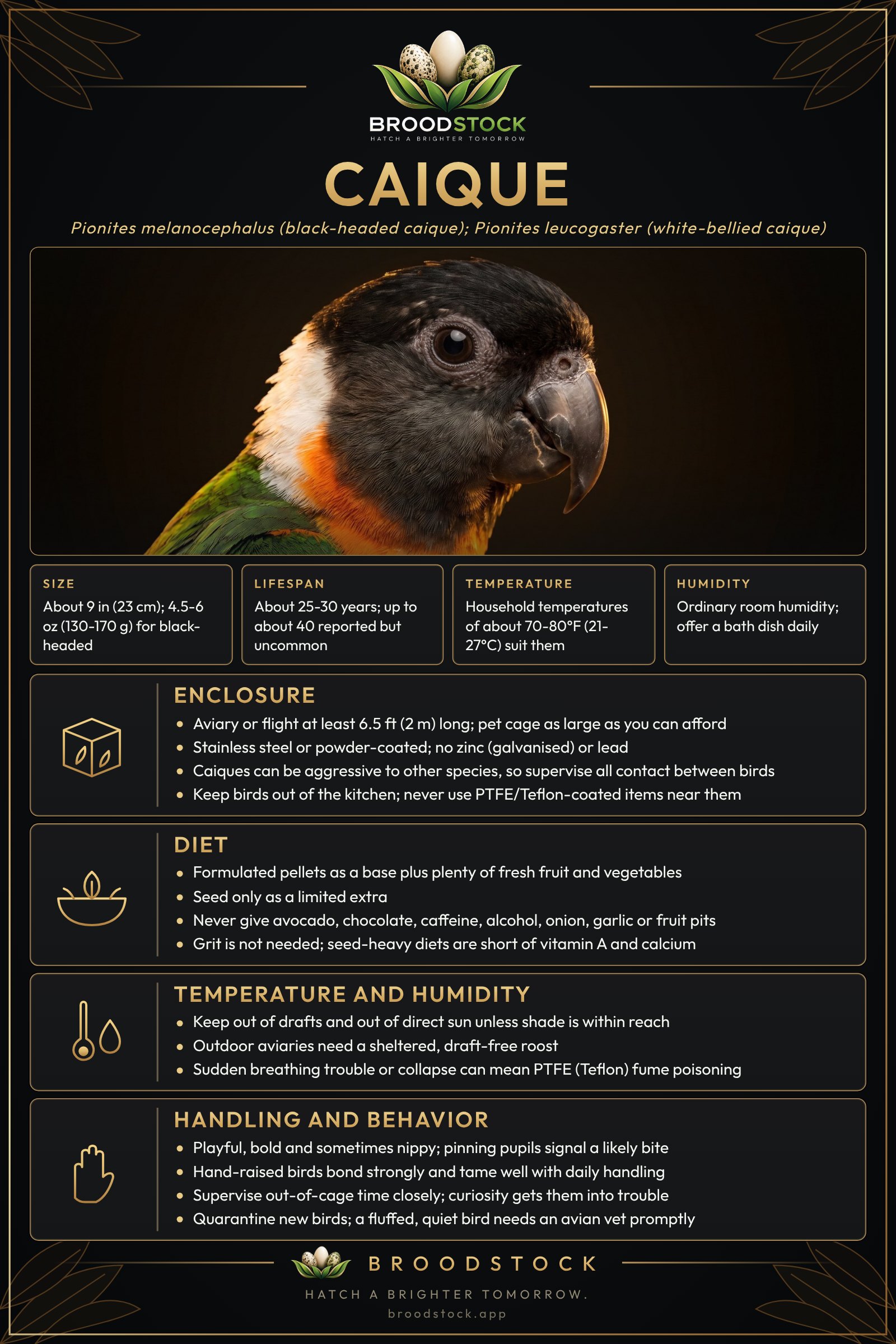
Print it or save it
The care sheet is a one-page summary you can print or keep on your phone. The full care text is below.
Keeping Caique? Broodstock tracks feeding, weights, sheds, enclosures and equipment for every animal you keep, and it is free to start.
Scientific name
Black-headed caique: Pionites melanocephalus. White-bellied caique: Pionites leucogaster.
Adult size
Length is about 9 in (23 cm). Black-headed birds weigh about 4.5-6 oz (130-170 g); white-bellied are similar or slightly heavier at about 5.5-6.3 oz (155-180 g), depending on the source. They have a stocky build and are heavy for their length.
Lifespan
Around 25-30 years is common in captivity, and up to about 40 years has been reported, though that is uncommon.
Enclosure
Caiques are very active and need room. Specialists recommend an aviary or suspended flight at least 6.5 ft (2 m) long. A pet cage should be the largest you can afford; one guide suggests about 2 ft wide x 3 ft high x 6 ft long (60 x 90 x 180 cm). Choose stainless steel or sturdy powder-coated, with a floor grate, bar spacing right for a medium parrot, and no zinc (galvanised) or lead.
Fill the cage with plenty of destructible toys, foot toys, bird-safe branches and ladders, and rotate them often. Caiques can be aggressive toward other species, so supervise all contact between birds. Two caiques can share a cage.
Keep birds out of the kitchen. Never use PTFE/Teflon-coated items (non-stick pans, some heat lamps, heaters, irons) near them, because the fumes can cause sudden death, even in another room.
Temperature
Normal household temperatures of about 70-80°F (21-27°C) are suitable, and healthy birds can handle a wider range. Keep them out of drafts and out of direct sunlight unless shade is within reach. A safe minimum outdoors is not well documented for caiques, so outdoor aviaries need a sheltered, draft-free roost.
Humidity
Caiques cope fine with ordinary room humidity. They love bathing, even in cold weather, so offer a deep bath dish every day or mist them. In very dry heated rooms, bathe them often to compensate.
UVB
Little is documented for caiques specifically. The best choice is unfiltered natural sunlight (an outdoor flight or open window, since glass blocks UVB) with shade available. For birds with no natural light, avian vets suggest a bird-specific full-spectrum/UVB lamp at the maker's distance, run on the normal day cycle. Keepers differ on whether lamps are needed indoors.
Lighting
Typical pet-bird practice is about 10-12 hours of darkness each night.
Heating
Never put heaters, heat lamps or appliances with a PTFE (Teflon) coating near birds.
Diet
Offer formulated pellets as a base, with plenty of fresh fruit and vegetables. Specialist keepers add sprouted seed, cooked beans and lentils, brown rice and fruit-heavy fresh food, with seed as a limited extra. In the wild, caiques take fruit pulp, seeds, flowers and a few insects.
Never give avocado, chocolate, caffeine, alcohol, onion or garlic, fruit pits or apple seeds. Human foods high in salt, fat or sugar are also off limits.
Supplements
A good pellet diet normally makes added vitamins unnecessary. Cuttlebone or a mineral block is common practice, and laying hens need enough calcium. Grit is unnecessary since parrots hull their seed. Seed-heavy diets run short of vitamin A and calcium, so offer orange and dark green vegetables and talk to an avian vet before adding a supplement.
Shedding
Adults molt gradually through the year. Have an avian vet look at patchy feather loss that is not a molt, and at chewed feathers.
Handling
Caiques are playful, high-energy and bold: they hop, roll on their backs and 'surf' on soft items. They can be stubborn and nippy, and pupils that pin (flash) signal a likely bite. Hand-raised birds bond strongly and usually tame well with consistent daily handling. Supervise time out of the cage closely, as curiosity gets them into trouble.
Health signs to watch
Watch for polyomavirus (caiques are reported to be especially susceptible, and chicks are most at risk), PBFD, psittacosis (Chlamydia, which can infect people), egg binding in hens, injuries from fights with other birds, and obesity on seed diets. Sudden breathing trouble or collapse may be PTFE (Teflon) fume poisoning.
Get an avian vet quickly for a bird that is fluffed and quiet, for any change in droppings, and for a hen straining on the floor. Quarantine new birds.
Welfare
Caiques are poor long-distance flyers but need plenty of climbing, play and chewing, and small cages cause suffering. Do not house them with other species without close supervision. The green-thighed white-bellied form (P. l. leucogaster) is treated as a separate species by BirdLife and the IUCN, and has been rated Vulnerable since 2021, although the IOC still lists it as a subspecies. Never mix forms you cannot identify. CITES lists them under Appendix II.
Keep every animal's care in one place
Log feedings, weights and sheds, set reminders, and let Ranger, the built-in AI manager, help with the rest. Free to start, no card needed.