
Broodstock / Care sheets / California Kingsnake
California Kingsnake Care Sheet
Lampropeltis californiae
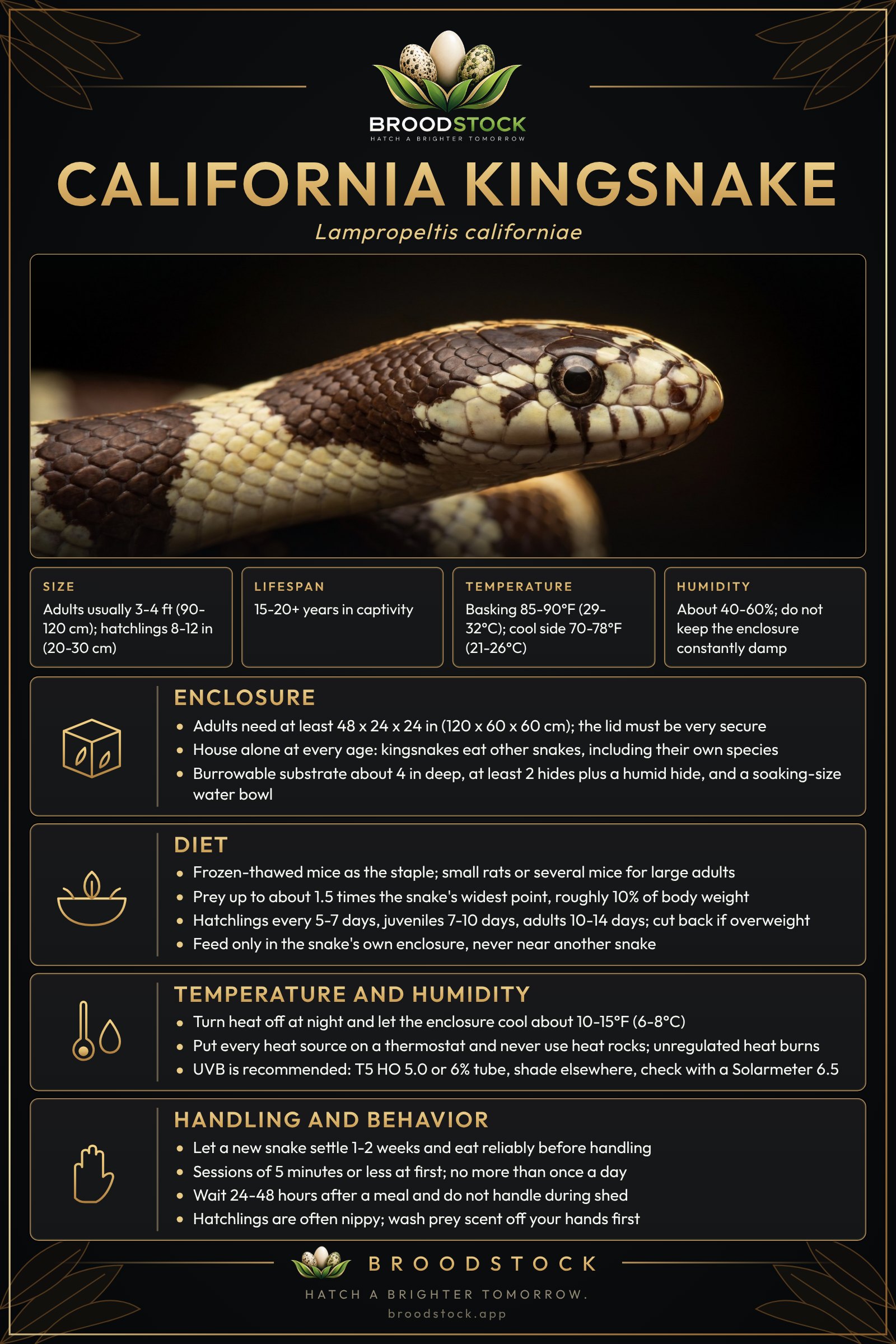
Print it or save it
The care sheet is a one-page summary you can print or keep on your phone. The full care text is below.
Keeping California Kingsnake? Broodstock tracks feeding, weights, sheds, enclosures and equipment for every animal you keep, and it is free to start.
Scientific name
Lampropeltis californiae
Adult size
Adults usually reach 3-4 ft (90-120 cm), and some occasionally exceed 5-6 ft. Hatchlings are about 8-12 in (20-30 cm).
Lifespan
In captivity 15-20+ years is common, and the captive record for the common kingsnake complex is about 33 years. Lifespans in the wild are far shorter.
Enclosure
Adults need at least 48 x 24 x 24 in (120 x 60 x 60 cm); more space is better, and adults over 4 ft need extra. Hatchlings can begin in a small secure enclosure (shoebox to 10 gal size) and move up as they grow. These snakes escape easily, so the lid must be very secure and latched.
Offer burrowable substrate about 4 in deep, at least 2 hides (warm and cool) plus a humid hide, and a water bowl big enough to soak in.
Keep every kingsnake by itself, juveniles included, since kingsnakes eat other snakes, their own species among them.
Temperature
Basking surface should be 85-90°F (29-32°C), with a cool side of 70-78°F (21-26°C). Turn heat off at night and let the enclosure cool by about 10-15°F (6-8°C), which usually lands at room temperature.
Humidity
Average about 40-60%, measured mid-enclosure; readings higher at night and on the cool end are normal. Give a humid hide with damp sphagnum, particularly before a shed. Do not let the enclosure stay damp all the time.
UVB
UVB is recommended but not strictly required on a whole-prey diet. Keepers differ on UVB for snakes, and many keep them healthy without it. Target Ferguson Zone 2 (partial sun, occasional basker): maximum UVI about 1.1-3.0 at the basking spot, with ReptiFiles aiming for 2.0-3.0. Use a T5 HO 5.0 or 6% tube that spans about half the enclosure, placed on the warm side, about 9-12 in above the basking surface over mesh or 14-17 in without mesh, with shade elsewhere. Check with a Solarmeter 6.5.
Lighting
Give about 12 hours of light a day, ideally following local sunrise and sunset through the year.
Heating
Overhead halogen heat lamps over the basking area work well (two 50 W halogen floods for an average enclosure, or a basking spot bulb if that runs too hot), controlled by a dimming or proportional thermostat. Alternatively, use a heat mat, cable or tape under one end on a thermostat, which is common in tubs and racks. Never use heat rocks. Put every heat source on a thermostat.
Diet
Frozen-thawed mice are the staple, moving to small rats or several mice for large adults. Size prey up to about 1.5 times the width of the snake at its thickest, roughly 10% of body weight. Feed hatchlings every 5-7 days, juveniles every 7-10 days and adults every 10-14 days (weekly is acceptable for lean adults; cut back if overweight, as kingsnakes are very food-driven). Let the meal digest before handling.
Kingsnakes naturally eat other snakes, so feed in their own enclosure only, never near another snake.
Supplements
Whole prey from rodents on a complete diet covers most needs, so supplements are optional. If you dust, do it lightly and only now and then (not every meal), with a single calcium plus multivitamin powder that contains D3. Under UVB, pick a low-D3 product such as Repashy Calcium Plus LoD or Arcadia RevitaliseD3. If there is no UVB, food is the only D3 source, so a regular-D3 powder is fine too, for example Repashy Calcium Plus or Zoo Med Reptivite with D3.
Females recovering after laying can be given extra plain calcium without D3 (Repashy SuperCal NoD or Zoo Med Repti Calcium without D3) for 4-6 weeks.
Never use more than one product containing D3 at once. Swap out powders roughly every 6 months.
Shedding
Dull skin and milky or bluish eyes, which clear a few days before the skin comes off, signal a coming shed. Do not handle the snake while it is in shed. Offer a humid hide; the shed should come off whole, including the eye caps (retained spectacles are a known kingsnake problem). Soak the snake and gently help with stuck shed, and never pull it off dry. Young snakes shed more often than adults. A typical shed interval for this species is not well documented.
Handling
Let a new snake settle for 1-2 weeks and feed reliably before you handle it. Begin with sessions of 5 minutes or less. Handle at least weekly, but no more than once a day. Wait 24-48 hours after a meal, and skip handling during shed. Hold the head, neck and body up with your hands. Hatchlings are often nippy and musk, though most settle with gentle, regular handling. Because kingsnakes have strong feeding responses, wash prey scent off your hands first.
Brumation
A winter cool-down is optional for pets, though LafeberVet recommends one for healthy animals. Condition the snake with extra meals for 6-8 weeks in late summer, then fast it for at least 14 days. Shorten the day to 8-10 hours over 2-3 weeks, then cool to about 50-60°F (10-16°C) for 8-12 weeks (roughly mid-November to mid-February), giving fresh water weekly and checking every 7-10 days. Warm it back up over 2-3 weeks before feeding. Use only healthy adults of good weight.
Health signs to watch
Hatchlings that refuse food, retained shed or eye caps, mites, obesity and burns from unregulated heat are all common worries. Respiratory infection shows as wheezing, nasal discharge or open-mouth breathing. Damp, dirty substrate can cause blister disease. Internal parasites are mostly found in wild-caught animals.
If a snake regurgitates mucus-covered prey a few days after eating and has a firm swelling mid-body, suspect cryptosporidiosis: quarantine it and see a vet. Egg binding means straining or restlessness with no eggs after 24-48 hours. Any of these calls for a reptile vet, as does food refusal combined with weight loss.
Welfare
Kingsnakes must be housed singly at every age because of cannibalism, and hatchlings are fed apart. This is native wildlife in California. Anyone there who breeds or sells native reptiles needs a Native Reptile Captive Propagation Permit, plus a numbered bill of sale for every sale, and captive reptiles cannot be released without state approval. Look up the rules in your own state as well.
Keep every animal's care in one place
Log feedings, weights and sheds, set reminders, and let Ranger, the built-in AI manager, help with the rest. Free to start, no card needed.