
Broodstock / Care sheets / Canary (Domestic Canary)
Canary (Domestic Canary) Care Sheet
Serinus canaria [var. domesticus]
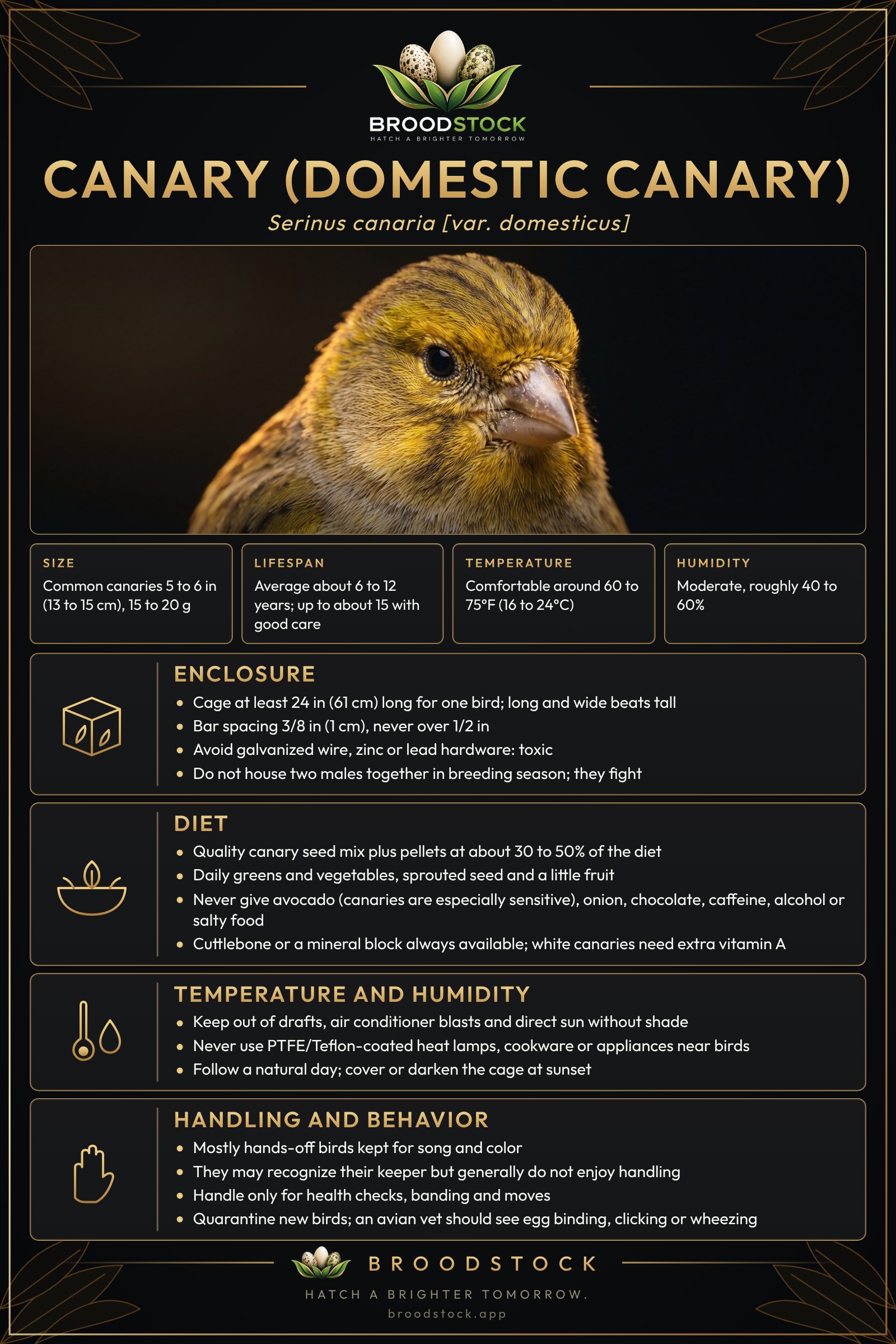
Print it or save it
The care sheet is a one-page summary you can print or keep on your phone. The full care text is below.
Keeping Canary? Broodstock tracks feeding, weights, sheds, enclosures and equipment for every animal you keep, and it is free to start.
Scientific name
Serinus canaria (domestic variety, var. domesticus)
Adult size
Common canaries measure about 5 to 6 in (13 to 15 cm) and weigh 15 to 20 g. Breeds vary from about 4 to 4.5 in (10 to 11.5 cm, Fife Fancy) to about 8 to 9 in (20 to 23 cm, Parisian Frill, Lancashire). Vets list a weight range of 12 to 30 g across breeds.
Lifespan
The average is about 6 to 12 years, and good care can stretch that to about 15.
Enclosure
A pet cage for one bird should be at least 24 in (61 cm) long; long and wide beats tall. Bar spacing should be 3/8 in (1 cm) and never above 1/2 in. Use perches of mixed diameter, roughly 3/8 to 3/4 in (1 to 1.9 cm), placed so droppings cannot fall into food.
Do not put two males in one cage during breeding season, because they fight. Avoid galvanized wire, zinc or lead hardware, which is toxic.
Temperature
Comfort range is around 60 to 75°F (16 to 24°C), so ordinary indoor room temperature is fine. Acclimated birds cope with cooler rooms. Keep them away from drafts, blasts of air conditioning and direct sun without shade.
Humidity
Moderate room humidity of roughly 40 to 60% suits them. Offer a shallow bath, about 1/4 in or 6 mm of room-temperature water, 2 to 4 times a week, or about once a week in cold winter rooms.
UVB
Not well documented. Best is some unfiltered outdoor sun with shade, as window glass filters UV. Avian vet evidence on UVB bulbs for birds is mixed, so a lamp is optional. If you use one, pick a bird-specific UVB lamp, avoid flickering fluorescent tubes, keep to the maker's distance (lamps very close can harm eyes) and replace it on schedule. Otherwise a diet with vitamin D3 (pellets) meets the need.
Lighting
Follow a natural day, covering or darkening the cage at sunset.
Heating
Room temperature should stay between 60 and 75°F (16 to 24°C). Move a sick or egg-bound bird to a warm, humid hospital cage at about 85°F (29°C). Never use nonstick (PTFE/Teflon) coated heat lamps, cookware or appliances near birds, since some heat lamps give off PTFE fumes.
Diet
Feed a quality canary seed mix alongside a pelleted canary diet, with pellets making up about 30 to 50% of the total. Add greens and vegetables daily (broccoli, kale, dandelion, watercress), sprouted seed, and a little fruit.
Never give avocado (canaries are named as especially sensitive), onion, chocolate, caffeine, alcohol or salty foods.
Supplements
Keep a cuttlebone or calcium/mineral block available at all times; hens especially need it before and during laying. Canaries do not require grit. Extra vitamin A is needed for white canaries. For red-factor birds, supply color food (canthaxanthin or beta-carotene) from conditioning right through the molt. Birds kept indoors get vitamin D3 from sunlight, UVB or a fortified diet.
Shedding
Canaries have one main molt a year, usually in mid-summer, lasting about 2 to 3 months; most males stop singing during it. Young birds complete a juvenile molt (body feathers only) within about 3 to 4 months of leaving the nest.
Handling
Canaries are mainly hands-off birds kept for song and color. They can learn to recognize their keeper but generally do not enjoy being handled. Pick them up only for health checks, banding and moves.
Brumation
Canaries do not hibernate. Their rest comes with the summer molt and the shorter days that follow.
Health signs to watch
Take the bird to an avian vet for any of these. Egg binding is an emergency, shown by straining and sitting fluffed on the floor. Air sac mites cause clicking, wheezing or open-mouth breathing, and canaries are among the birds most susceptible to them. Canary pox affects outdoor birds, and a vaccine exists. Young birds can get atoxoplasmosis and coccidiosis, and nestlings bacterial disease such as E. coli diarrhea.
Other conditions: avian gastric yeast (megabacteria), cataracts, male baldness, and feather cysts (lumps under the skin; inherited, most often in Gloster, Norwich and Border canaries). Keep new birds in quarantine.
Welfare
Feather cysts (lumps of ingrown feather) appear to be genetically linked and are most common in Gloster, Norwich and Border canaries. Recessive white canaries cannot convert the carotenoids in seed and greens into vitamin A, so their diet must include ready-made vitamin A.
Keep every animal's care in one place
Log feedings, weights and sheds, set reminders, and let Ranger, the built-in AI manager, help with the rest. Free to start, no card needed.