
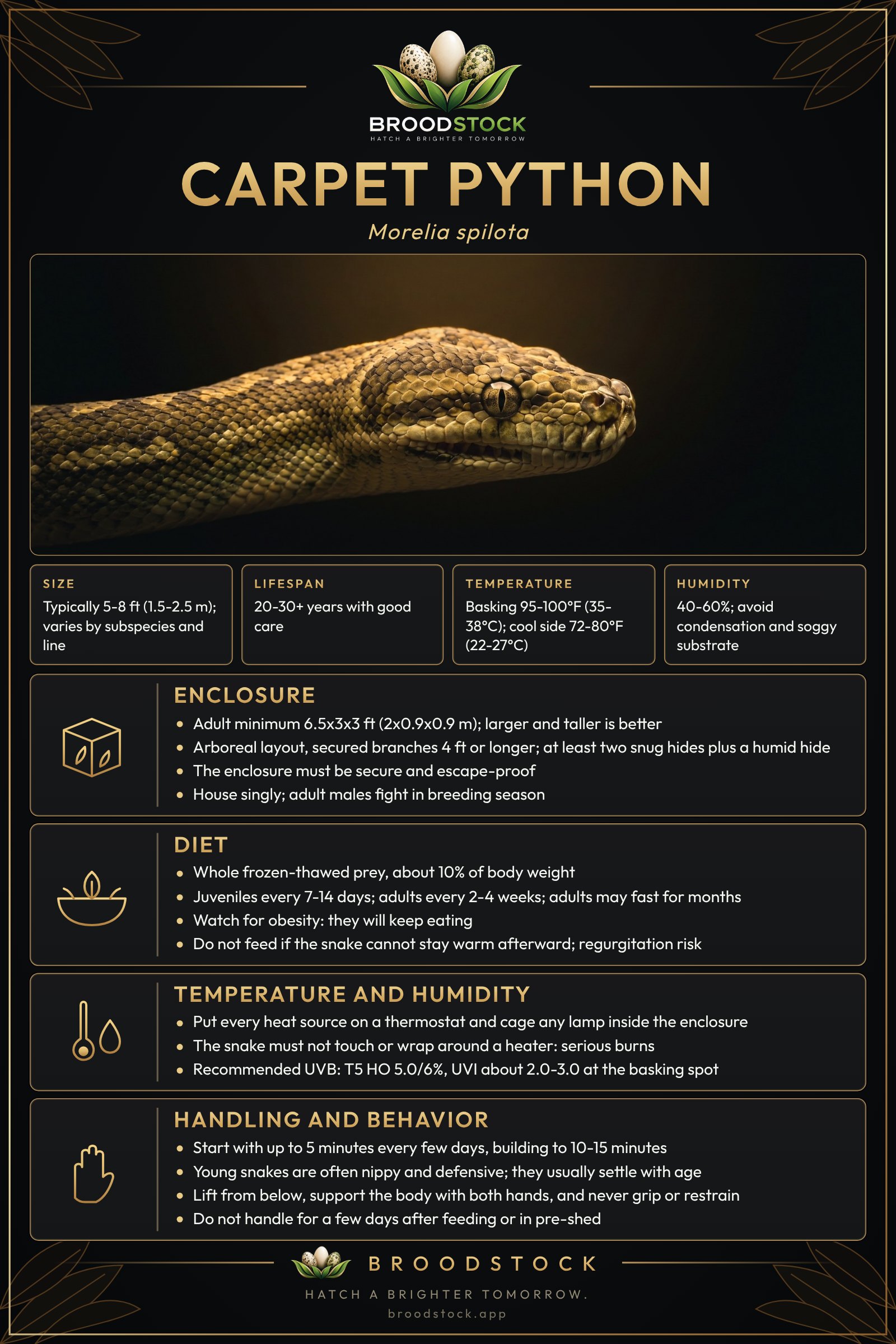
Print it or save it
The care sheet is a one-page summary you can print or keep on your phone. The full care text is below.
Keeping Carpet Python? Broodstock tracks feeding, weights, sheds, enclosures and equipment for every animal you keep, and it is free to start.
Scientific name
Morelia spilota
Adult size
Size varies greatly by subspecies and line. About 5-8 ft (1.5-2.5 m) is typical, and you should plan for roughly 6.5 ft (2 m) if parentage is unknown. The smallest form (M. s. variegata) reaches 4-6 ft (1.2-1.8 m), while the largest (M. s. mcdowelli) reaches 9-10 ft (2.7-3.0 m). Females are usually bigger than males, and in some regions much heavier; the largest snakes reach about 15 kg (33 lb).
Lifespan
A carpet python in good care lives 20-30+ years.
Enclosure
Adults need at least 6.5x3x3 ft (2x0.9x0.9 m); more length and height is better, such as 8x4x4 ft or larger for big adults. Older guides list much smaller cages (4x2x1 ft for adults, 3x2x2 ft for jungle and Irian Jaya), but current guidance favors the larger sizes above.
Set it up arboreal: sturdy, secured branches 4 ft or longer, perches near the heat, and foliage for cover. The enclosure must be secure and escape-proof. Use 2-4 in (5-10 cm) of a soil and sand mix topped with leaf litter, and give at least two snug hides plus a humid hide.
Hatchlings go in small tubs with a hide, water, heat and a climbing perch. Juveniles can move to the adult enclosure once settled, if it has plenty of hides. House carpet pythons singly, since adult males fight in breeding season.
Temperature
The basking surface under the lamp should be 95-100°F (35-38°C), and the cool side 72-80°F (22-27°C). At night keep 72-78°F (22-26°C), and do not let the warm end stay below 68°F (20°C) for long.
Humidity
Hold 40-60%. Mist as needed to stay in range (often 2-3 times a day in dry homes), letting surfaces dry between mistings, keep a humid hide available and mist more during shed. Condensation and soggy substrate signal poor ventilation and lead to illness, so avoid them.
UVB
Recommended: the snake can survive without it but does better with it. Most carpets fit Ferguson Zone 2. That includes M. bredli, while M. s. variegata is Zone 1-2 and the diamond python M. s. spilota is Zone 3. Aim for UVI about 2.0-3.0 at the basking spot, falling to 0 in shade. Use a T5 HO 5.0/6% tube (e.g. ReptiSun 5.0, Arcadia Forest 6%) in a reflector that spans about half the enclosure on the warm side. Mount it 9-11 in from the snake's back over mesh, or 12-15 in with no mesh. Replace it on the maker's schedule, usually 12 months.
Lighting
Give about 12-14 hours of light in summer and 10 hours in winter. A bright 6500K LED or T5 plant light across most of the enclosure is recommended.
Heating
Overhead heat should be the main source: halogen floods or a radiant heat panel; for example, start with two 50 W bulbs and add more as the snake grows. Put every heat source on a thermostat. Any lamp inside the enclosure must be caged, and the snake must not be able to wrap around or touch any heater, as this causes serious burns. Hatchlings in tubs get belly heat on a thermostat, available 24 h. Check the basking surface with an infrared thermometer.
Diet
Feed whole frozen-thawed prey: mice, rats, and for variety African soft-furred rats, hamsters, gerbils, quail or chicks. Choose prey at roughly 10% of body weight, with a width of at most 1.5x the thickest part of the snake. Juveniles eat every 7-14 days, adults every 2-4 weeks. Obesity is a risk, as they keep eating. Adults can fast for months, especially in winter.
Do not feed if the snake cannot stay warm afterward, because of regurgitation risk. Frozen-thawed is usually recommended, though some keepers feed live; practices vary.
Supplements
Supplements are optional, since whole prey covers the diet. You can occasionally dust thawed prey lightly with a 50/50 calcium and multivitamin mix. Under UVB use a low-D3 product (e.g. Repashy Calcium Plus LoD or Arcadia RevitaliseD3); without UVB use one with standard D3 (e.g. Repashy Calcium Plus). Do not combine D3 products. Beyond well-fed prey animals, no vitamin A or gut-loading is needed.
Shedding
Milky or blue eyes signal an approaching shed, so do not handle until it finishes. Mist more during shed. Stuck shed (dysecdysis) points to husbandry problems and calls for vet advice if it persists.
Handling
Begin with sessions of up to 5 minutes every few days and build to 10-15 minutes. Snakes under about 1-2 years old tend to be nippy and defensive, and most calm down as they age. First tap gently with a hook or paper towel tube, then lift from below and support the body with both hands. Never grip or restrain the snake. Skip handling for a few days after feeding and during pre-shed.
Health signs to watch
Go to a reptile vet if you see respiratory signs such as wheezing or mucus; mouth infection; stuck shed; regurgitation; diarrhoea or constipation; lethargy; burns; fasting that goes on outside the cool season; or abnormal movement or balance (neurological signs, with IBD one possible cause). Breeders often report neurological problems in the jaguar morph, but this is not well documented in published sources.
New snakes should be quarantined in a separate room for at least 6 months. Book vet checks every 6-12 months.
Welfare
The jaguar morph carries a neurological wobble (head tilt, poor coordination) that can be mild or severe. Commercial export of native reptiles is banned in Australia, which means animals elsewhere come from established captive lines.
Keep every animal's care in one place
Log feedings, weights and sheds, set reminders, and let Ranger, the built-in AI manager, help with the rest. Free to start, no card needed.