
Broodstock / Care sheets / Central Bearded Dragon
Central Bearded Dragon Care Sheet
Pogona vitticeps
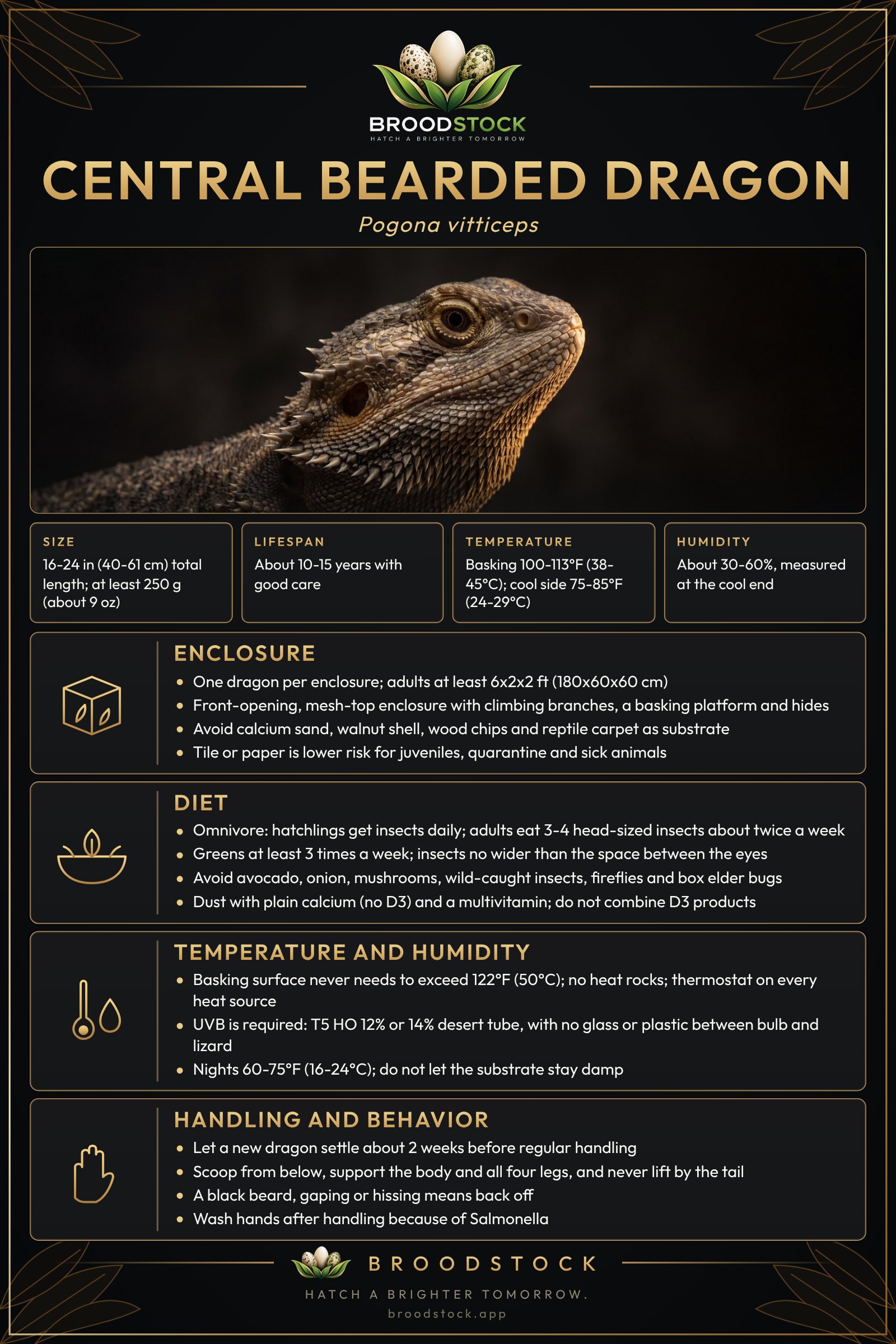
Print it or save it
The care sheet is a one-page summary you can print or keep on your phone. The full care text is below.
Keeping Central Bearded Dragon? Broodstock tracks feeding, weights, sheds, enclosures and equipment for every animal you keep, and it is free to start.
Scientific name
Pogona vitticeps
Adult size
Total length runs 16-24 in (40-61 cm), about half of it tail. Adults weigh at least 250 g (about 9 oz). Males are typically bigger with broader heads.
Lifespan
Good care gives them roughly 10-15 years. In practice 8-12 years is typical, and 20+ years happens only rarely.
Enclosure
Keep one dragon per enclosure. Adults need at least 6x2x2 ft (180x60x60 cm), or at least 24 cu ft, and up to 3 ft (90 cm) of height is useful for climbing. 4x2x2 ft works only for small adults under about 18 in (45 cm). Juveniles outgrow small tanks fast, so many keepers move them into the adult enclosure early. Choose a front-opening enclosure with a mesh top.
Substrate choice varies among keepers. A common naturalistic option is 4-6 in (10-15 cm) of a packed sand/soil mix (e.g. 50% fine sand, 30% topsoil, 20% excavator clay). Solid options such as tile or paper carry lower risk for juveniles, quarantine and sick animals. Avoid reptile carpet, wood chips, walnut shell and calcium sand as substrates. Add climbing branches, a basking platform and hides.
Temperature
Adults need a basking surface of 100-113°F (38-45°C), measured with an infrared temp gun. Many keepers aim for 108-113°F (42-45°C), but it never needs to go above 122°F (50°C). Keep the cool side at 75-85°F (24-29°C) and nights at 60-75°F (16-24°C). Add non-light night heat only if the room drops below about 60-65°F (16-18°C).
Humidity
Low to moderate, about 30-60% on average, measured at the cool end and usually at the low end by day. Short rises after misting or at night are normal. Do not let the substrate stay damp. Shedding goes better with a warm soak.
UVB
UVB is required. Target Ferguson zone 3 (open/partial sun basker, upper end): UVI about 4.0-4.5 at the basking spot, falling to 0 in shade. Hypomelanistic, translucent or silkback morphs should get no more than 3.0.
Use a T5 HO 12% or 14% desert tube covering about half the enclosure length on the basking side. Arcadia Desert 12% sits about 11 in above mesh, or 16-17 in with no mesh, and Arcadia Dragon 14% about 11-12 in above mesh, or 17-18 in with no mesh. Nothing of glass or plastic may sit between bulb and lizard. Replace T5 tubes every 12 months and check with a Solarmeter 6.5 where possible.
Lighting
Give 12-14 hours of light daily (about 14 is common). Late autumn and winter are when you can gradually shorten the day, particularly ahead of brumation. In addition to UVB, add bright 6500K daylight lighting across most of the enclosure.
Heating
For basking heat, use halogen flood bulbs over mesh (two side by side give a wider, more even zone) or an intense basking spot bulb. If ambient or night heat is needed, use a deep heat projector, radiant heat panel or ceramic heat emitter. Every heat source belongs on a thermostat: dimming/proportional for halogens, panels and DHPs, while on/off is acceptable for ceramic emitters. Measure the basking surface with an infrared temp gun. Do not use heat rocks.
Diet
Bearded dragons are omnivores, and insects make up less of the diet as they age. Hatchlings (0-3 months) get insects daily, as many as they eat, plus daily greens. Juveniles eat about 5-6 head-sized insects daily plus greens (about 3 times the insect volume), with roughly 60% protein. Subadults and adults take 3-4 head-sized insects about twice a week and greens at least 3 times a week (many vets advise daily), at about 15-30% protein; adult males need the least.
Insects should be no wider than the space between the eyes. Staples: dubia and discoid roaches, crickets, black soldier fly larvae, locusts. Superworms, mealworms, hornworms and waxworms are treats. For greens, use collard, mustard, turnip, endive, escarole, arugula or cactus pad, mixing in dandelion. Fruit is rare, if given at all.
Avoid avocado, onion, mushrooms, wild-caught insects, fireflies and box elder bugs, and limit spinach and other high-oxalate greens. Keepers differ on pinky mice, but if you offer them, do so about once a month at most.
Supplements
Dust insects and salads with plain calcium (no D3) at most feedings; do it at every feeding for hatchlings, juveniles and gravid females. Add a multivitamin with D3 and preformed vitamin A once a week for adults, and twice a week for hatchlings, juveniles and gravid females. Example pairings: Zoo Med Repti Calcium without D3 with Zoo Med Reptivite with D3; Repashy SuperCal NoD with Repashy SuperVite; Miner-All Outdoor with a multivitamin. Alternatively, a single all-in-one low-D3 calcium/multivitamin such as Repashy Calcium Plus LoD can be used alone, without a separate multivitamin.
With correct UVB, the D3 in these products is only a safety margin. Do not combine several D3 or vitamin A products. Gut-load the feeder insects for 1-3 days before they are eaten, using something like Repashy SuperLoad, Mazuri Better Bug or Arcadia InsectFuel. Practices vary, and some vet care sheets dust adults less often, with calcium about weekly and a multivitamin about monthly.
Shedding
Juveniles shed often and in patches as they grow, while adults shed less. Signs include pale or white patches, itchiness, reduced appetite and grumpiness. Warm baths and the right humidity both help, and skin that is already lifting can be loosened with a soft toothbrush. Skin that resists should never be pulled. Look at the toes and tail tip for shed that has stayed on. Bad sheds that are long or repeated point to husbandry or health problems, so see a reptile vet.
Handling
Give a new dragon about 2 weeks to settle before regular handling. Scoop from below, supporting the body and all four legs, and never lift by the tail. Slow movements and short, frequent sessions build trust. Back off if the beard turns black or the dragon gapes or hisses. Because of Salmonella, wash your hands afterward.
Brumation
Brumation is an optional seasonal rest, usually in adults over 1 year during late autumn and winter, lasting about 1-4 months (2-4 months is a common target). Keepers differ on it: some skip it with no reported harm. Many get a vet check and fecal test first. Stop feeding about 2 weeks before, reduce light and heat gradually (down to about 6 hours of light, then off), let temperatures fall to about 55-72°F (13-22°C), keep water available and weigh weekly. Stop and take the dragon to a reptile vet if it loses over 10% of its weight, does not wake or eat afterward, or becomes lethargic with discoloration.
Health signs to watch
Weigh weekly. Weight loss, not eating outside brumation, and lethargy are reasons for a vet visit. Gaping or wheezing suggests respiratory infection. A swollen jaw, soft or bent limbs, or tremors suggest metabolic bone disease. Runny, bloody or very smelly stool can mean parasites such as coccidia, and straining or no poop can mean impaction.
Other signs: mouth rot; yellow or brown crusty skin lesions (yellow fungus, CANV); a dark or shrivelled tail tip (tail rot); stuck shed on toes; and prolapse. A gravid female that is bloated, lethargic and not laying is an emergency (egg binding). Atadenovirus is common in the hobby, so ask breeders about testing.
Keep every animal's care in one place
Log feedings, weights and sheds, set reminders, and let Ranger, the built-in AI manager, help with the rest. Free to start, no card needed.