
Print it or save it
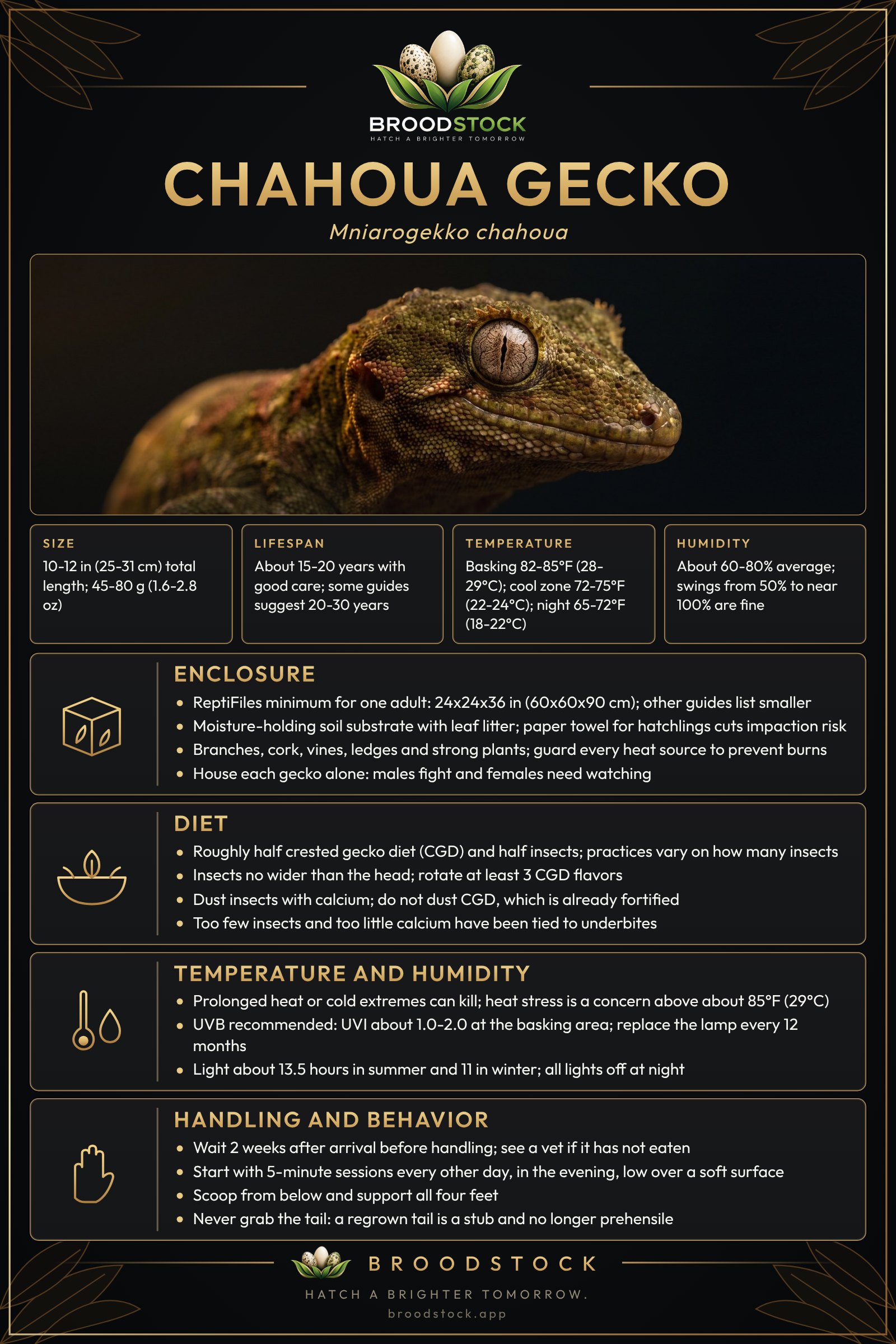
The care sheet is a one-page summary you can print or keep on your phone. The full care text is below.
Keeping Chahoua Gecko? Broodstock tracks feeding, weights, sheds, enclosures and equipment for every animal you keep, and it is free to start.
Scientific name
Mniarogekko chahoua
Adult size
Total length runs about 10-12 in (25-31 cm), and the tail is thick and prehensile. Snout-vent length has not been well recorded in care guides. Adult weight is roughly 45-80 g (1.6-2.8 oz), though figures differ between guides. Animals from Pine Island are often described as growing a little bigger than mainland ones.
Lifespan
With good care, expect roughly 15-20 years. Some guides suggest 20-30 years.
Enclosure
This is an arboreal gecko, so choose a front-opening enclosure. ReptiFiles sets the minimum for a single adult at 24x24x36 in (60x60x90 cm), and wider is better. Other guides list 18x18x24-36 in (45x45x60-90 cm), so keepers do not agree on the minimum.
Young geckos under about 12-20 g do better in a small grow-out enclosure of about 12x12x12 in (30 cm cube), with no heat or UVB lamps. Fit out adult enclosures with sturdy branches, standing cork, vines, ledges and strong plants.
Use a soil-type substrate that holds moisture, topped with leaf litter. Hatchlings are safer on paper towel, which lowers the risk of impaction.
Keep each gecko on its own. Males fight, and females need monitoring.
Temperature
Aim for a basking spot of 82-85°F (28-29°C), a cool zone of 72-75°F (22-24°C) and nights of 65-72°F (18-22°C). Do not let the enclosure stay far above 85°F (29°C) or below 65°F (18°C) for long, since prolonged extremes can kill.
Humidity
Average humidity of about 60-80% works. Swings from 50% up to nearly 100% now and then are fine. Mist each evening, and again in the morning if needed. Let the substrate dry a little between mistings, but it should never become bone dry or soggy. Put a water bowl on a ledge.
UVB
UVB is recommended. Chahouas can survive on D3 from their food, but ReptiFiles says they need UVB to thrive, while some breeders treat it as optional, so practices vary. Aim for UVI of about 1.0-2.0 at the basking area. Options are a T8 ReptiSun 5.0 in a reflector or an Arcadia ShadeDweller kit, with the basking branch at least 6 in (15 cm) below the lamp. A Solarmeter 6.5 is worth using to check the reading if you can. Replace the lamp every 12 months.
Lighting
One common schedule is about 13.5 hours of light in summer and 11 hours in winter. Other keepers run 10-12 hours and trim 2-4 hours for winter. Turn every light off overnight.
Heating
Place low-wattage white incandescent bulbs over the basking branch, run them through a dimmer or thermostat, and put a probe on the basking surface. ReptiFiles suggests two 40 W bulbs, but begin lower if your room is warm. Some guides advise against ceramic emitters and against red or blue bulbs. Guard every heat source so the gecko cannot get burned. If the room stays at about 72-78°F (22-26°C), you may need little or no added heat.
Diet
Chahouas are omnivores and depend on insects more than crested geckos do. ReptiFiles suggests roughly half crested gecko diet (CGD) and half insects. Juveniles (0-12 months) get CGD daily and insects every other day, while adults get both every other day. Other guides give adults insects only once a week, and some keepers raise them on CGD alone, so practices vary.
Offer CGD on a ledge on the wall. Insects should be no wider than the gecko's head: crickets, dubia, discoid and red-head roaches, locusts, hornworms. Rotate through at least 3 CGD flavors. In the wild, chahouas shift between fruit and insects with the seasons and may eat small lizards.
Supplements
CGD already has supplements added, so leave it undusted. Dust insects with calcium instead. With UVB, pick one without D3 (such as Arcadia CalciumPro Mg or Repashy SuperCal NoD); with no UVB, pick a calcium that contains D3. Check the product label for amounts. Females that are producing eggs need close calcium monitoring, because depletion can make them crash. Underbites in captive chahouas have been tied to too few insects and too little calcium.
Shedding
Shedding is not well documented for chahouas specifically. They shed in pieces and normally eat the skin. Keep humidity within range and look at the toes and tail tip for stuck shed. Never pull it off. If shed keeps sticking, review your husbandry or see a vet.
Handling
Usually they are calm and accept gentle handling now and then, although some stay shy. Give a new gecko 2 weeks to settle, and see a vet if it has not eaten by then. Each evening, rest a hand inside the enclosure for a few minutes. Then begin 5-minute sessions every other day and lengthen them over time. Scoop from underneath, support all four feet and let the tail wrap around. Handle in the evening, low over a soft surface. Chahouas seldom drop their tails, but a regrown tail is just a stub and is no longer prehensile, so never grab the tail.
Brumation
Chahouas do not brumate.
Health signs to watch
See a reptile vet for any of these: a soft, bent or underslung jaw, weak limbs or tremors (metabolic bone disease); a female that turns weak or thin while producing eggs (calcium crash); straining or failing to lay (egg binding); no eating 2 weeks after arrival; burns; bite or tail injuries from cage-mates or falls; and stuck shed. Heat stress is a concern when the room climbs above about 85°F (29°C).
Welfare
The IUCN lists the species as Vulnerable (2021). In the hobby, 'mainland' refers to Grande Terre (often shortened to GT) and 'Pine Island' to the Isle of Pines (PI). Pine Island animals are often said to be slightly larger. Hobby lore also gives them more white pattern and 'nicer' heads, and calls mainland animals brown or red, more bug-eyed and prone to underbites.
None of this holds up. White-marked mainland animals are documented, head shape overlaps, underbites are tied to diet, and the two are not treated as taxonomically distinct. Smuggling and poor records mean many locality claims cannot be checked, so only documented lineage counts.
Keep every animal's care in one place
Log feedings, weights and sheds, set reminders, and let Ranger, the built-in AI manager, help with the rest. Free to start, no card needed.