
Broodstock / Care sheets / Chinese Water Dragon
Chinese Water Dragon Care Sheet
Physignathus cocincinus, also called the green or Asian water dragon
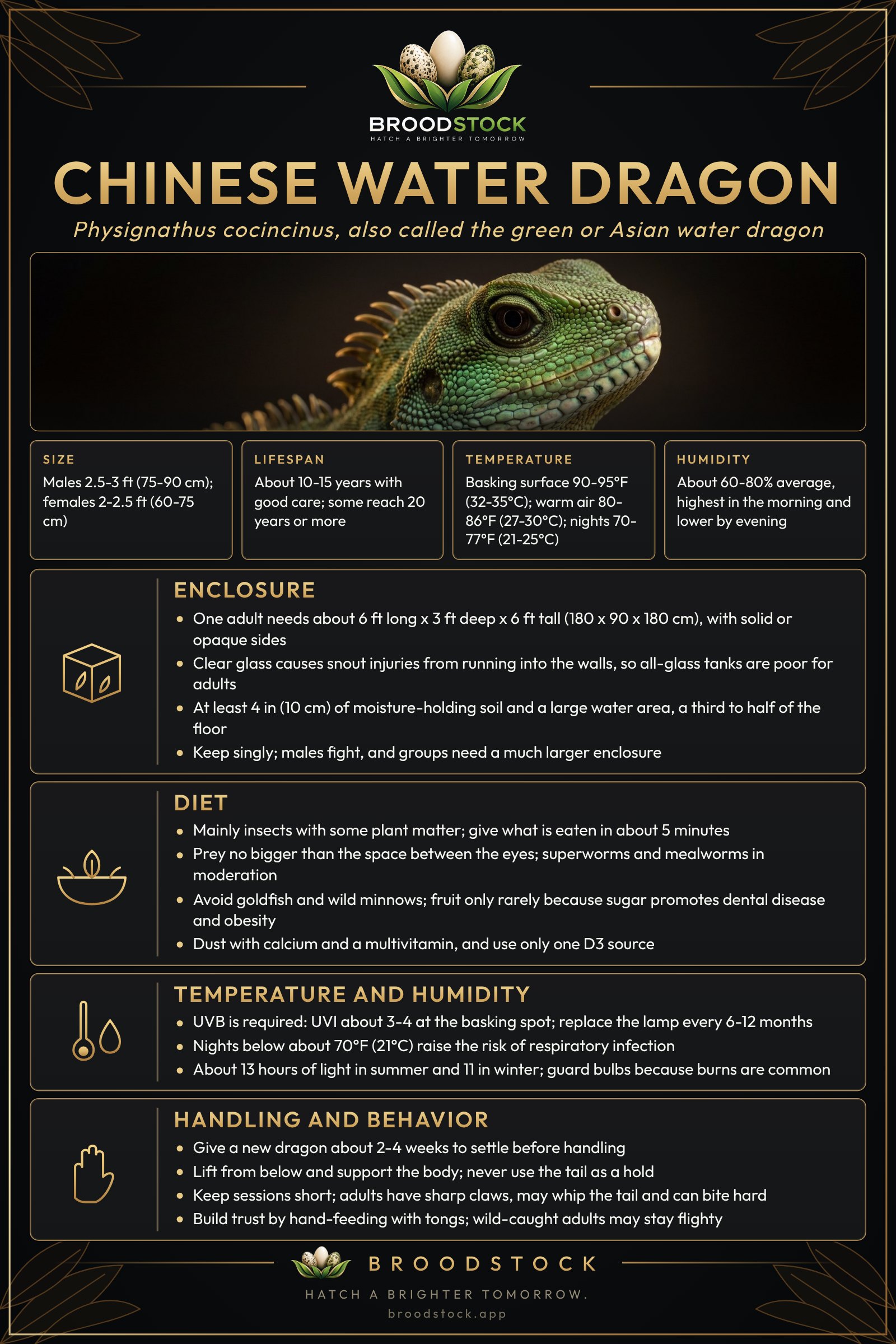
Print it or save it
The care sheet is a one-page summary you can print or keep on your phone. The full care text is below.
Keeping Chinese Water Dragon? Broodstock tracks feeding, weights, sheds, enclosures and equipment for every animal you keep, and it is free to start.
Scientific name
Physignathus cocincinus, also known as the green or Asian water dragon. The Australian water dragon, now Intellagama lesueurii, was once placed in the same genus and needs different care. The species comes from forest streams in southern China, Vietnam, Laos, Cambodia and eastern Thailand. The IUCN lists it as Vulnerable (assessment published 2019), and it has been on CITES Appendix II since 2023, largely because animals are taken for food and the pet trade.
Adult size
Males reach about 2.5-3 ft (75-90 cm) in total length, with the tail making up two-thirds or more of that. Females are smaller at about 2-2.5 ft (60-75 cm). Snout-vent length tops out near 10 in (25 cm) in males and 8 in (20 cm) in females. Males weigh up to about 1.3 lb (0.6 kg) and females up to about 0.55 lb (0.25 kg).
Lifespan
With good care expect about 10-15 years, and some animals reach 20 years or more.
Enclosure
Water dragons need a large, tall, humid enclosure with space to climb, bask and swim. Current guides call for at least about 6 ft long x 3 ft deep x 6 ft tall (180 x 90 x 180 cm) for one adult. Some older sources accept 4 x 2 x 5 ft (120 x 60 x 150 cm), but bigger is better.
Choose solid or opaque sides with a screened front. Water dragons often run into clear glass and injure their snouts, which makes all-glass tanks a poor choice for adults; grow tents and custom wooden enclosures are popular. Hatchlings can begin in about 2 x 2 x 4 ft (60 x 60 x 120 cm) or a 40-55 gal tank with three sides covered, and should move up quickly.
Lay at least 4 in (10 cm) of moisture-holding soil or soil mix. One source links coco coir used alone to eye irritation. Replace substrate every 2-4 months unless the setup is bioactive. Provide a big water area, from at least 6 in (15 cm) deep up to a filtered pond of 20-65 gal (75-245 L), covering a third to half of the floor. Add branches, vines and dense plants.
Dragons are usually kept alone. A pair, or a male with 2-3 females, needs a much larger enclosure, and males fight.
Temperature
The basking surface should be about 90-95°F (32-35°C). One older article uses hotter spots for adults, but most current guides stay within this range. Warm ambient air should be about 80-86°F (27-30°C) and the cool side about 75-80°F (24-27°C). Nights run about 70-77°F (21-25°C). Do not let nights fall below about 70°F (21°C), since that raises the risk of respiratory infection.
Humidity
Average about 60-80% (one vet source goes up to 90%). It should peak in the morning at about 75-80% and drift down to about 50-60% by evening. Mist morning and evening, and if needed run a cool-mist humidifier or fogger for a few hours before lights-on. Ventilate well: low humidity brings shedding and eye problems, while stale, wet enclosures cause scale rot and infections.
UVB
UVB is required. Use a strong linear T5 HO tube, such as a 10.0 or 12% desert lamp, covering about half the enclosure length in a reflective fixture on the heat side. Mounted over mesh, the lamp should sit about 11-15 in (28-38 cm) above the basking spot; inside the enclosure, about 16-20 in (40-50 cm). Aim for a UVI of about 3-4 at the basking spot, measured with a Solarmeter 6.5. Replace the lamp every 6-12 months depending on brand.
Lighting
Give about 13 hours of light in summer and 11 in winter, shifting gradually between them. Switch all lamps off at night. A bright 6500K LED or plant light across most of the enclosure encourages activity and supports live plants.
Heating
Cluster halogen flood bulbs over the basking branch on a dimming thermostat so the dragon can warm its entire body. Add a radiant heat panel or ceramic emitter on a thermostat for night heat only if nights drop below about 70-75°F (21-24°C). Avoid red bulbs, blue bulbs and heat rocks. Guard bulbs so the dragon cannot touch them, and check the basking surface with an infrared thermometer, because burns from bulbs mounted too close are common.
Diet
Water dragons eat mainly insects plus some plant matter. Hatchlings under about 3 months get insects daily. Juveniles under about 16 in/40 cm get insects and a small salad every other day. Subadults and adults get insects every 3-5 days with greens offered daily (one vet sheet feeds adults only once or twice a week). Give what is eaten in about 5 minutes.
Staples are dubia and discoid roaches, crickets, black soldier fly larvae, silkworms, hornworms, earthworms and snails, with superworms and mealworms in moderation. Keep prey no larger than the gap between the eyes. Greens include collard, mustard and dandelion greens, cactus pad, kale and bok choy.
Occasional treats include frozen-thawed silversides or other fish strips, live-bearing fish of known origin, and pinky mice. Avoid goldfish and wild minnows. Offer fruit rarely, since sugar promotes dental disease and obesity.
Supplements
Insects should be dusted with both calcium and a reptile multivitamin. One approach is a light coating of an all-in-one calcium plus multivitamin (for example Repashy Calcium Plus LoD) at most feedings. Another is plain calcium 1-2 times a week, with a multivitamin every 1-2 weeks for adults. Under strong UVB, choose a low-D3 product. Keepers do things differently here, so stick to a single D3 source. Feed insects a gut-load diet for 1-3 days before they go to the dragon. Females producing eggs need extra calcium.
Shedding
Water dragons shed in patches. Stuck shed (dysecdysis) is common in dry enclosures, especially on the toes, tail tip and around the eyes. Raise humidity, allow access to the pool and soak gently instead of pulling skin. Left alone, stuck shed may turn into mouth and toe infections.
Handling
Many dragons prefer to be left alone, and wild-caught adults can stay flighty; captive-bred animals usually tame better. Give a new dragon about 2-4 weeks to settle before you handle it. Build trust by hand-feeding with tongs. Then lift from underneath and support the body, and never use the tail as a hold. Short sessions are best. Adults have sharp claws, so gloves help, and they may whip their tails and can bite hard.
Brumation
This tropical species does not brumate, so the topic does not apply.
Health signs to watch
Rostral (nose) rubbing and snout injuries come from running into clear walls and can progress to mouth rot, jaw damage and loss of the snout. Move to solid-sided enclosures and treat wounds early. Metabolic bone disease results from weak UVB or low calcium and shows as a kinked tail or spine, bent limbs, tremors and hind-leg weakness.
Other risks are respiratory infection when kept too cool, eye infections from dry substrate or dirty water, scale rot from wet and dirty enclosures, dental and periodontal disease from sugary diets, burns from basking bulbs, obesity and fatty liver, and egg binding in females, particularly with calcium deficiency.
Wild-caught imports very commonly carry internal and external parasites, so get a fecal test and vet check for every new dragon. Water dragons can also drop their tails.
Welfare
Most water dragons on sale are still wild-caught imports, and they are often stressed, thin, parasitized and snout-damaged. With the species now Vulnerable in the wild and CITES-listed, captive-bred animals are the better choice. Many keepers underestimate how much space adults need: a very large, tall, humid enclosure with water for swimming. Snouts get hurt on clear glass walls.
Keep every animal's care in one place
Log feedings, weights and sheds, set reminders, and let Ranger, the built-in AI manager, help with the rest. Free to start, no card needed.