
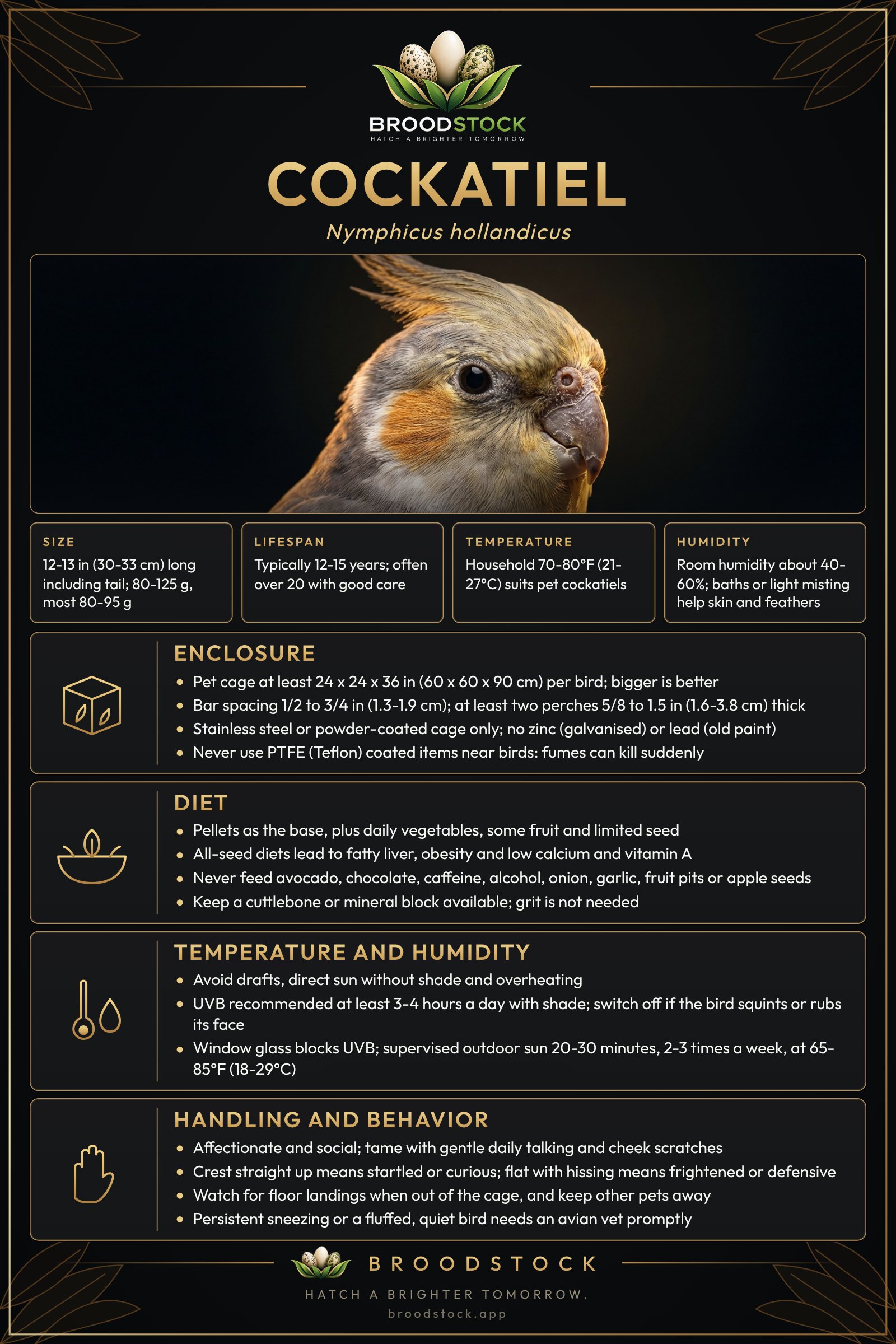
Print it or save it
The care sheet is a one-page summary you can print or keep on your phone. The full care text is below.
Keeping Cockatiel? Broodstock tracks feeding, weights, sheds, enclosures and equipment for every animal you keep, and it is free to start.
Scientific name
Nymphicus hollandicus
Adult size
Cockatiels measure about 12-13 in (30-33 cm) including the long tail, and weigh 80-125 g, most between 80-95 g.
Lifespan
Average care typically gives 12-15 years, and birds in good care often pass 20. Reports go up to about 25 years, with a record of about 36 years.
Enclosure
A pet cage should measure at least 24 x 24 x 36 in (60 x 60 x 90 cm) per bird. Vet minimums begin at 20-24 in (50-60 cm) in length and width, and bigger is better. Bar spacing should be 1/2 to 3/4 in (1.3-1.9 cm).
Provide at least two perches 5/8 to 1.5 in (1.6-3.8 cm) thick, placed so the bird can hop or glide between them. Do not use sandpaper perch covers. Choose a stainless steel or powder-coated cage that has no zinc (galvanised) or lead (old paint). Leaving a night light on helps head off night frights.
Temperature
Household temperatures of 70-80°F (21-27°C) suit pet cockatiels, and healthy birds cope with a wider range. Avoid drafts, direct sun without shade, and overheating. Outdoor aviaries need a sheltered, draft-free roosting area; a safe minimum outdoor temperature has not been well documented.
Humidity
Room humidity of about 40-60% is right. Cockatiels produce a lot of powder down, so regular baths or light misting help the skin and feathers and keep dust down.
UVB
UVB is recommended. Mount an avian UVB fluorescent tube or compact bulb above the cage for at least 3-4 hours a day, with shade available, at the distance the maker specifies, and replace it every 6 months. Turn it off if the bird squints, rubs its face or gets red around the eyes. It is especially helpful year round for chronic layers and for birds on mostly seed diets. UVB does not pass through window glass. Supervised time in outdoor sun is ideal: 20-30 minutes, 2-3 times a week, at 65-85°F (18-29°C).
Lighting
If a hen lays continually, she needs an avian vet, who may shorten her day to about 8 hours of light.
Heating
For an egg-bound or sick hen, use a hospital cage at about 85-90°F (29-32°C) and see an avian vet.
Never use anything with a PTFE (Teflon) coating, including non-stick pans, heat lamps and heaters, near birds. When overheated, PTFE releases fumes that can kill a bird suddenly, even if the bird is in another room.
Diet
Base the diet on formulated pellets, add vegetables daily and some fruit, and treat seed as a limited extra. A diet of seed alone is high in fat and low in calcium and vitamin A, which leads to fatty liver and obesity. Never feed any of these: avocado, chocolate, caffeine (coffee, tea), alcohol, onion, garlic, fruit pits, apple seeds, and salty, fatty or sugary human foods.
Supplements
Keep a cuttlebone or mineral block available at all times for calcium. Laying hens need more calcium, either from fortified food or as an avian vet advises. For vitamin A, rely on pellets and orange or dark green vegetables, since seed diets are short of it.
Pellets provide some vitamin D3. If you provide UVB, do not give extra oral D3 unless a vet advises it. Grit is unnecessary because cockatiels hull their seed, and sick birds may eat too much and become impacted.
Shedding
Cockatiels molt a couple of times a year, sometimes lightly and sometimes heavily, and can do so at any age. A first molt at about 4 months is normal. Adult colouring, and dependable visual sexing, appear after the first adult molt at about 6-12 months. Pearl cocks lose most of their visible pearling then but still carry the gene.
Handling
Cockatiels are affectionate and social, and become tame with gentle daily contact such as talking and cheek scratches. Learn to read the crest: straight up means startled or curious, flat (especially with hissing) means frightened or defensive, and slightly back with fluffed cheeks means relaxed. When the bird is out of its cage, watch for landings on the floor and keep other pets away.
Health signs to watch
Egg binding is an emergency: the hen sits on the floor, fluffed, with tail bobbing and straining. Related problems are chronic laying, soft-shelled eggs and yolk peritonitis. Other concerns are obesity and fatty liver on seed diets, vitamin A deficiency, psittacosis (Chlamydia, which can infect people), giardiasis, candidiasis, feather cysts, night frights, and feather plucking, which may be medical or stress-related. Lutino lines run into more health problems, and many carry a bald patch behind the crest.
Sudden breathing trouble or collapse can point to PTFE (Teflon) fume poisoning. A bird with persistent sneezing, coloured nasal discharge, or a fluffed-up, quiet look needs an avian vet promptly.
Welfare
Lutino and white/albino lines are reported to carry more health problems: night frights, weaker immunity, feather defects and a bald patch behind the crest. An older source also mentions some silver lines with poor eyesight or blind chicks.
Keep every animal's care in one place
Log feedings, weights and sheds, set reminders, and let Ranger, the built-in AI manager, help with the rest. Free to start, no card needed.