
Broodstock / Care sheets / Collared Lizard
Collared Lizard Care Sheet
Crotaphytus collaris, the common or eastern collared lizard
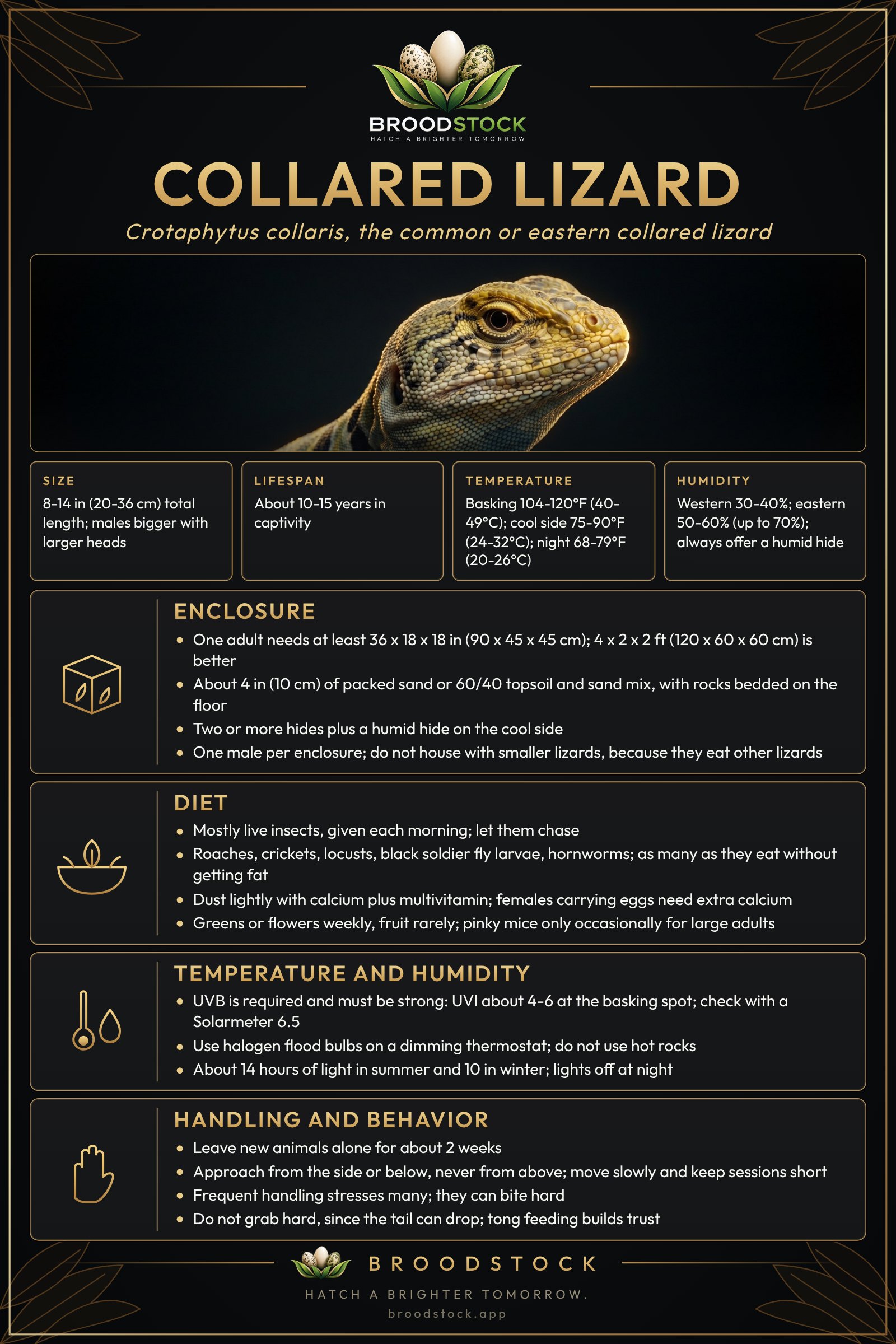
Print it or save it
The care sheet is a one-page summary you can print or keep on your phone. The full care text is below.
Keeping Collared Lizard? Broodstock tracks feeding, weights, sheds, enclosures and equipment for every animal you keep, and it is free to start.
Scientific name
Crotaphytus collaris, the common or eastern collared lizard, is a fast, ground-dwelling iguanian from dry, open, rocky country in the south-central and southwestern US (Missouri and Arkansas west to Arizona) and northern Mexico, and it can sprint on its hind legs. Several other Crotaphytus species are sold as collared lizards (one guide lists nine). Western populations and species need drier housing than eastern ones, so record the exact species and locality.
Adult size
Total length is about 8-14 in (20-36 cm), occasionally reaching about 15 in (38 cm). Males are bigger and have much larger, more muscular heads.
Lifespan
Captive animals live about 10-15 years (Animal Diversity Web), while ReptiFiles says over 10 years with good care. Lives in the wild are typically much shorter.
Enclosure
This is an active, fast lizard that needs floor space and heat. For one adult the minimum is about 36 x 18 x 18 in (90 x 45 x 45 cm, about a 40-gallon breeder). A size of 4 x 2 x 2 ft (120 x 60 x 60 cm) or larger is better, and a group needs more again. Choose a front-opening enclosure with a mesh top.
Fill it with about 4 in (10 cm) of packed sand or a 60/40 topsoil and sand mix for digging. Add stacked, stable rocks for basking and climbing, bedded on the floor so they cannot collapse. Provide two or more hides, plus a humid hide on the cool side.
Keep one male per enclosure; a male can share a larger enclosure with 1-3 females. Do not house them with smaller lizards or other species, because they eat other lizards.
Temperature
The basking surface should be about 104-120°F (40-49°C), the cool side about 75-90°F (24-32°C) and nights about 68-79°F (20-26°C). Use an infrared thermometer on the basking rock to measure.
Humidity
Western populations and species need low humidity of about 30-40%, with misting about once a week. Eastern C. collaris want about 50-60% (up to 70%), misted daily or every other day. A humid hide should be available whatever the population.
UVB
UVB is required and should be strong. ReptiFiles suggests an Arcadia Desert 12% T5 HO covering about half the enclosure length on the warm side, with the basking spot about 8-12 in (20-30 cm) below it over mesh or about 14-16 in (35-40 cm) if mounted inside, giving a UVI of about 4-6 at the basking spot. Dubia gives closer distances for a 22 in tube. Confirm with a Solarmeter 6.5 instead of relying on distance alone.
Lighting
Run a timer for about 14 hours of light in summer and 10 in winter, with all lights off at night. A 6500K daylight LED or T5 adds brightness.
Heating
Use halogen flood bulbs (for example two 50W) above a flat basking rock, on a dimming thermostat. Avoid ceramic heat emitters and red and blue bulbs as the main heat. Do not use hot rocks.
Diet
Collared lizards eat mostly insects, plus small vertebrates in the wild such as small lizards and occasionally snakes. Captive staples are roaches (dubia, discoid, red runner), crickets, locusts, black soldier fly larvae, hornworms, mealworms and superworms. Each morning give live insects, as many as they eat without getting fat, and let them chase. Young animals are fed more frequently and eat more relative to their size. Offer greens or edible flowers about once a week, and fruit rarely. Large adults may get occasional pinky mice or Reptilinks, though keepers differ on this.
Supplements
Use a calcium plus multivitamin product, for example Repashy Calcium Plus LoD or Arcadia EarthPro, as a light dusting on insects, and follow the label directions. Females carrying eggs need extra calcium.
Shedding
Shedding is not well documented here. Collared lizards shed in patches. Stuck shed on the toes suggests humidity is too low or there is no humid hide.
Handling
Leave a new animal alone for about 2 weeks. Captive-bred animals are far more tolerant than wild-caught ones, and juveniles are more skittish than adults. Come at the lizard from the side or from below, never from above, move slowly and keep handling short, since frequent handling stresses many of them. They can bite hard. Feeding with tongs helps build trust.
Brumation
Wild collared lizards hibernate through the winter. Adults may withdraw as early as late summer (about August) and come out again in spring.
Health signs to watch
Metabolic bone disease follows weak UVB and low calcium. Wild-caught animals often have parasites and may not settle in, so fecal-test and quarantine them. Males fight each other. The tail can drop if grabbed hard. Animals that have not eaten after about 2 weeks need a reptile vet.
Welfare
Most collared lizards for sale are still wild-caught, and captive-bred animals are limited. Buy captive-bred when you can, because wild animals carry parasites and stay stressed. Each US state and Mexico regulates wild collection, so check local laws before collecting, buying or selling. They need much more heat and UVB than many beginner lizards, plus room to run.
Keep every animal's care in one place
Log feedings, weights and sheds, set reminders, and let Ranger, the built-in AI manager, help with the rest. Free to start, no card needed.