
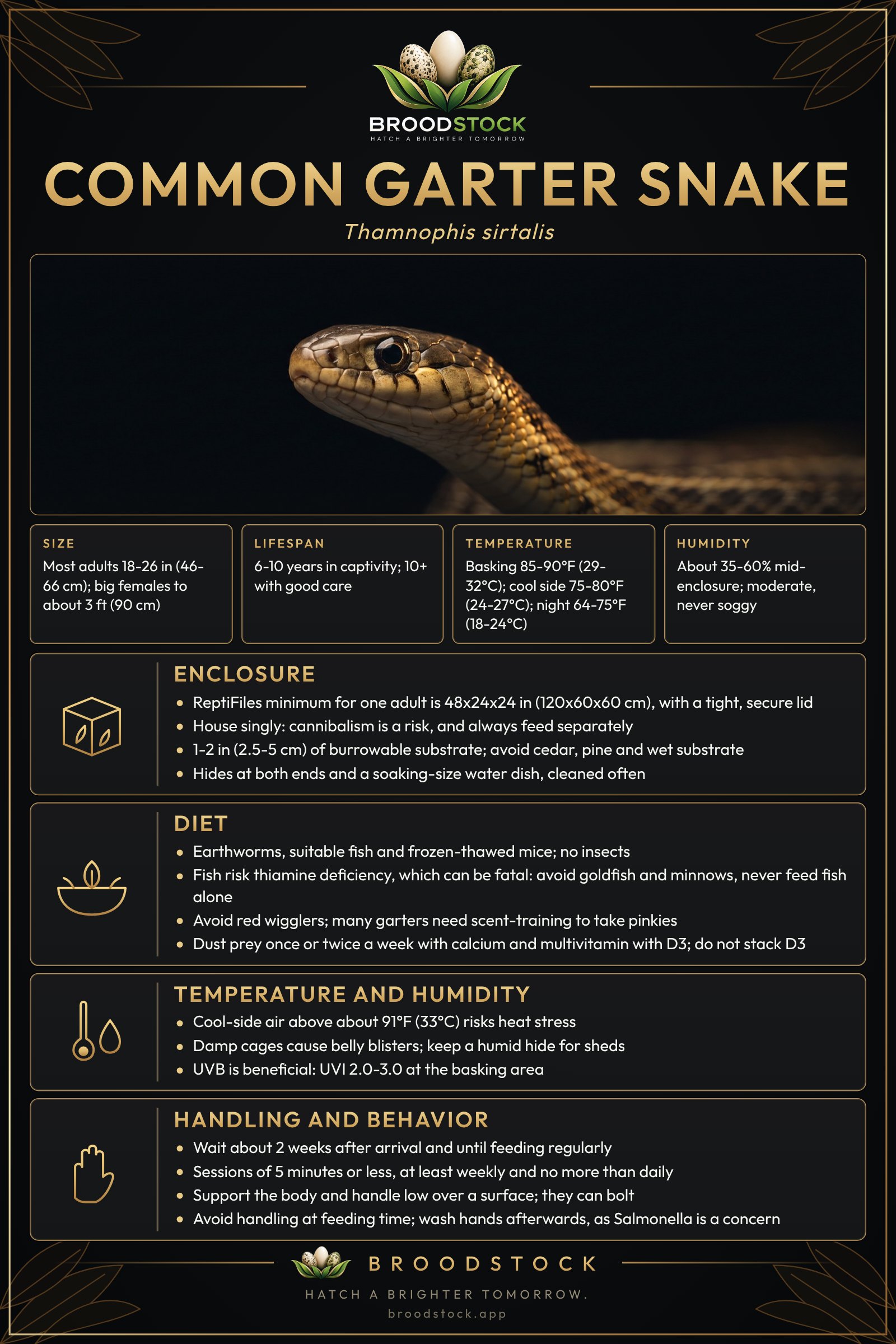
Print it or save it
The care sheet is a one-page summary you can print or keep on your phone. The full care text is below.
Keeping Common Garter Snake? Broodstock tracks feeding, weights, sheds, enclosures and equipment for every animal you keep, and it is free to start.
Scientific name
Thamnophis sirtalis
Adult size
Most adults measure about 18-26 in (46-66 cm) according to the Missouri Department of Conservation, and the maximum is about 54 in (137 cm). Animal Diversity Web gives an average of 34 in (88 cm) and about 5 oz (150 g), which only fits large animals. Size varies widely by subspecies and region. Females are larger and heavier, and big ones can reach about 3 ft (90 cm). Males are usually 2 ft (60 cm) or less, slimmer and longer-tailed. Newborns are about 5-9 in (12.5-23 cm).
Lifespan
In captivity 6-10 years is common and 10+ with good care, with about 20 years on record. In the wild they frequently last just a few years.
Enclosure
These are active, day-active snakes that escape easily, so use a secure, tight lid. ReptiFiles gives a minimum of 48x24x24 in (120x60x60 cm), at least 18 in (45 cm) tall, for one average adult. Reptiles Magazine gives a 40-gallon (150 L) equivalent minimum and 55 gallons (210 L) for a pair, so practices vary. Add space for every extra snake.
Some garter species can live in small groups of similar size, but ReptiFiles puts the common garter among those not to be housed together because of cannibalism. Housing singly is therefore the safer default. Keepers who do group them use a much larger enclosure and same-size snakes, so practices vary. Always feed them separately.
Use 1-2 in (2.5-5 cm) or more of absorbent, burrowable substrate: soil mix, aspen, coco husk or paper pellets. Avoid cedar, pine and wet substrate. Put hides at both ends, add climbing branches, and give a water dish big enough to soak in; clean it often because garters foul it.
Temperature
The basking surface should be 85-90°F (29-32°C), although Reptiles Magazine suggests up to 90-95°F (32-35°C). The cool side should be 75-80°F (24-27°C) and night 64-75°F (18-24°C). Air on the cool side that climbs past about 91°F (33°C) puts the snake at risk of heat stress. A winter dip is optional, with daytime around 60-68°F (16-20°C).
Humidity
Aim for about 35-60% mid-enclosure, higher at the cool end and at night. Keep it moderate and never soggy, since a damp or wet cage causes belly blisters. Garters soak often, particularly before a shed, so keep a soaking bowl; a humid hide also helps with sheds.
UVB
UVB is not essential when feeding whole prey, but it benefits this day-active snake. Target UVI 2.0-3.0 at the basking area, using a T5 HO 5.0/6% (ReptiSun 5.0 or Arcadia Forest 6%) over about half the enclosure on the warm side: 9-12 in (23-30 cm) away over mesh or 12-14 in (30-36 cm) without. If you do not use UVB, give a supplement that contains D3.
Lighting
ReptiFiles suggests about 14 hours of light in summer and 10 in winter, changed gradually. Use a bright 6500K LED or T5 HO plant light for general lighting, and switch lights off at night.
Heating
Cage overhead halogen basking lamps so the snake cannot touch them, as burns are a risk. For tubs, heat tape or a mat under one end works too. Put all heat on a thermostat. Newborn tubs can stay at about 75°F (24°C) room temperature; when the snakes move up to larger enclosures, add a warm spot of 85°F (29°C).
Diet
Garters eat whole prey and have a more varied diet than most snakes, but they do not eat insects. Staples are earthworms (rinsed, and chopped to head size for small or grouped snakes), suitable fish, and frozen-thawed mice from pinky size up. Avoid red wigglers (manure worms with pale rings), because garters often refuse them or bring them back up. For nightcrawlers, ReptiFiles advises against them while some long-time breeders use them as a staple, so practices vary.
Thiaminase is the big fish risk. Some fish carry an enzyme that destroys vitamin B1 (thiamine), and a diet heavy in them causes thiamine deficiency, which can be fatal. High-risk fish include goldfish, rosy red and fathead minnows, many shiners and smelt. The enzyme survives freezing, and WikiVet notes freezing can even raise its activity in some cases, which means frozen goldfish are no safer. Tilapia, trout and salmon are lower risk. Guppies and platies are widely used, but their thiaminase content is not well documented. If you feed fish often, rotate low-thiaminase species, avoid long frozen storage, heat the fish to destroy the enzyme (2 minutes in boiling water, or about 5 minutes at 176°F (80°C)) and cool before feeding, and/or add a vitamin B1 or B-complex supplement. Never feed fish alone. Live pet-store feeder fish and wild-caught fish or amphibians can carry parasites, so frozen-thawed or quarantined fish from a good supplier are safer.
Frozen-thawed mice alone are complete nutrition and can be fed less often, but many garters must be scent-trained. Cut small pieces of pinky and mix them with chopped worm or fish so the snake picks up the scent (about 30 minutes), or rub the pinky with fish or worm. Present it from tongs with movement, then reduce the scent until plain pinkies are accepted. Some snakes switch at once while others take weeks.
Prey can be up to about 1.5x the snake's widest point or about 10% of body weight; worms and fish go several at a time. Newborns eat every other day to every 2-3 days, juveniles every 3-5 days, and adults every 4-7 days, with mouse eaters needing it least often.
Supplements
Diets built on worms and fish need supplementing. Dust prey lightly, once or twice a week, with a calcium and multivitamin powder that has D3 and preformed vitamin A (for example Repashy Calcium Plus). Snakes fed mice need little or none. If fish are a regular part of the diet, add vitamin B1 or B-complex support, and ask a reptile vet for the dose. Do not stack D3 products.
Shedding
Fast-growing young snakes go through shed frequently. A dull color and cloudy blue eyes signal an upcoming shed, and the snake soaks more beforehand. Provide the soaking bowl and a humid hide, and do not peel the skin. Stuck shed points to dehydration or low humidity, and persistent problems need a reptile vet.
Handling
Garters are quick and wriggly. Wild-caught snakes and some captive-born babies are defensive, striking and musking, but most captive garters calm down with regular handling. Wait about 2 weeks after arrival and until the snake is feeding regularly. Begin with sessions of 5 minutes or less, at least weekly and no more than daily. Let the snake crawl onto your hand and support its body. Handle low over a surface because they can bolt. Avoid handling at feeding time, and wash your hands afterwards.
Brumation
Wild common garters hibernate together from about late October to March-April. Pets do not need this. ReptiFiles uses only a mild winter dip, with daytime 60-68°F (16-20°C) and about 10 hours of light.
Health signs to watch
Thiamine deficiency from thiaminase fish shows as incoordination, slow or missed strikes, tremors, head tilt, stargazing, rolling and seizures. It needs urgent vet care, and injected thiamine often brings fast recovery if caught early. Damp cages cause belly blisters and skin infection. Wild-caught snakes, live feeder fish and wild amphibians can bring internal parasites. Heat stress occurs above about 91°F (33°C), and unguarded lamps cause burns. Rodent-only diets can lead to obesity. As with all reptiles, Salmonella is a concern. New snakes should be quarantined.
Welfare
Fish-only diets and goldfish or minnow feeders are a well-known cause of preventable illness and death in captive garters, so build the diet around worms and rodents. Some garters are protected, including the endangered San Francisco garter snake (T. s. tetrataenia), and many states regulate collecting or keeping native garters. Check state laws, keep subspecies and locality records, and never release captives.
Keep every animal's care in one place
Log feedings, weights and sheds, set reminders, and let Ranger, the built-in AI manager, help with the rest. Free to start, no card needed.