
Broodstock / Care sheets / Common Kingsnake
Common Kingsnake Care Sheet
Lampropeltis getula complex (L. getula, L. floridana, L. holbrooki, L. splendida, L. nigra; formerly all subspecies of L. getula)
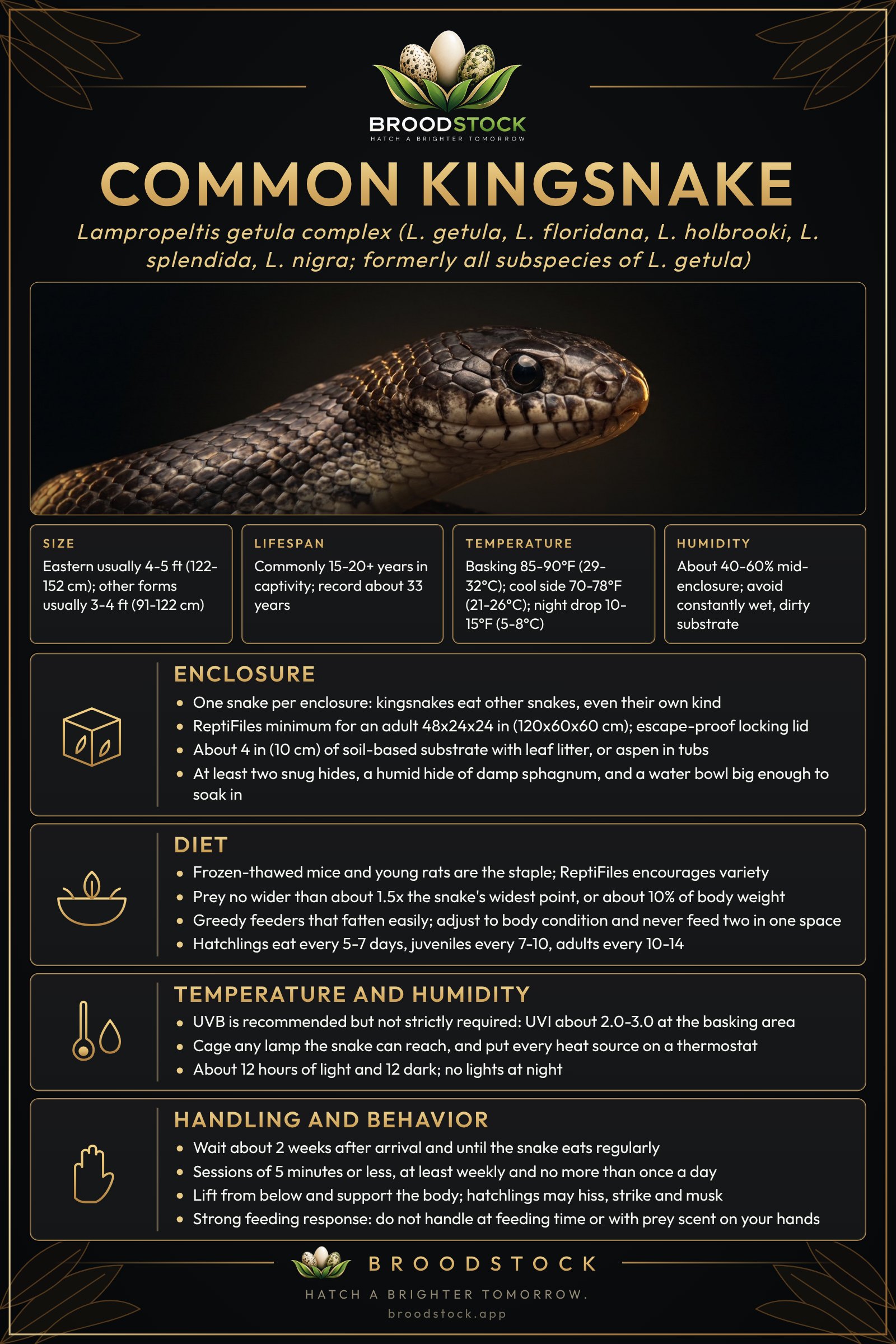
Print it or save it
The care sheet is a one-page summary you can print or keep on your phone. The full care text is below.
Keeping Common Kingsnake? Broodstock tracks feeding, weights, sheds, enclosures and equipment for every animal you keep, and it is free to start.
Scientific name
Lampropeltis getula complex: L. getula, L. floridana, L. holbrooki, L. splendida and L. nigra, all formerly subspecies of L. getula. The California kingsnake (L. californiae) is covered separately.
Adult size
Size depends on the form. The eastern kingsnake (L. getula) is the largest, usually 4-5 ft (122-152 cm) and up to about 6 ft (1.8 m), with a record near 82 in (208 cm). Speckled (holbrooki), Florida-type (floridana), black (nigra) and desert (splendida) kings typically reach 3-4 ft (91-122 cm). They are heavy-bodied, and adult weight varies widely and is not well documented. Animal Diversity Web gives about 3-5 lb (1,360-2,270 g) for large eastern adults, and smaller forms weigh much less. The larger sex is often the male. Hatchlings measure about 7-11 in (18-28 cm) and 9-14 g.
Lifespan
In captivity 15-20+ years is common (LafeberVet says 15+, ReptiFiles 20+). Reports of 25+ years exist, and the captive record is about 33 years. Wild snakes rarely live beyond about 9 years.
Enclosure
Keep one snake per enclosure, since kingsnakes eat other snakes, including their own kind. ReptiFiles sets the minimum for an average adult at 48x24x24 in (120x60x60 cm), with more room for eastern kings over 4 ft (1.2 m). A vet information sheet lists a 20-gallon long (75 L) as a bare minimum and breeders commonly use rack tubs, so practices vary. Hatchlings can live in a shoebox-size tub with a snug hide. Use an escape-proof, locking lid.
For substrate, use about 4 in (10 cm) of a soil-based mix (for example topsoil, coco fiber and play sand) topped with leaf litter, or aspen in tubs; aspen breaks down if it gets wet. Provide at least two snug hides (warm and cool), a humid hide of damp sphagnum, and a water bowl big enough to soak in. Spot-clean daily and replace all substrate every 3-4 months.
Temperature
The basking surface over the warm hide should be 85-90°F (29-32°C) and the cool side 70-78°F (21-26°C). Across the whole enclosure, LafeberVet describes a gradient of 70-85°F (21-29°C). At night turn the heat off or down; a drop of about 10-15°F (5-8°C) from daytime is normal. Read the basking surface with an infrared thermometer and the warm hide with a digital probe.
Humidity
Keep humidity at about 40-60% measured mid-enclosure, higher at the cool end and at night. Offer a humid hide of damp sphagnum, replaced before it molds, and a water bowl big enough to soak in; mist more during a shed. Constantly wet, dirty substrate should be avoided because it is linked to blister disease (pustular dermatitis).
UVB
UVB is not strictly required on a whole-prey diet, but ReptiFiles recommends it. Aim for UVI about 2.0-3.0 at the basking area, falling to 0 in the shade. Use a T5 HO 5.0/6% (ReptiSun 5.0 or Arcadia Forest 6%) over about half the enclosure length on the warm side, in a reflector fixture. Mount it about 9-12 in (23-30 cm) from the snake's back over mesh, or 14-17 in (36-43 cm) with no mesh. Measure with a Solarmeter 6.5 if possible and replace according to the maker. Practices vary, as many breeders house kingsnakes in racks with no UVB at all.
Lighting
Provide about 12 hours light and 12 dark, ideally following local sunrise and sunset. During a winter cool-down, cut back toward about 8 hours or darkness. For a display enclosure, a bright 6500K LED spread over most of the space is the recommendation. Keep lights off at night.
Heating
In display enclosures, place overhead halogen flood bulbs over a flat stone on top of the warm hide. ReptiFiles suggests starting with two 50 W and adjusting wattage to reach the target. Cage any lamp the snake can reach. For racks and tubs, use heat tape or a heat mat under one end. Put every heat source on a thermostat.
Diet
Kingsnakes eat whole prey. Frozen-thawed mice and young rats are the staple, and ReptiFiles encourages variety: African soft-furred rats, hamsters, gerbils, chicks, young quail, quail eggs and Reptilinks. In the wild they take other snakes (including venomous species), lizards, rodents, birds and eggs. Choose prey no wider than about 1.5x the snake's widest point, or about 10% of body weight.
Hatchlings eat every 5-7 days, juveniles every 7-10 days and adults every 10-14 days (LafeberVet says adults take 1-3 mice once a week). Kingsnakes are greedy and fatten easily, so adjust to body condition. Use tongs, and never feed two kingsnakes in the same space. Frozen-thawed is the usual advice, while some keepers feed live, so practices vary. A small number of hatchlings turn down pinkies at first and need scented prey.
Supplements
Supplements are optional because whole prey covers the diet. If you want to, occasionally dust thawed prey with a 50/50 calcium and multivitamin mix, or an all-in-one such as Repashy Calcium Plus or Arcadia RevitaliseD3. Under UVB, pick a low-D3 product so D3 does not stack up. Never combine D3 products.
Shedding
Growing juveniles shed every few weeks and adults less often. Watch for dull color, blue or milky eyes, hiding and poor appetite. Offer the humid hide and soaking bowl, and do not handle or peel the snake. Vets see stuck shed and retained eye caps among the most common kingsnake problems; they point to low humidity or dehydration, and persistent cases need a reptile vet.
Handling
Kingsnakes usually settle well, though hatchlings may hiss, strike, rattle the tail and musk. Hold off for about 2 weeks after arrival, and until it is eating regularly. Begin with sessions of 5 minutes or less, at least weekly and no more than once a day. Let it crawl onto your hand, lift it from below and support its body. The feeding response is strong, so do not handle at feeding time or with prey scent on your hands, and wait 1-2 days after a meal.
Brumation
Pet kingsnakes do not need a winter cool-down, though LafeberVet recommends one for healthy animals. A typical schedule starts with a last meal about 2 weeks ahead and 7-14 days of warmth so the gut empties. Then lower temperatures over 1-2 weeks to about 50-60°F (10-16°C). Guides range from 50-65°F (10-18°C), and many keepers hold a steady 55°F (13°C). Cut the light to about 8 hours, or to darkness.
Hold the cool period for 8-12 weeks (about 60-90 days) with water always available and checks at least weekly. Rewarm over 10-14 days (usually late January-February), and give food within about a week of reaching full temperatures. Cool only healthy, well-weighted snakes, and remove any that lose noticeable weight or look unwell.
Health signs to watch
LafeberVet lists these common problems: refusing food, stuck shed and retained eye caps, egg binding, internal parasites (mainly in wild-caught snakes), and blister disease from damp, dirty substrate. Also watch for respiratory signs (wheezing, mucus, open-mouth breathing), mites, regurgitation, obesity, and bite wounds if snakes were ever put together. Quarantine new snakes, and get a fecal check on wild-caught animals.
Welfare
Never house kingsnakes together; they will eat cagemates and even mates. Before you collect, keep or sell native kingsnakes, check state wildlife laws. Captives must never be released.
Keep every animal's care in one place
Log feedings, weights and sheds, set reminders, and let Ranger, the built-in AI manager, help with the rest. Free to start, no card needed.