
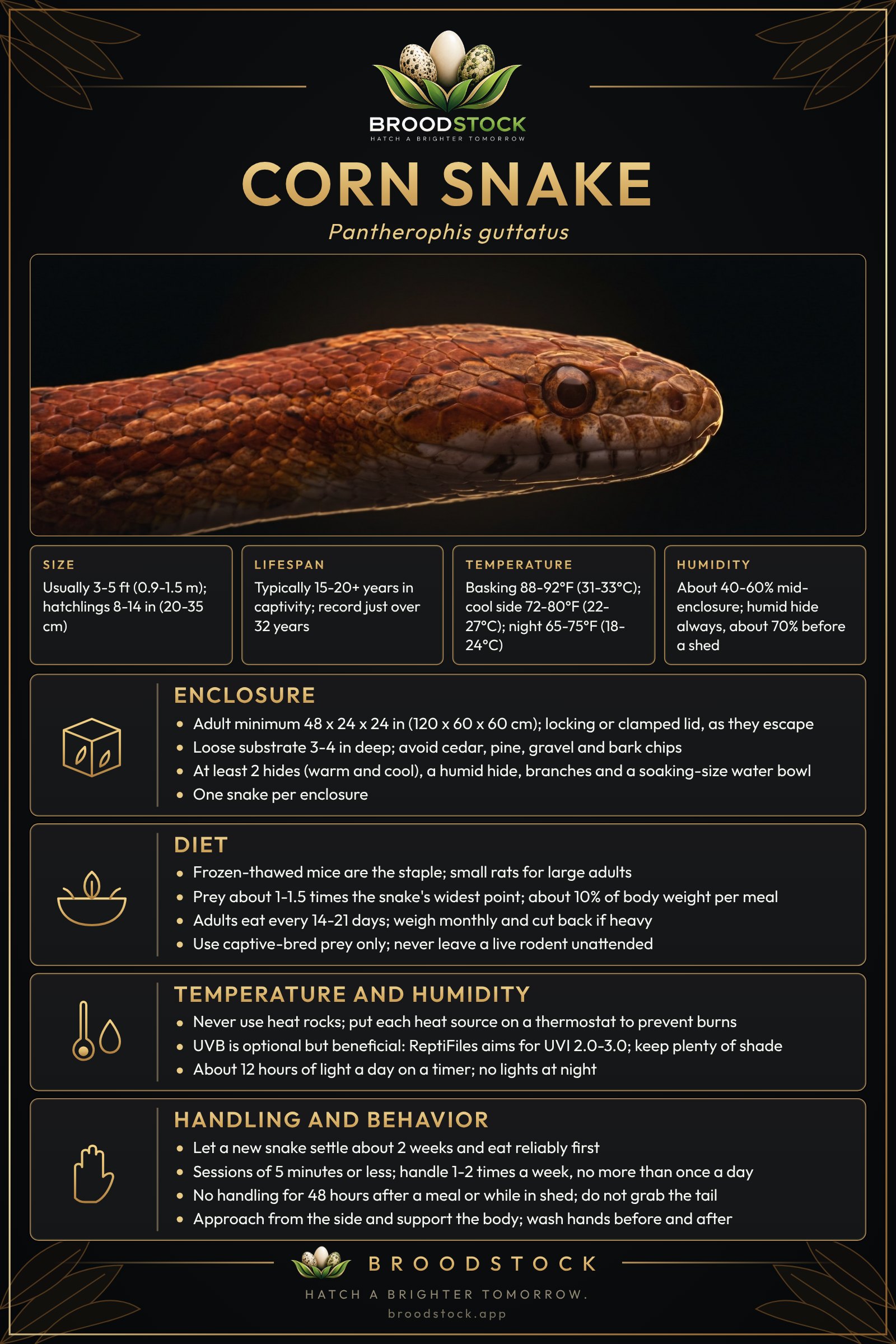
Print it or save it
The care sheet is a one-page summary you can print or keep on your phone. The full care text is below.
Keeping Corn Snake? Broodstock tracks feeding, weights, sheds, enclosures and equipment for every animal you keep, and it is free to start.
Scientific name
Pantherophis guttatus
Adult size
Adults are usually 3-5 ft (0.9-1.5 m), though individuals range from about 2 ft to 6 ft. Hatchlings measure about 8-14 in (20-35 cm). Average adult mass is about 900 g, but many adults weigh less.
Lifespan
Captive corn snakes typically reach 15-20+ years, often pass 20 and may reach about 25. The longest captive record is just over 32 years.
Enclosure
The adult minimum is 48 x 24 x 24 in (120 x 60 x 60 cm). Corn snakes climb, so go larger and taller when you can. Snakes under a year can start in a smaller, secure tank with many tight hides. Choose a front-opening or locking enclosure with a clamped lid, because corn snakes are escape artists.
Use loose, burrowable substrate 3-4 in deep: topsoil/sand mix or coconut fiber, or aspen in dry climates. Avoid cedar, pine, gravel and bark chips. Provide at least 2 hides (warm and cool) plus a humid hide, climbing branches and a water bowl large enough to soak in. Keep one snake per enclosure.
Temperature
Basking surface should be about 88-92°F (31-33°C), with the cool side about 72-80°F (22-27°C). At night the enclosure can fall to room temperature, about 65-75°F (18-24°C), but hatchlings under a year should stay at the warmer end overnight. Use probe thermometers at both ends.
Humidity
Aim for about 40-60% on average, measured mid-enclosure; higher readings at night and on the cool end are normal. Keep a humid hide (damp sphagnum) available at all times, and especially before a shed (around 70% in the hide). Higher ambient humidity is fine provided the enclosure is ventilated and the substrate does not stay soggy.
UVB
UVB is not strictly required, since corn snakes do well on whole prey without it, but it is recommended as beneficial. Keepers differ on UVB for snakes, and many keep them healthy without it. Under the Ferguson Zone 1 model (crepuscular, shade dweller), maximum UVI is about 0.6-1.4 at the basking spot, whereas ReptiFiles aims higher at UVI 2.0-3.0. A T5 HO tube should span about half the enclosure over the warm side, and the snake needs plenty of shade.
For UVI 2-3, ReptiFiles gives distances to the snake's back: Zoo Med ReptiSun 5.0 or Arcadia Forest 6% at 10-14 in over mesh or 14-18 in without mesh; Arcadia ShadeDweller MAX at 4-6 in over mesh or 6-8 in without. To hit the lower Zone 1 target, mount the tube further away and verify the reading with a Solarmeter 6.5. Change the tube once a year, every 12 months.
Lighting
Give about 12 hours of light a day, or optionally 13 in summer and 11 in winter. Use a timer and keep lights off at night.
Heating
Put overhead halogen or incandescent heat lamps (usually two bulbs, sized to the enclosure) over the basking area, on a dimming or proportional thermostat. A ceramic heat projector can warm the cool end. A heat mat under a hide works as a secondary source, or a primary one in tubs and racks, always on a thermostat. Never use heat rocks. To prevent burns, put each heat source on a thermostat.
Diet
The staple is frozen-thawed mice, with small rats for large adults and optional variety such as quail chicks. Size prey at about 1-1.5 times the snake's widest point, totalling about 10% of body weight per feeding. Hatchlings (pinkies) eat every 5-7 days, juveniles every 7-10 days, subadults every 10-12 days and adults every 14-21 days, adjusted to body condition.
Defrost prey in the fridge and then warm it to about 100°F (38°C). Use only captive-bred prey. Offer live prey only if a snake refuses frozen-thawed, and never leave a live rodent unattended. Weigh the snake monthly, and reduce feedings if it gets heavy.
Supplements
Whole prey from rodents on a complete diet covers most needs, so supplements are optional. If you dust, do it lightly and only now and then, not at every meal, using a single calcium plus multivitamin powder with D3. Under UVB pick a low-D3 one such as Repashy Calcium Plus LoD or Arcadia RevitaliseD3. When there is no UVB, the only D3 is what the food supplies, so a standard-D3 powder is also fine, for example Repashy Calcium Plus or Zoo Med Reptivite with D3. For 4-6 weeks, a female recovering after laying can be given extra plain calcium with no D3 (Repashy SuperCal NoD or Zoo Med Repti Calcium without D3). Never use more than one D3-containing product at once, and swap out powders about every 6 months.
Shedding
Hatchlings and juveniles shed about every 4-6 weeks, adults about every 3 months. Signs are dull skin, blue or cloudy eyes, hiding, reduced appetite and more defensiveness. A good shed comes off whole, including the eye caps and tail tip. For stuck shed, use a humid hide or a warm shallow soak and then help gently; never pull dry skin. See a vet if eye caps stay on or shed problems keep recurring, which often means humidity is too low.
Handling
Let a new snake settle for about 2 weeks and eat reliably before you handle it. Begin with sessions of 5 minutes or less and build up; handle 1-2 times a week and no more than once a day. Do not handle for 48 hours after a meal or while the snake is in shed (blue eyes). Approach from the side, support the body and do not grab the tail. Hatchlings may strike or musk, while adults are typically docile. Wash your hands before and after.
Brumation
A winter cool-down is optional for pets. Cool only healthy, well-fed adults, never hatchlings or underweight snakes. Fast about 2 weeks so the gut empties, shorten the day, then cool gradually to about 55-60°F (13-16°C) for about 8-12 weeks with water available, checking weekly. Rewarm gradually and resume feeding once temperatures are normal. In the wild corn snakes brumate roughly October to April, briefly or not at all in the far south.
Health signs to watch
Watch for respiratory infection (wheezing, open-mouth breathing, bubbles or mucus at the nose), retained shed and eye caps, mites, mouth infection, prolapse, obesity, and burns from unregulated heaters.
Regurgitation deserves attention, especially mucus-covered prey a few days after eating with a firm swelling mid-body: this may be cryptosporidiosis, so quarantine the snake and see a vet. Egg binding looks like a female straining or restless for more than 24-48 hours without laying.
Weigh regularly, as sudden weight loss often means illness. Any of these, or food refusal combined with weight loss, calls for a reptile vet.
Welfare
Welfare studies specific to corn snakes were not found.
Keep every animal's care in one place
Log feedings, weights and sheds, set reminders, and let Ranger, the built-in AI manager, help with the rest. Free to start, no card needed.