
Broodstock / Care sheets / Coturnix Quail (Japanese Quail)
Coturnix Quail (Japanese Quail) Care Sheet
Coturnix japonica
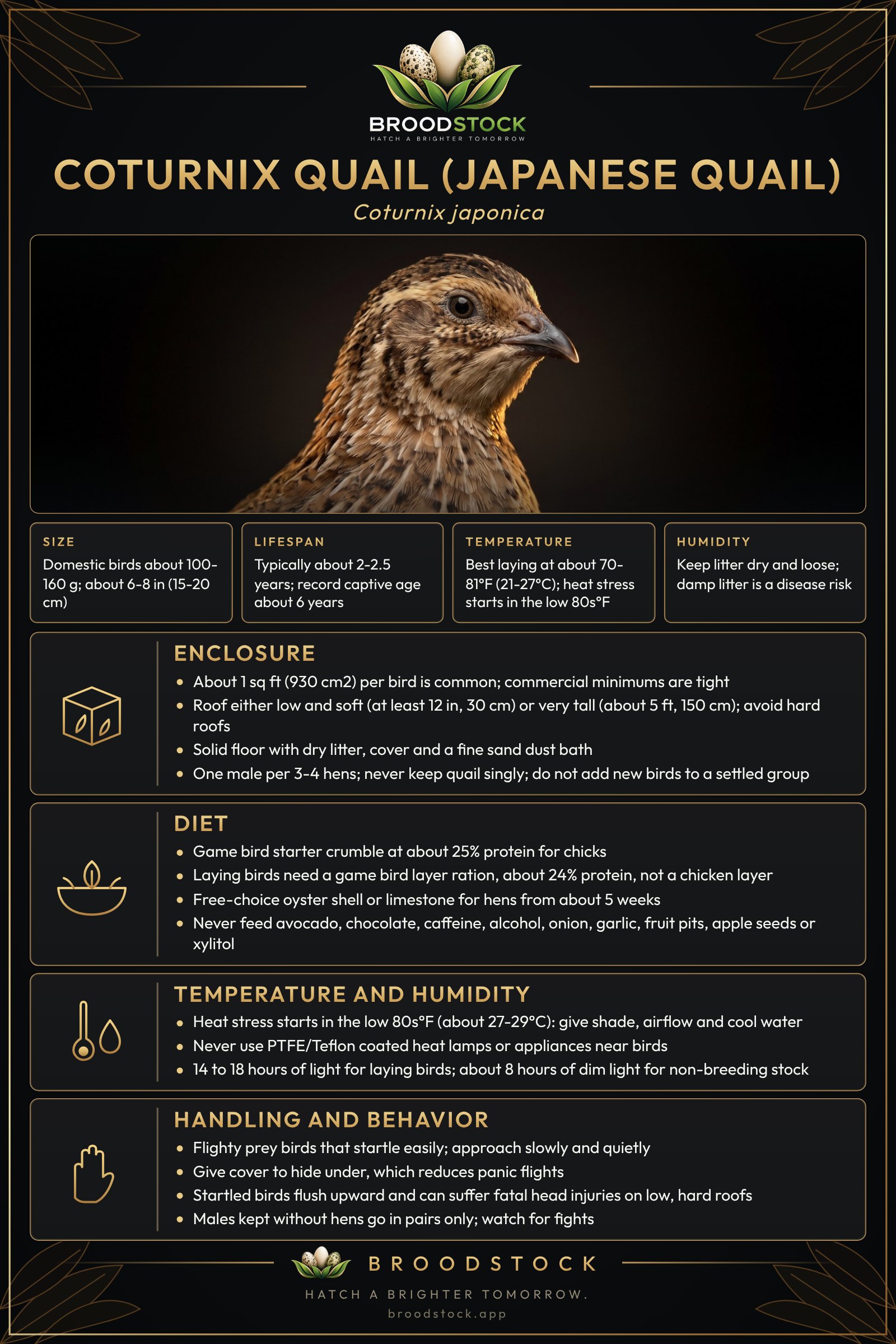
Print it or save it
The care sheet is a one-page summary you can print or keep on your phone. The full care text is below.
Keeping Coturnix Quail? Broodstock tracks feeding, weights, sheds, enclosures and equipment for every animal you keep, and it is free to start.
Scientific name
Coturnix japonica
Adult size
Wild-type birds weigh about 90-100 g, while domestic birds run about 100-160 g, with hens heavier than cocks (males 100-140 g, females 120-160 g). Commercial meat lines can reach about 300 g. Body length is not well documented, though keepers commonly describe adults as about 6-8 in (15-20 cm).
Lifespan
Life expectancy is typically about 2-2.5 years, with a record captive age of about 6 years.
Enclosure
Commercial cage minimums (about 0.5 sq ft, 465 cm2, per bird) are tight. Welfare bodies ask for more space, and backyard keepers commonly give about 1 sq ft (930 cm2) per bird.
Quail flush straight up when startled. Either keep the roof low with soft netting (at least 12 in, 30 cm) or make it very tall (about 5 ft, 150 cm); avoid in-between heights with hard roofs. A solid floor with dry, loose litter is preferred. If you use wire, choose about 1/4 in (7 mm) mesh and check feet regularly. Include cover such as screens, plants and straw, plus soft nesting material and a dust bath of fine sand. Perches are not needed.
Mature males fight, so keep one male with 3-4 hens, and house spare males in pairs, not alone, since quail should not be kept singly. Watch for fights. Do not put new birds into a group that has already settled.
Temperature
Laying is best at about 70-81°F (21-27°C). Heat stress begins in the low 80s°F (about 27-29°C), so above that provide shade, airflow and cool water. Cold limits are not well documented; keepers commonly house adults outdoors below freezing only when the housing is dry and draft-free and the water stays unfrozen.
Humidity
Keep litter dry and loose, as damp litter is a disease risk. Room humidity figures are not well documented. Quail clean their feathers by dust bathing, not water bathing, so supply a box of fine sand.
UVB
UVB is not well documented for quail. Outdoor access or a covered veranda is recommended where possible. Indoors, a complete game bird ration provides the vitamins.
Lighting
Laying birds get 14 to 18 hours of light a day. Non-breeding stock such as spare males and meat birds gets about 8 hours of dim light.
Heating
Within their comfort range, adults need no added heat. Never use PTFE/Teflon coated (nonstick) heat lamps or appliances near birds.
Diet
Feed chicks a game bird or turkey starter crumble at about 25% protein. Laying birds need a game bird layer ration (about 24% protein and 2.5-3% calcium) instead of a low-protein chicken layer. Expect an adult to eat about 14-18 g daily. Provide fresh water at all times; small amounts of greens are fine. Feed is best used within about 8 weeks of milling. Never feed avocado, chocolate, caffeine, alcohol, onion, garlic, fruit pits, apple seeds, xylitol, and salty, fatty or sugary human food.
Supplements
Laying hens should have free-choice oyster shell or ground limestone from about 5 weeks, before laying starts, in addition to a layer ration with about 2.5 to 3.5% calcium. A feeding trial found 3 to 3.5% best, and the higher end suits hot weather. It is not well documented whether insoluble grit is needed with a complete crumble, though many keepers offer a little.
Shedding
This is not well documented. A molt in autumn, as days shorten, is what keepers usually report, and laying slows or stops during it. Most hens keep laying through it if given 14-18 hours of light.
Handling
These are flighty prey birds that startle easily. Approach slowly and quietly, give them cover to hide under, and consider wearing the same clothing colors each time.
Brumation
Quail need no seasonal rest.
Health signs to watch
Take birds to a vet or poultry lab for: ulcerative enteritis ('quail disease': sudden deaths, watery or bloody droppings, mostly in young birds, spreads in droppings); quail bronchitis (chicks under 4 weeks with coughing, sneezing, rattling breath and eye discharge; 10-100% die, with no licensed vaccine or treatment); splay leg in chicks; drowning in deep waterers; head wounds from flushing into hard roofs; and cannibalism or feather pecking from crowding or too many males. General signs are fluffed, lethargic birds and a drop in eggs.
Welfare
Startled quail flush straight up and can suffer serious or fatal head injuries on low, hard roofs. Give at least 12 in (30 cm) of height with a soft, flexible roof, or far more room to fly (EFSA puts the height needed for jumping and flight at about 150 cm). Always provide cover, which reduces panic flights, plus fine material such as sand for dust bathing. Never keep quail singly; males without hens should live only in pairs. Albino quail have light-sensitive eyes that develop cataracts, so give them shade.
Keep every animal's care in one place
Log feedings, weights and sheds, set reminders, and let Ranger, the built-in AI manager, help with the rest. Free to start, no card needed.