
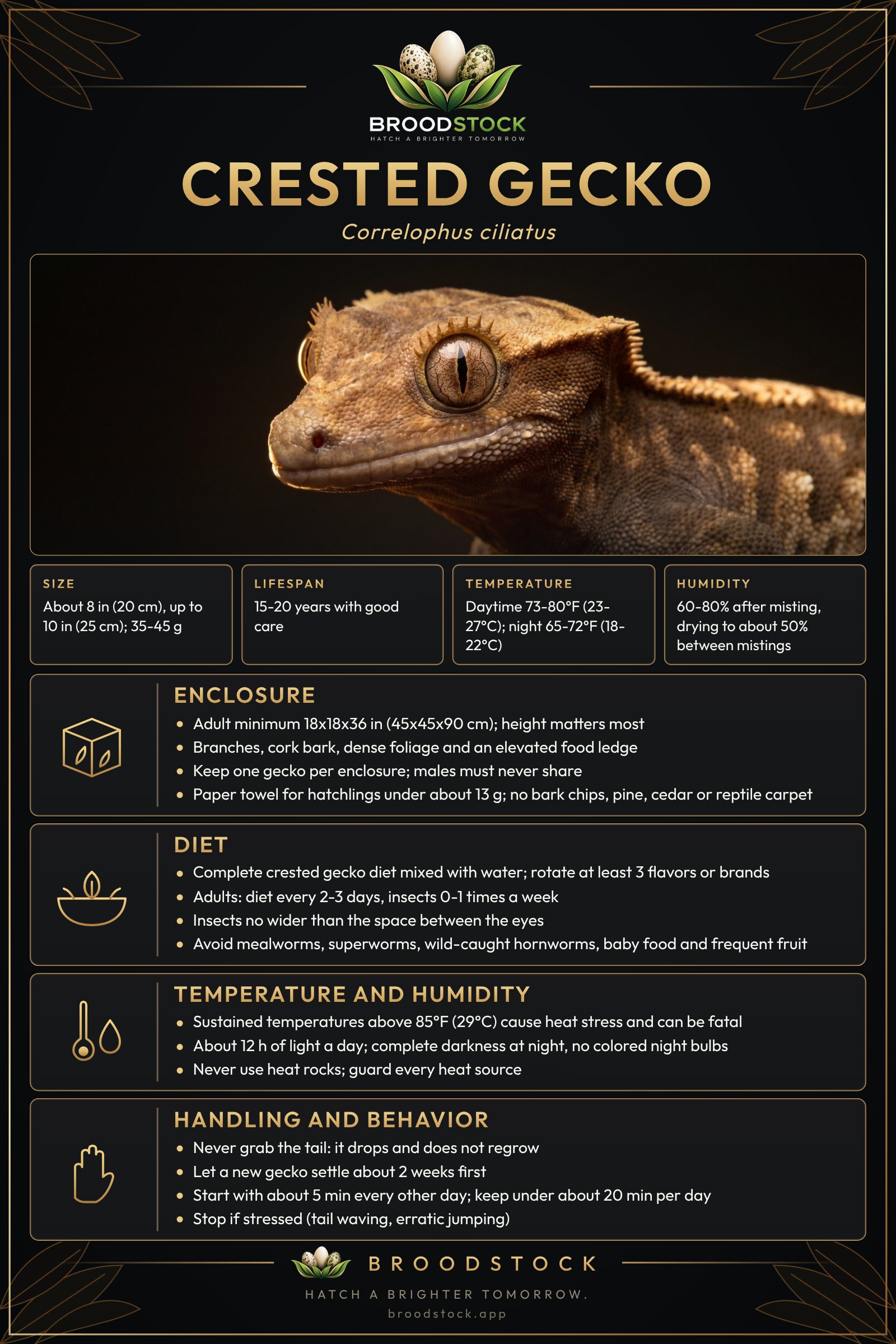
Print it or save it
The care sheet is a one-page summary you can print or keep on your phone. The full care text is below.
Keeping Crested Gecko? Broodstock tracks feeding, weights, sheds, enclosures and equipment for every animal you keep, and it is free to start.
Scientific name
Correlophus ciliatus
Adult size
Total length is about 8 in (20 cm), occasionally reaching 10 in (25 cm). Adult weight is about 35-45 g.
Lifespan
With good care, expect 15-20 years.
Enclosure
These geckos climb, so height matters most, though the enclosure should not be too narrow. Hatchlings under about 12 g need 12x12x12 in. Juveniles and adults need at least 18x18x36 in (45x45x90 cm), and bigger is better.
Furnish with climbing branches, cork bark, dense live or artificial foliage and an elevated food ledge. Use paper towel for hatchlings under about 13 g and during quarantine. Larger geckos can have a 2-4 in mix of soil and coco fiber with leaf litter. Do not use bark chips, pine, cedar or reptile carpet.
Keeping one gecko per enclosure is best. Males must never share an enclosure. Two females can share only if they are similar in size and have an enclosure of at least double the volume (about 23,000 cubic in). Tail and crest biting are signs to watch for.
Temperature
Most crested geckos do well with daytime temperatures of 73-80°F (23-27°C). If you offer a basking spot, hold the top of the enclosure at 82-85°F (28-29°C) and keep a cooler lower zone at 70-75°F (21-24°C). Nights of 65-72°F (18-22°C) suit them, and a drop at night is good. Do not let temperatures stay above 85°F (29°C), which causes heat stress and can be fatal. Days that stay at or below about 72°F (22°C) cause lethargy and poor appetite.
Humidity
Aim for 60-80% right after misting, then let it dry to about 50% before the next misting so mold doesn't grow. Mist more heavily in the evening, with a lighter pass in the morning when needed. During a shed you can briefly raise it to 80-100% if needed.
UVB
UVB is recommended. A complete diet means it isn't strictly required, but it supports calcium use and natural behavior, and practices vary. Ferguson Zone 1 applies: aim for a UVI of 1.0-2.0 at the highest perch, measured with a Solarmeter 6.5.
Use a low-output tube over mesh, such as Arcadia ShadeDweller 7% (12 in) at 8-12 in (20-30 cm) or ShadeDweller Max 2.5% (24 in) at 6-9 in (15-23 cm). Another low-output 5-6% lamp works at the maker's distance. Provide plenty of shade, and keep glass and plastic out of the gap between bulb and gecko. Replace the lamp about every 6-12 months, following the maker. When using UVB, dust insects with calcium without D3.
Lighting
Give about 12 h of light a day, or follow the seasons with about 14 h in summer easing down to 10 h in winter, changing gradually. Do not use colored night bulbs, and keep the room completely dark at night.
Heating
If the room holds 73-80°F (23-27°C), you often need no added heat. When heat is needed, use a low-wattage white incandescent or halogen bulb over the mesh at the top, on a thermostat. Size it so the top stays at or below 85°F (29°C); start low, such as 25 W, and adjust.
For hatchlings, place a small heat mat on one side wall under a proportional thermostat, with the surface no hotter than 85°F (29°C) and switched off at night. Heat rocks must never be used. Guard every heat source, and monitor with a digital probe thermometer and an infrared temp gun.
Diet
The staple is a complete crested gecko diet (CGD) mixed with water to a ketchup or smoothie texture. Options include Repashy Crested Gecko Diet, Pangea, Black Panther Zoological, Lugarti, Zoo Med (new formula), Blue River, or Arcadia (only with UVB). Use at least 3 flavors or brands in rotation.
Juveniles (0-12 months) get CGD daily and insects 1-2 times a week. Adults get CGD every 2-3 days and insects 0-1 times a week; cut back insects if the gecko is overweight. How long CGD can stay out is not well documented, and keepers commonly replace leftovers after about a day.
Insects must be no wider than the space between the eyes. Suitable ones are crickets, dubia or discoid roaches, black soldier fly larvae, silkworms and captive-bred hornworms, with waxworms as rare treats. Avoid mealworms, superworms, wild-caught hornworms, baby food, unlisted diet brands and frequent fruit.
Supplements
A complete diet already has calcium, vitamin D3 and vitamin A (Repashy's label lists all three), so add no powders to it. Dust insects with calcium at every insect feeding. With UVB, use calcium without D3 (such as Repashy SuperCal NoD, Zoo Med Repti Calcium without D3, Miner-All Outdoor). Without UVB, use calcium with D3 (such as Repashy SuperCal MeD, Zoo Med Repti Calcium with D3, Miner-All Indoor, or an all-in-one like Repashy Calcium Plus). Calcium with D3 must never be added when UVB is present.
When CGD is the staple, a separate multivitamin is skipped by most keepers. Some vets still suggest dusting insects with a vitamin powder now and then, so practices vary. Gut-load insects for 2-3 days before feeding (such as Repashy SuperLoad, Mazuri Better Bug, Arcadia InsectFuel). Arcadia's gecko diets are made to be used with UVB, so do not feed them without it.
Shedding
Geckos shed periodically as they grow, more often when young, and usually eat the skin. Before a shed they look duller and grayish and eat and move less. Check the toes and tail tip for stuck shed, which can constrict and cost digits. To fix it, raise humidity, provide a humid hide, or give a 10-15 min humid 'sauna' (a container with damp, lukewarm paper towel), then loosen the skin gently with a cotton swab. Stuck shed that keeps recurring points to low humidity or dehydration.
Handling
Allow a new gecko about 2 weeks to settle before handling. Begin with about 5 min every other day over a soft, low surface, build up to 15 min, and keep sessions under about 20 min per day. For jumpy geckos, 'hand-walk' (treadmill) them from one hand to the other. Never grab the tail, since it drops and does not regrow. Stop if the gecko shows stress such as tail waving or erratic jumping.
Brumation
Crested geckos do not truly brumate. Do not let temperatures go below about 65°F (18°C).
Health signs to watch
Weigh weekly, since sudden weight loss often means illness. Watch for metabolic bone disease (kinked spine or limbs, weak grip, trouble climbing), floppy tail syndrome (tail flopping over the body when hanging upside down), impaction, dehydration (sunken eyes, wrinkled skin, sticky saliva), obesity, stuck shed on toes or tail, and tail loss (it does not regrow). Respiratory infection can follow if the enclosure stays constantly wet with poor airflow.
Take the gecko to a reptile vet for any of these: appetite loss over several feedings, weight loss, inability to climb, falls with injury, prolapse, open-mouth breathing or wheezing, or an inflamed tail stump. An annual checkup with a reptile vet is recommended.
Keep every animal's care in one place
Log feedings, weights and sheds, set reminders, and let Ranger, the built-in AI manager, help with the rest. Free to start, no card needed.