
Print it or save it
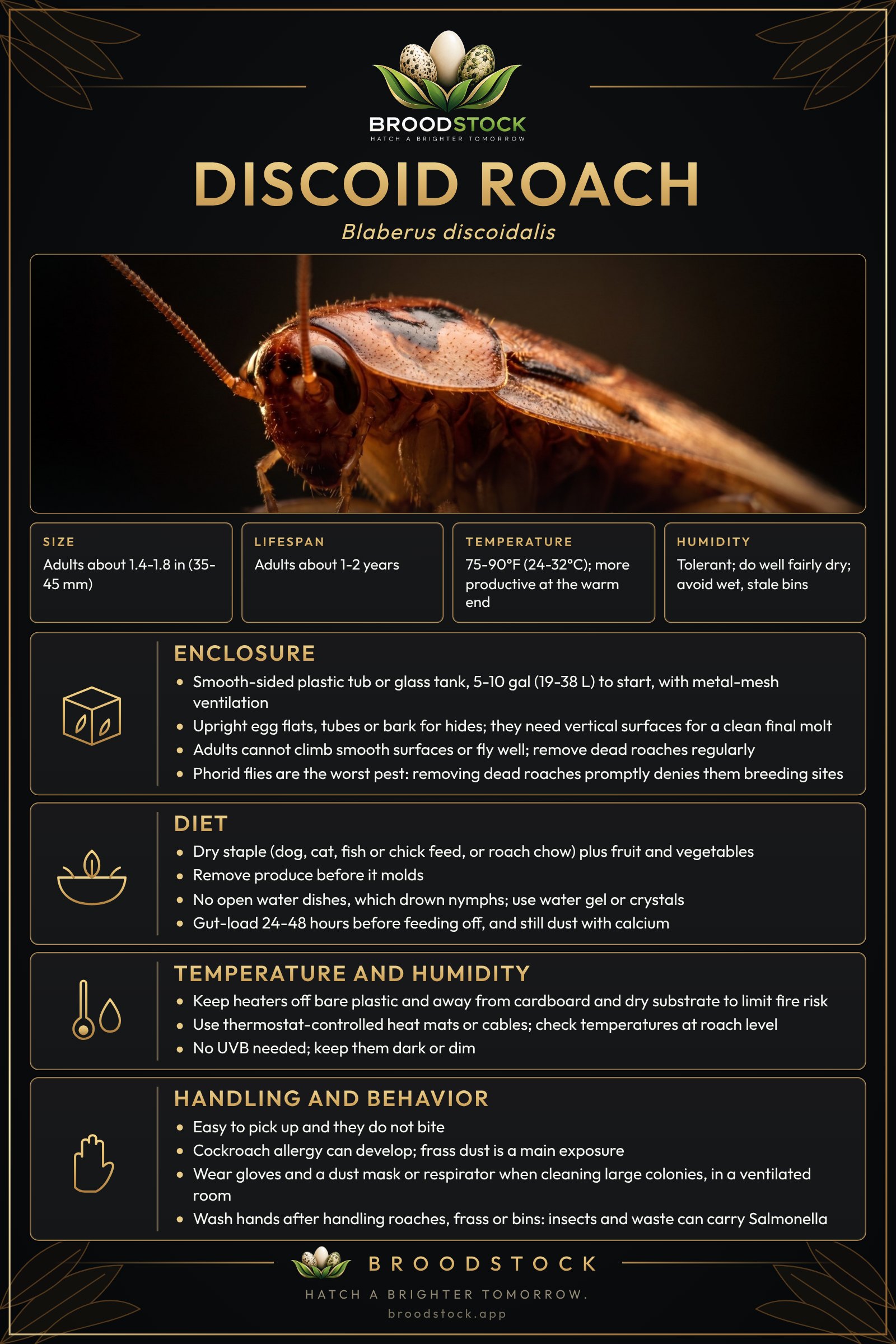
The care sheet is a one-page summary you can print or keep on your phone. The full care text is below.
Keeping Discoid Roach? Broodstock tracks feeding, weights, sheds, enclosures and equipment for every animal you keep, and it is free to start.
Scientific name
Blaberus discoidalis, also called the false death's head roach, is a large live-bearing cockroach from Central America and the Caribbean (Cuba, Hispaniola, Jamaica, Puerto Rico, Panama, Colombia, Venezuela, Trinidad). It also occurs in extreme south Florida, where entomologists debate whether it is native or long established. Many feeder colonies sold as discoids are really hybrids with other Blaberus species.
Adult size
Adults measure about 1.4-1.8 in (35-45 mm) and are broader and flatter than dubias. They are tan with a dark patch on the shield behind the head, while nymphs are brown with tan speckles.
Lifespan
Adults live about 1-2 years; one breeder reports an average of about 1.5 years.
Enclosure
Use a smooth-sided plastic tub or glass tank, about 5-10 gal (19-38 L) for a starter colony and larger as it grows, with moderate to high ventilation through metal mesh. Hides can be upright egg flats, cardboard tubes or bark. Blaberus need vertical surfaces to hang from so the final molt goes cleanly.
You can keep them bare like dubias. They burrow heavily if given 1-2 in (2.5-5 cm) of coconut fiber, peat or plain soil, which some keepers say they prefer, so practices vary. Adults fly poorly and cannot climb smooth surfaces. Clear out dead roaches on a regular basis.
Temperature
For growth and breeding, 75-90°F (24-32°C) works, and colonies are more productive at the warm end; one source suggests 85-90°F / 29-32°C for breeding. Cooler conditions are tolerated, though breeding slows down.
Humidity
They are tolerant and do well kept fairly dry. Some keepers offer a gradient with one moister area. Avoid wet, stale bins that grow mold.
UVB
UVB plays no part in their care. The roaches live in the dark or dim light, and nothing suggests that UVB benefits the colony.
Lighting
Darkness or dim light is fine, and no photoperiod is needed.
Heating
Warm the tub with a heat mat or heat cable on a thermostat, placed under or beside part of it, or use a warm room. Keep heaters off bare plastic and away from cardboard and dry substrate, and use thermostat-controlled products to lower fire risk. Measure temperatures at roach level with a digital thermometer.
Diet
Feed a dry staple (dog, cat, fish or chick feed, or commercial roach chow) along with fruit and vegetables; a little leaf litter helps picky colonies. Take out produce before it molds. Do not use open water dishes, which drown nymphs; offer water gel or crystals in a shallow dish, or rely on moisture from produce.
Supplements
Gut-load for about 24-48 hours before feeding off, using a calcium-rich diet and produce. Seller figures give a calcium-to-phosphorus ratio of about 0.8:1 (similar to dubias), while research on feeder roaches reports low Ca:P and low vitamins A and E. So still dust with calcium, as advised for the reptile being fed. Shown in crickets, the calcium gained from gut-loading drops back within about a day without food, so feed out promptly.
Shedding
After each of their repeated molts, nymphs stay pale and soft for a time. For the final molt to adult, they need something vertical to hang from, or adults may molt badly. Others in the colony can eat fresh molts.
Handling
Discoids move at a slow to moderate pace, are easy to pick up, and do not bite. People who keep colonies can develop cockroach allergy, with frass dust as a main exposure, so wear gloves and a dust mask or respirator when cleaning large colonies and work in a ventilated room. Wash your hands after handling roaches, frass or bins, because insects and their waste can carry bacteria such as Salmonella.
Brumation
There is no diapause. Growth and breeding slow at lower temperatures, which can be used to keep feeders at size.
Health signs to watch
Phorid flies are the most damaging pest in Blaberus colonies; remove dead roaches promptly so the flies have no place to breed. Wet food or substrate causes mold and odour. Dermestids or lesser mealworms can act as cleaner beetles by tidying carcasses, but they may turn into pests themselves. Poor breeding is possible in hybrid colonies sold as discoids.
Welfare
Feeders must never be released. In Florida, Blaberus discoidalis is on FDACS's list of deregulated feeder arthropods (July 2026 list), so no state permit is needed to keep or move it, since it already occurs in south Florida. A federal USDA permit may still apply to some movements. This makes it the usual alternative to dubias there.
Elsewhere, sellers describe it as legal in most US states. Oregon lists the genus Blaberus as approved without a state permit for education and pet use (OAR 603-052-1320, 2026); pet food use is not named, so confirm feeder use with the Oregon Department of Agriculture. California's plant quarantine list includes it among insects that can be shipped without a state permit. Hawaii prohibits imports of animals, including insects, not on its approved lists, and the USDA feeder-cockroach permit exceptions do not cover Hawaii, Alaska or territories. Rules change, so check with your state agriculture department before buying or shipping.
Keep every animal's care in one place
Log feedings, weights and sheds, set reminders, and let Ranger, the built-in AI manager, help with the rest. Free to start, no card needed.