
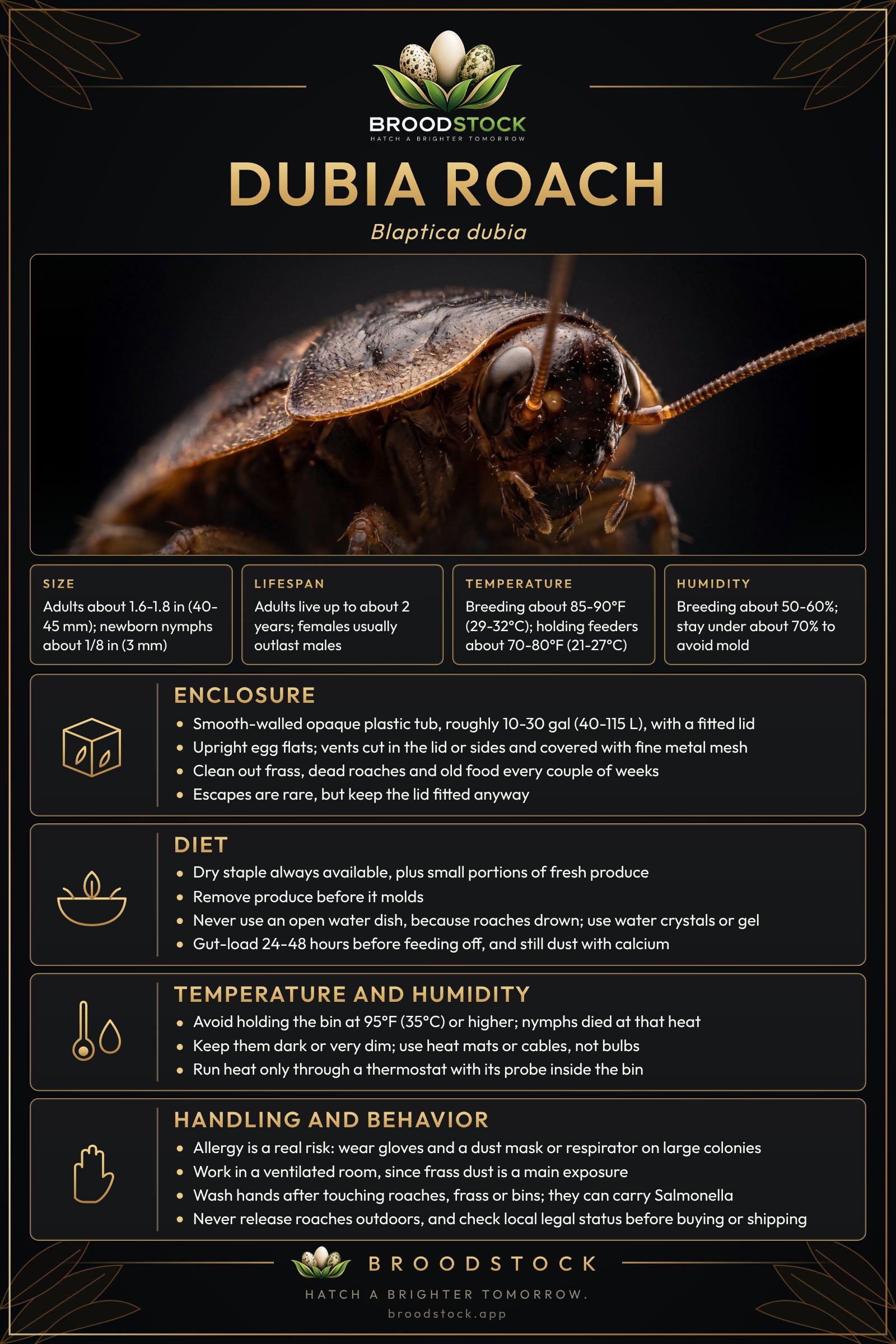
Print it or save it
The care sheet is a one-page summary you can print or keep on your phone. The full care text is below.
Keeping Dubia Roach? Broodstock tracks feeding, weights, sheds, enclosures and equipment for every animal you keep, and it is free to start.
Scientific name
Blaptica dubia, a tropical cockroach that gives birth to live nymphs. It is also sold as the orange-spotted, Argentinian wood or Guyana spotted roach. Its native range is southern South America, with records from Brazil, Argentina and Uruguay.
Adult size
Full-grown adults measure roughly 1.6-1.8 in (40-45 mm). Newly born nymphs are only about 1/8 in (3 mm). Colour runs from dark brown to black, occasionally with faint orange marks, and differs a little from colony to colony.
Lifespan
An adult can reach about 2 years. Females generally outlast males.
Enclosure
Use a smooth-walled, opaque plastic tub sized to the colony, roughly 10-30 gal (40-115 L). A 30 gal tub can house thousands of roaches. Set cardboard egg flats on end so frass drops to the floor, and offset them so air can move. Cut big vents in the lid or sides and cover each with fine metal mesh.
Most keepers skip substrate and leave only a thin dry layer of frass for small nymphs. Neither life stage can scale slick plastic or glass, and they seldom fly, so escapes are rare. Keep a fitted lid on anyway. Every couple of weeks, remove frass, dead roaches and old food, and swap out egg flats that are falling apart.
Temperature
For a breeding colony, aim for about 85-90°F (29-32°C). One research figure gives 77-86°F (25-30°C) as best for growth and breeding, and a university study found 86°F (30°C) produced the quickest development. Avoid holding the bin at 95°F (35°C) or higher. In that study, nymphs kept at a constant 95°F died before adulthood, and every nymph was dead within 4 days at 104°F (40°C).
To hold feeders with little growth or breeding, use about 70-80°F (21-27°C). Brief cold snaps are survivable, but they stress the colony and may kill roaches.
Humidity
A breeding colony does well at about 50-60%. One breeder gives 40% as the minimum and about 60% as ideal, and research cites above 60% as best. For holding, use about 45-50%. Stay under about 70%, because damper bins grow mold and smell of ammonia. When nymphs have trouble molting, mist lightly to lift humidity a little, then let the bin dry out completely.
UVB
UVB is not needed. Roaches live in the dark, and there is no sign that UVB helps the colony. A reptile gets its vitamin D from its own lighting and supplements rather than from the feeder.
Lighting
Keep the colony dark or very dim. Bright light pushes roaches into the egg flats, which causes pile-ups and stress. That is also why heat mats or cables are better than heat bulbs. No photoperiod is required.
Heating
Warm the tub with a heat mat or heat cable placed under or beside one part of it, always run through a thermostat with its probe inside the bin. Heating the whole room is the alternative. Do not let any heat source touch bare plastic, keep cardboard away from heaters, and pick a self-regulating or thermostat-controlled product to reduce fire risk. Measure temperature at roach level with a digital thermometer.
Diet
Keep a dry staple out all the time: commercial roach chow, rolled oats, cereal, chick feed or a grain mix. Add fresh produce such as carrots, sweet potato, squash, dark greens, apple, orange, banana or mango, in small portions, and take it out before it molds.
Never use an open water dish, since roaches drown. Provide water crystals or gel in a shallow dish, changed every few days, or rely on moisture from produce. Keepers differ on protein: some add a little cat or dog food, while others say high-protein foods should be avoided, since roaches are already protein-rich. Practices vary.
Supplements
Gut-load for roughly 24-48 hours before feeding off, using a calcium-rich diet plus fresh produce. Roaches have a low calcium-to-phosphorus ratio, about 0.7:1 in one seller's figures, and research on feeder roaches also finds low Ca:P along with low vitamins A and E. Gut-loading alone therefore falls short. Cricket studies show gut-loaded calcium falls back to near baseline within a day of fasting. Feed out soon after gut-loading, and still dust with calcium as the reptile's care sheet advises.
Shedding
Nymphs molt several times while growing and stay soft and pale for a few hours afterward. Adults never molt again. Bins that are too dry can cause stuck molts, which a light mist helps. Newly molted roaches are easy prey for the others.
Handling
Allergy is a genuine risk for people who breed them. A 2021 case report described a home dubia breeder who developed asthma, nasal symptoms and hives from her colony, and breeders warn that reactions can grow from itchy skin to breathing problems. When sorting or cleaning large colonies, wear gloves and a dust mask or respirator and work in a ventilated room, since frass dust is a main source of exposure.
After touching roaches, frass or bins, wash your hands. As with any animal or insect culture, they can carry bacteria such as Salmonella.
Brumation
They have no true diapause. To slow growth and breeding and keep feeders at a usable size, hold the colony at about 70-80°F (21-27°C) with lower humidity. Long periods below about 70°F (21°C) make the colony decline.
Health signs to watch
Colony crashes usually come from cold, damp or dirty bins. Look for mold on wet frass or old food, an ammonia smell, and gnats or phorid-type flies drawn to dead roaches. Stressed females may drop their oothecae (aborted). Birth rates fall as females age, so let more nymphs grow into breeders. Too many males reduces output.
Grain mites and other pests are kept down by dry food and regular cleaning. A cleaner crew, such as small beetles, can eat dead roaches, but it is optional.
Welfare
Never release roaches, and never dump frass outdoors if it could hold live nymphs. Legal status varies, so check before you buy or ship them.
Florida: the state agriculture department (FDACS, Division of Plant Industry) regulates dubias under Chapter 581.083, Florida Statutes, and Rule Chapter 5B-57, F.A.C. Sellers say no permits go to pet owners or feeder sellers. For private keepers and breeders in Florida, assume they are prohibited unless FDACS tells you otherwise in writing. Discoid roaches are the usual alternative there. Hawaii: live animals, insects included, that are missing from the state's approved lists cannot be imported, and suppliers report that Hawaii does not allow dubias. Ask the Hawaii Department of Agriculture Plant Quarantine Branch.
Alaska, Hawaii and US territories fall outside the USDA's federal exemptions from permits for feeder cockroaches, which reach only the contiguous US. Public import is restricted in Canada and some other places.
Oregon lists the species as approved for pet food with no state permit (OAR 603-052-1320, 2026). California's plant quarantine list names it among insects that can ship without a state permit, though that list was being amended in 2026. Because rules change, contact your state agriculture department first, whether you plan to buy, breed or ship.
Keep every animal's care in one place
Log feedings, weights and sheds, set reminders, and let Ranger, the built-in AI manager, help with the rest. Free to start, no card needed.