Print it or save it
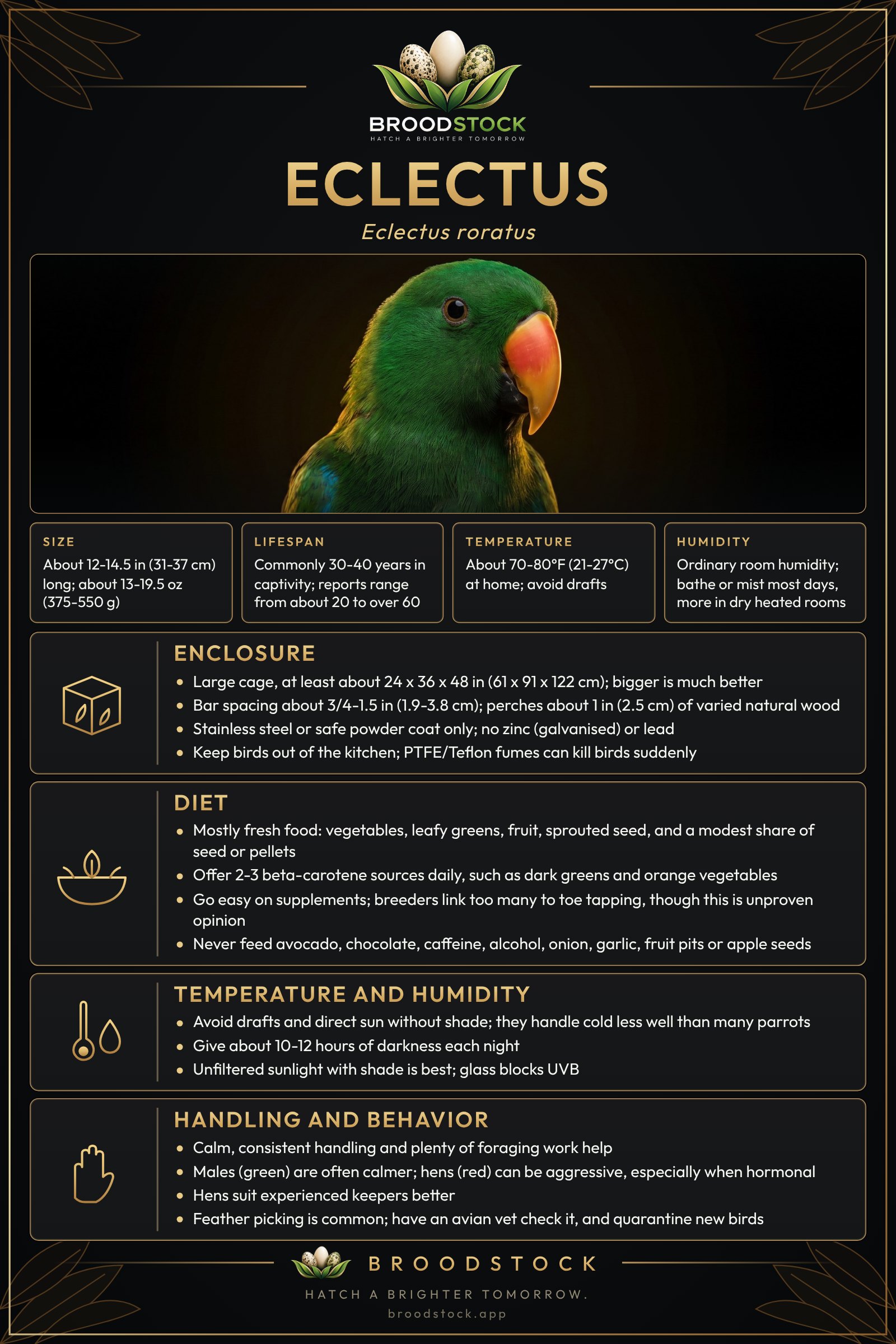
The care sheet is a one-page summary you can print or keep on your phone. The full care text is below.
Keeping Eclectus? Broodstock tracks feeding, weights, sheds, enclosures and equipment for every animal you keep, and it is free to start.
Scientific name
The group is Eclectus roratus. In 2023 the IOC divided it into several species: the Moluccan (E. roratus), Papuan (E. polychloros), Sumba (E. cornelia) and Tanimbar (E. riedeli). Captive birds are still mostly sold under subspecies names (Solomon Island, Red-sided, Vosmaeri, Grand).
Adult size
Length is about 12-14.5 in (31-37 cm) and weight about 13-19.5 oz (375-550 g), depending on subspecies.
Lifespan
In captivity, 30-40 years is common. The vet reference puts the maximum at about 50-60 years, and reports run from about 20 to over 60.
Enclosure
Use a large cage of at least about 24 x 36 x 48 in (61 x 91 x 122 cm); bigger is much better. Bars should be spaced about 3/4-1.5 in (1.9-3.8 cm) apart, and perches should be about 1 in (2.5 cm) thick in varied natural wood. Choose stainless steel or safe powder coat, with no zinc (galvanised) or lead. Plan for daily foraging and climbing.
Keep birds out of the kitchen. Never use PTFE/Teflon-coated items near them: some heat lamps, heaters, irons and non-stick pans. The fumes can kill birds suddenly, even from another room.
Temperature
Household temperatures of about 70-80°F (21-27°C) are generally fine, and healthy birds tolerate a wider range. Avoid drafts, and avoid direct sun without shade. As tropical birds, eclectus handle cold less well than many parrots. For outdoor aviaries, provide a sheltered roost free of drafts. How cold is safe outdoors has not been well documented.
Humidity
This tropical species likes regular bathing or misting, so offer a bath or spray on most days. Ordinary room humidity is otherwise fine, but very dry heated rooms call for frequent baths.
UVB
Birds with no natural light should get full-spectrum lighting, which avian vets advise to cut the risk of vitamin D deficiency. Unfiltered sunlight is best, from outdoor flight or an open window (glass blocks UVB), with shade available. Use a bird-specific lamp at the maker's distance, on the normal day cycle. Keepers differ on whether indoor lamps are needed (practices vary).
Lighting
Give about 10-12 hours of darkness each night.
Diet
Diet sensitivity is the main issue with this species. Eclectus eat fruit and plants and have a long digestive tract. Most specialists feed mainly fresh food: a wide mix of vegetables, leafy greens and fruit (often half or more of daily intake), sprouted seed and pulses, and a modest portion of seed or pellets. Offer 2-3 beta-carotene sources daily, such as dark greens and orange vegetables.
Keepers differ on pellets. The vet reference includes a formulated diet within a varied menu, while many eclectus breeders keep pellets to a small part of the diet or avoid heavily fortified, coloured brands. Never feed avocado, chocolate, caffeine, alcohol, onion or garlic, fruit pits, apple seeds, or salty, fatty or sugary human food.
Supplements
Go easy on supplements. Specialist breeders link over-supplementation (synthetic vitamins added on top of fortified pellets) to toe tapping, wing flipping and feather damage. That is breeder and aviculturist opinion, not proven in studies, and other suggested triggers include low calcium and food additives. Practices vary, but most specialists give no synthetic vitamins to pellet-fed birds and use them sparingly, if at all, with a fresh-food diet.
If toe tapping or wing flipping begins, stop all supplements and see an avian vet, because other conditions cause the same signs. Grit is not needed.
Shedding
The moult is gradual and mostly yearly. The feathers look hair-like because they lack the usual barbules, and that is normal. Feather picking or chewing is common and is often linked to diet, stress or skin problems, so have an avian vet check it.
Handling
These are intelligent, relatively quiet birds. Males (green) are often calmer and easier to tame, though some are timid. Hens (red) range from assertive to aggressive, particularly when hormonal, and suit experienced keepers better. Foraging opportunities and calm, steady handling both help.
Health signs to watch
Watch for toe tapping and wing flipping (involuntary twitching, often linked to diet or supplements; see an avian vet), feather-destructive behaviour, vitamin A deficiency, polyomavirus, PBFD, egg binding, and psittacosis (Chlamydia, which can infect people). Sudden breathing trouble or collapse can indicate PTFE (Teflon) fume poisoning. New arrivals should be quarantined.
Welfare
For this species, a diet that is over-fortified is a genuine welfare risk. In cramped quarters a hen may turn on a male, so allow space and keep an eye on newly introduced pairs. Some eclectus forms are threatened in the wild (for example the Sumba eclectus), and the species is CITES Appendix II. Feral populations from escaped birds exist in Hawaii and Palau. Keep aviaries secure and never let a bird go free.
Keep every animal's care in one place
Log feedings, weights and sheds, set reminders, and let Ranger, the built-in AI manager, help with the rest. Free to start, no card needed.