
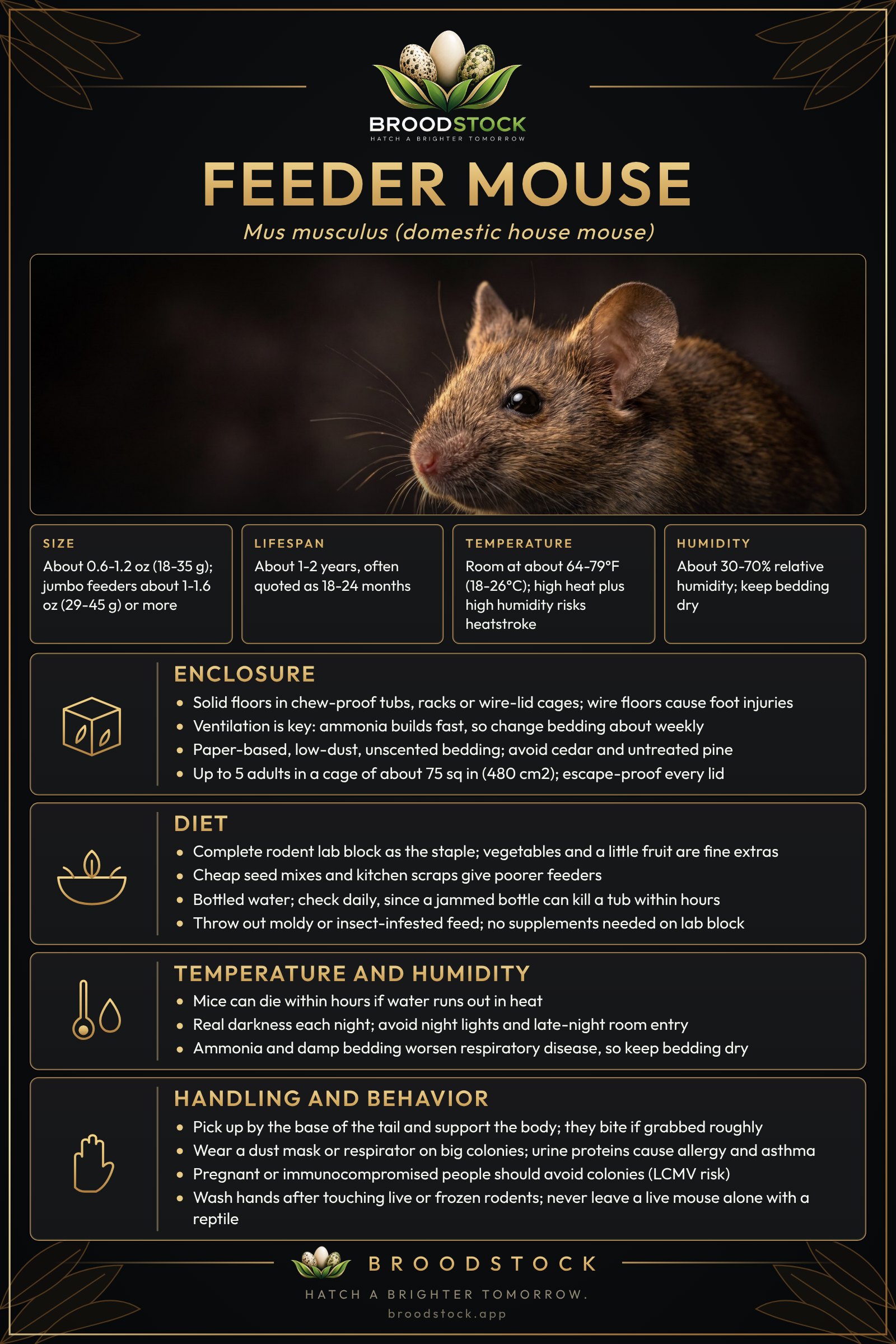
Print it or save it
The care sheet is a one-page summary you can print or keep on your phone. The full care text is below.
Keeping Feeder Mouse? Broodstock tracks feeding, weights, sheds, enclosures and equipment for every animal you keep, and it is free to start.
Scientific name
The species is Mus musculus, the domestic house mouse. Feeder mice come from the same domestic species as pet and lab mice, typically albino or mixed-colour animals sold for feeding.
Adult size
Adults weigh about 0.6-1.2 oz (18-35 g). Males run about 0.7-1.1 oz (20-30 g) and females about 0.6-1.2 oz (18-35 g). Sellers label the largest adults and retired breeders 'jumbo', at about 1-1.6 oz (29-45 g) or more.
Lifespan
Mice live roughly 1-2 years, often quoted as 18-24 months.
Enclosure
Use plastic tubs, a tub rack or wire-lid cages made of chew-proof, easy-to-clean material. Floors should be solid, because wire mesh floors trap feet and cause injuries.
Ventilation matters most. Urine breaks down into ammonia, so choose well-ventilated lids or racks with good airflow, keep stocking density low, spot clean often, and change all the bedding about weekly (sooner if you smell ammonia). Glass aquariums are a poor choice because they hold ammonia in.
Bedding should be paper-based, low-dust and unscented. Avoid cedar, untreated pine (aromatic oils irritate the airways) and any scented bedding. Provide nesting material (paper or nestlets) and a hide, since mice with no cover may barber each other.
For density, lab guidance allows up to 5 adults in a standard cage of about 75 sq in (480 cm2). Make every lid escape-proof, since mice squeeze through tiny gaps and chew plastic edges.
Temperature
Keep the room at about 64-79°F (18-26°C). High heat combined with high humidity risks heatstroke and worsens respiratory disease, and mice can die within hours if their water runs out in hot conditions.
Humidity
Aim for roughly 30-70% relative humidity. Very dry air is linked to ringtail (tail constriction) in young rodents, while very damp air increases ammonia and respiratory disease. Bedding should stay dry.
UVB
UVB is not needed. Mice are nocturnal, indoor mammals eating a complete pelleted diet that supplies vitamin D, and nothing recommends UVB for feeder colonies.
Lighting
Use a regular day-night cycle with real darkness, so avoid night lights, glowing equipment and late-night entry to the room. Many colonies run about 12 hours of light and 12 of dark. Keep the room quiet.
Heating
A normal house usually needs no added heat. When the room is cold, warm the room, or put a heat cable or mat under part of a rack, with a thermostat in control and a cooler area left open. Too much heat is more dangerous than cold. For fire safety, keep heat cables, power strips and plugs clear of bedding and chewing, use rated thermostats, and never leave heat equipment running unattended without a thermostat.
Diet
Make a complete rodent lab block (laboratory or rodent breeder chow) the staple. Cheap seed mixes and kitchen scraps give poorer feeders. A hopper keeps the block clean. Sealed and stored cool and dry, it lasts about a year, and it can be frozen. Throw out any moldy or insect-infested feed. Occasional fresh vegetables and a little fruit are fine extras.
Give fresh water at all times from bottles. Check every bottle daily, because a jammed or empty bottle can kill a tub of mice within hours. Open bowls get fouled with bedding, and pups can drown in them.
Supplements
A complete lab block needs no supplements. For whole-prey feeders, gut loading just means feeding the colony a quality block diet. A well-fed mouse is complete nutrition, with its own skeleton supplying calcium, so rodents are not normally dusted with calcium. Underfed or seed-fed colonies give less nutritious prey.
Shedding
This does not apply, since mammals do not shed skin like reptiles. Hair loss and itching usually point to fur mites or barbering rather than a molt.
Handling
Lift mice by the base of the tail while supporting the body. They bite if grabbed roughly.
Allergies: rodent urine proteins are a well-known cause of allergy and occupational asthma among people who work with rodents, and the allergen travels on hair and clothes. In big colonies, put on a dust mask or respirator for bedding changes, change bedding gently, wear a cap or wash your hair, and keep the colony out of living areas.
Zoonoses: house mice carry lymphocytic choriomeningitis virus (LCMV), which infected workers at a US feeder-rodent breeding facility (13 of 52 employees tested had recent infection). It can cause meningitis and severe birth defects, so people who are pregnant or immunocompromised should stay away from rodent colonies. Frozen feeder rodents have been traced to national Salmonella outbreaks (in 2014, 41 people in 21 states). Rat-bite fever (Streptobacillus moniliformis) is mostly carried by rats, but any rodent bite deserves care.
Hygiene: wear gloves for cleaning and for handling frozen feeders, and wash your hands with soap and water as soon as you have handled rodents, live or frozen. Do thawing and rodent work away from the kitchen and food, keep hands off your face while working, and wash any bite thoroughly and get medical advice.
Brumation
This does not apply to living mice. For frozen feeders, euthanize humanely, freeze promptly, label bags with size and date, and use within about 6 months. Thaw either in the fridge or by sealing the rodent in a bag and setting it in warm water. Never use a microwave or oven, and never refreeze a thawed rodent that was not eaten.
Health signs to watch
Respiratory disease is commonly caused by Sendai virus and Mycoplasma pulmonis. Signs are sneezing, chattering, labored breathing and a hunched posture. Dirty bedding gives off ammonia that greatly aggravates the problem, so a strong smell is an early warning.
Fur mites (Myobia and others) cause hair loss, scabs and itching. The tropical rat mite lives in bedding, can cause anemia and also bites people, so treat the environment as well as the animals (vet advice). Older mice often develop tumors, with mammary tumors especially common in females.
Other things to watch: overgrown incisors, fighting wounds (mainly males), ringtail in dry rooms, and dehydration when a water bottle fails. If a whole colony goes quiet, loses weight or dies, cull it, clean the room before restarting, and consult a vet.
Welfare
Kill mice humanely, using only methods that the AVMA Guidelines for the Euthanasia of Animals accept for rodents. For mice these are injectable barbiturates (through a vet), an overdose of inhaled anesthetic, and carbon dioxide from a compressed gas cylinder, filled gradually rather than into a prefilled chamber (dry ice CO2 is not acceptable). Cervical dislocation and decapitation are also accepted, but only when done by trained, practiced people, and sedation first is recommended. Newborn pups resist low oxygen, so they need far longer CO2 exposure plus a second method to ensure death. Check that the animal is dead before it goes in the freezer. Never freeze, chill or drown a live mouse. Freezing without prior anesthesia is not an accepted method.
Live feeding: never leave a live mouse alone with a reptile. Live rodents bite back and can badly injure or kill a snake or lizard, so remove any that is not eaten within a few minutes. The usual recommendation is frozen-thawed (or freshly killed) prey, which is safer and lets freezing kill many parasites. Practices vary, and some keepers feed live to animals that refuse dead prey.
For biosecurity, keep wild mice away from the colony (they bring LCMV and parasites), and never release feeders outdoors.
Keep every animal's care in one place
Log feedings, weights and sheds, set reminders, and let Ranger, the built-in AI manager, help with the rest. Free to start, no card needed.