
Broodstock / Care sheets / Fire-bellied Toad
Fire-bellied Toad Care Sheet
Bombina orientalis (Oriental fire-bellied toad)
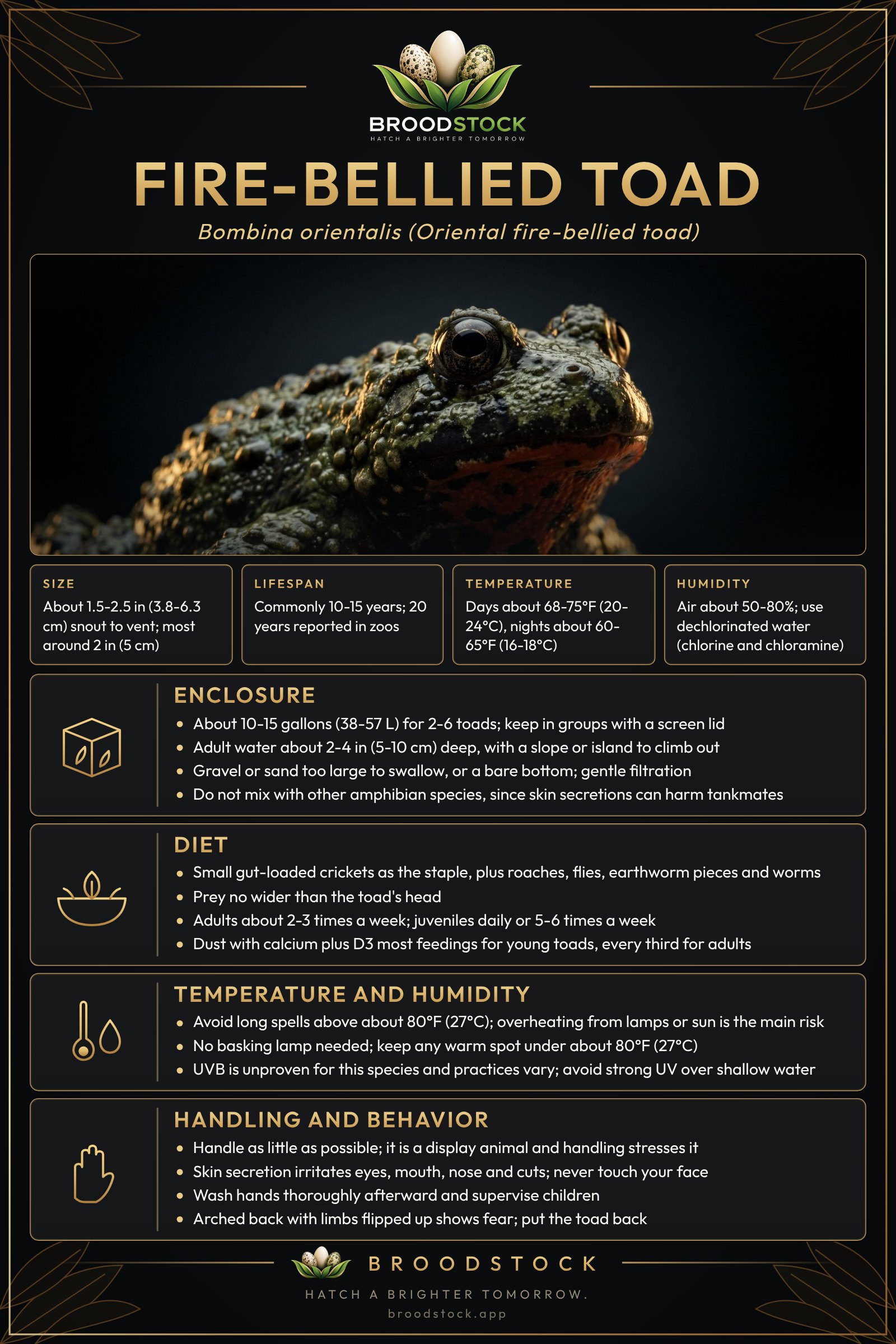
Print it or save it
The care sheet is a one-page summary you can print or keep on your phone. The full care text is below.
Keeping Fire-bellied Toad? Broodstock tracks feeding, weights, sheds, enclosures and equipment for every animal you keep, and it is free to start.
Scientific name
Bombina orientalis, the Oriental fire-bellied toad. Other Bombina species (B. bombina, B. variegata, B. maxima and others) are kept as well, and they differ in their water depth and temperature needs.
Adult size
These are small toads, about 1.5-2.5 in (3.8-6.3 cm) from snout to vent, with most around 2 in (5 cm). For captive animals, weight figures are not well documented.
Lifespan
10-15 years is common. Zoos report 20 years, and some sources cite up to about 30. Reported figures differ.
Enclosure
Fire-bellied toads are semi-aquatic and social, so keep them in groups. The minimum tank is about 10-15 gallons (38-57 L) for 2-6 toads. For about six, use a tank of 24x12x12 in (60x30x30 cm) or larger, and give bigger groups more room. Guides split water and land anywhere from half water to about two-thirds water, so practices vary. Make adult water about 2-4 in (5-10 cm) deep, with an easy slope, floating island, cork bark or turtle dock to climb out on.
For the floor, use a bare bottom, or gravel or sand too large to swallow. Add hardy plants (Java moss, Java fern, Elodea, pothos) and hides. Run gentle filtration (sponge filter or spray bar) and do partial water changes, from weekly to every few weeks depending on stocking. Use an escape-proof screen lid, because wet toads climb glass. Do not mix them with other amphibian species, since their skin secretions can harm tankmates.
Temperature
Keep them cool to room temperature: days about 68-75°F (20-24°C), falling to about 60-65°F (16-18°C) at night. Air can safely span about 65-80°F (18-27°C), but avoid long spells above about 80°F (27°C). Water stays at room temperature, and a heater is rarely needed in a heated home.
Humidity
Air humidity of about 50-80% is right, and the large water area usually supplies it with little misting. Water quality matters more. Tap water must be dechlorinated (treat for chlorine and chloramine), or use spring water. Letting tap water age is enough only if the local supply is free of chloramine. Remove waste quickly, and rely on gentle filtration plus regular partial water changes to keep the water clean.
UVB
UVB has not been shown necessary for this species, and care guides disagree on whether to offer it. Many keepers use only daylight LED or fluorescent lighting, some add a low-output UVB tube, and one Bombina guide uses UVB for part of each week. Keepers do things differently here. If you use UVB, pick a low-strength tube, provide shaded areas, and avoid strong UV over shallow water where toads cannot escape it. For choosing UV zones, the best guide is the UV-Tool (Baines et al. 2016), which includes amphibians.
Lighting
Give about 12 hours of light a day on a timer. Use 5,000-6,700K daylight LEDs or fluorescents if you grow live plants.
Heating
Usually none is needed. Fire-bellied toads tolerate cold and need no basking lamp; if you use one, keep any warm spot under about 80°F (27°C). Overheating from lamps or sunlight is the main risk. Put a thermometer in the water and another on land.
Diet
These toads eat insects. The staple is small gut-loaded crickets, with small roaches, flies, earthworm pieces, waxworms and mealworms for variety, all no wider than the toad's head. Floating turtle or amphibian pellets are taken by some, if you offer them straight to the toad. Feed adults about 2-3 times a week, a few insects per toad (zoo diets use small crickets three times weekly), and juveniles daily or 5-6 times a week. Gut-load feeders 12-48 hours ahead with carrot, sweet potato, squash or greens. Foods rich in carotenoids help the belly stay red.
Supplements
Dust insects with calcium plus D3 at most feedings for young toads and about every third feeding for adults, and use a multivitamin with vitamin A or carotenoid gut-loading. A deficiency causes metabolic bone disease (bent or weak limbs, hind-leg paralysis). Captive-bred toads often have orange or yellow bellies rather than red because their diet lacks carotenoids. Carotenoid-rich gut-loads, water fleas or a canthaxanthin supplement help.
Shedding
Toads shed regularly and normally eat the skin, so you rarely see it. Frequent visible shedding, cloudy skin or excess mucus can signal chytrid or poor water and calls for a vet check.
Handling
Handle as little as possible. This is a display animal, and handling stresses it and exposes its skin to whatever is on your hands. Use wet, clean hands (no soap, lotion or sanitiser residue) or powder-free gloves with dechlorinated water, and move toads with a net or cup.
The skin releases a milky secretion that irritates eyes, mouth, nose and cuts. Never touch your face after handling, wash your hands thoroughly afterward, supervise children, and keep toads and their water away from other pets and amphibians. A toad that arches its back and flips up its limbs to show the red belly (the unken reflex) is frightened, so put it back.
Brumation
In the wild these toads hibernate roughly September to May, in rotting logs, leaf piles or stone heaps, and sometimes underwater in streams. Captives do not need full hibernation to live.
Health signs to watch
See an amphibian vet for lethargy, not eating, floating, bloating, red or blotchy skin on legs and belly (red-leg and other infections), excess shedding or mucus, weak or bent limbs (metabolic bone disease), or sudden deaths. Chytrid (Bd) and ranavirus are the major amphibian diseases. Both spread through the trade; ranavirus can kill most of a group quickly, and survivors may carry it.
For biosecurity, quarantine new toads for at least 6 to 8 weeks in a separate room with their own tools. Ask a vet about PCR skin swabs for chytrid and fecal tests; wild-caught toads often carry parasites and are treated by a vet.
Disinfect tanks and tools with a strong bleach solution (the 2023 NEPARC protocol uses at least 1.6% sodium hypochlorite for 5 minutes to cover chytrid including Bsal, which works out to about 6 cups of 6% household bleach, or 4 cups of 8.25% bleach, per gallon of water) or Virkon Aquatic, then rinse well and dry. Cork and wood should be heat-treated. Never release toads, and never pour tank water outdoors.
Welfare
The skin toxin means you should wash your hands after any contact and never house these toads with other species. Wild-caught animals make up most of what is sold, so request captive-bred toads and quarantine every new arrival. Without carotenoids in the diet, the bellies of captive-bred toads tend to fade to orange or yellow. Escaped or released fire-bellied toads threaten wild amphibians through disease and competition, so never release them.
Keep every animal's care in one place
Log feedings, weights and sheds, set reminders, and let Ranger, the built-in AI manager, help with the rest. Free to start, no card needed.