
Print it or save it
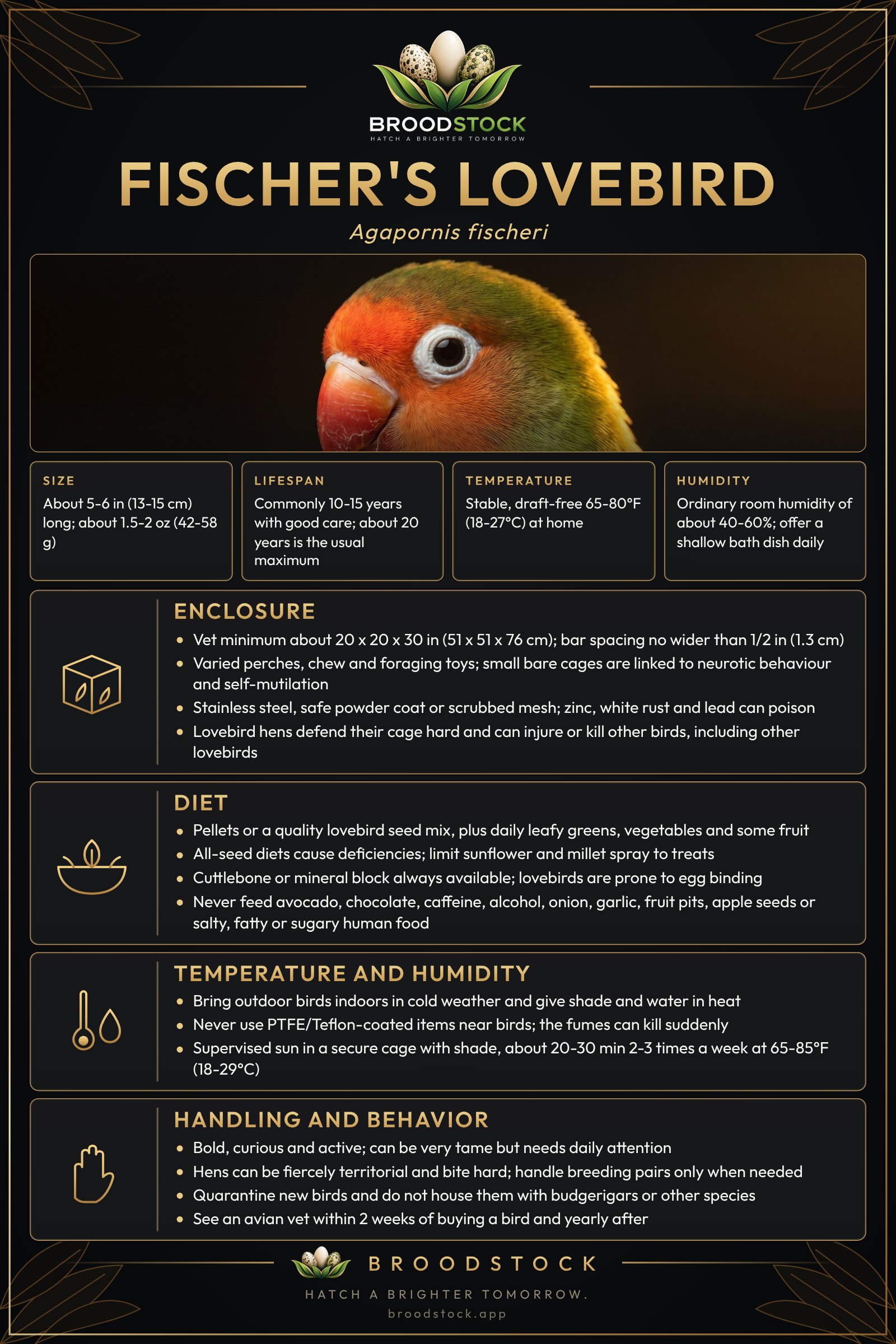
The care sheet is a one-page summary you can print or keep on your phone. The full care text is below.
Keeping Fischer's Lovebird? Broodstock tracks feeding, weights, sheds, enclosures and equipment for every animal you keep, and it is free to start.
Scientific name
Fischer's lovebird is Agapornis fischeri.
Adult size
These birds measure about 5-6 in (13-15 cm) long and weigh about 1.5-2 oz (42-58 g). The sexes are the same size, though hens often weigh slightly more.
Lifespan
10-15 years in captivity with good care is common. Some report 15-20 years, and about 20 years is the figure usually given as the top end.
Enclosure
A vet minimum for a lovebird cage is about 20 x 20 x 30 in (51 x 51 x 76 cm), with bar spacing no wider than 1/2 in (1.3 cm). Fit perches in several thicknesses, ideally natural branches, and supply chew toys, foraging toys and a shallow bath dish. Neurotic behaviour and self-mutilation have been tied to small, bare cages.
Lovebird hens defend their cage and nest hard and can injure or kill other birds, including other lovebirds, so keep one pair per cage when breeding. Bring outdoor birds indoors in cold weather, and keep the room away from kitchen fumes.
Use stainless steel, safe powder coat or well-scrubbed mesh. New galvanised (zinc-coated) wire, 'white rust' and old lead solder or paint can poison birds that chew them. Scrub new mesh with a wire brush and dilute vinegar, rinse well before birds go in, and repeat if white rust forms.
Temperature
Stable, draft-free household temperatures of about 65-80°F (18-27°C) suit them. Outdoor aviaries need a sheltered roost, and birds belong indoors when it turns cold. An exact safe outdoor minimum is not well documented. Provide shade and water in hot weather.
Humidity
Normal room humidity, about 40-60%, is fine. A shallow bath dish should be offered daily, since they like to bathe.
UVB
Unfiltered natural sunlight is the best source. Give supervised time outside, in a secure cage with shade available, for about 20-30 minutes 2-3 times a week at 65-85°F (18-29°C). UVB does not pass through window glass. For fully indoor birds, an option is an avian UVB fluorescent tube or compact bulb mounted above the cage for at least 3-4 hours a day and replaced about every 6 months. This is general avian vet guidance, not lovebird-specific studies. End UVB exposure if the bird squints, rubs its face, or develops red skin around the eyes. Laying hens and birds fed mostly seed gain the most from it.
Lighting
Pets need about 10-12 hours of light and 12-14 hours of dark and quiet. A hen that lays chronically needs her nest box and nest material taken away and a shorter day. An avian vet may recommend as little as 8 hours of light if she will not stop.
Heating
Put a sick or egg-bound hen in a warm, humid hospital cage and get her to an avian vet.
Never use pans, drip pans, irons, heat lamps or heaters with a non-stick (PTFE/Teflon) coating near birds. Overheated PTFE gives off colourless, odourless fumes that can kill birds suddenly, even in another room.
Diet
In the wild they feed mostly on grass and plant seeds, grains, small figs and other fruit. In captivity, feed a base of formulated pellets or a quality small-parrot or lovebird seed mix (canary seed, millets, some oats, a little hemp), and many keepers combine both. Add daily leafy greens and vegetables and some fruit (apple, pear, banana). All-seed diets cause nutritional deficiencies, so limit sunflower and millet spray to treats. Provide fresh water daily. Never feed avocado, chocolate, caffeine, alcohol, onion or garlic, fruit pits, apple seeds, or salty, fatty or sugary human food.
Supplements
Always have cuttlebone or a mineral block available. Hens that are laying must have a dependable calcium supply, because egg binding is especially common in lovebirds. Pellet-fed birds rarely need extra vitamins. Seed-fed birds benefit from a bird vitamin and mineral supplement with vitamin A and D3, used as the label directs and not stacked with pellets. Grit is not needed for seed-hulling parrots, and sick birds may overeat it. Keepers differ on routine water-soluble supplements. Putting nutrients in food gives you better control of the dose.
Shedding
Adults molt at least once a year, often after the breeding season, sometimes in a slow rolling molt. Juveniles show a duller face and a dark mark at the beak base, and reach full adult colour after the first molt at about 4-6 months. Give extra protein (egg food) during a molt. Take the bird to an avian vet for feather loss outside a molt, bald patches or chewed feathers, which can mean self-mutilation, mites or PBFD.
Handling
These birds are bold, curious and active. They chatter with whistling and chirping that peaks at dawn and dusk, and they are not known as talkers. They are generally considered gentler than many other lovebird species, especially in aviaries. A single hand-raised bird can be very tame but needs daily attention and chew toys, while bonded pairs often focus on each other and care less about people. Hens guard their cage and nest fiercely and bite hard, so handle breeding pairs only when you need to.
Health signs to watch
Egg binding is an emergency: the hen sits on the floor, fluffed, eyes closed, tail bobbing, straining, with a swollen belly. Other concerns are chronic egg laying, soft-shelled eggs, chlamydiosis (psittacosis, which can infect people), bite wounds from cagemates or aggressive hens, and nutritional deficiencies when birds eat only seed.
PBFD (psittacine beak and feather disease) and polyomavirus are both named in lovebirds by vet sources, so test new stock, quarantine new birds, and do not house lovebirds with budgerigars or other species. Self-mutilation and feather plucking come from stress, small cages or medical causes. PTFE (Teflon) fume poisoning may be behind sudden breathing trouble or death. Book an avian vet visit within 2 weeks of buying a bird, then once a year.
Welfare
Fischer's lovebird is Near Threatened in the wild (IUCN) and listed in CITES Appendix II, with wild trapping a main threat, so buy only captive-bred birds. To prevent fatal fights, house only one pair per cage during breeding.
Keep every animal's care in one place
Log feedings, weights and sheds, set reminders, and let Ranger, the built-in AI manager, help with the rest. Free to start, no card needed.