
Broodstock / Care sheets / Frilled Dragon
Frilled Dragon Care Sheet
Chlamydosaurus kingii, the frilled dragon, frilled lizard or frillneck
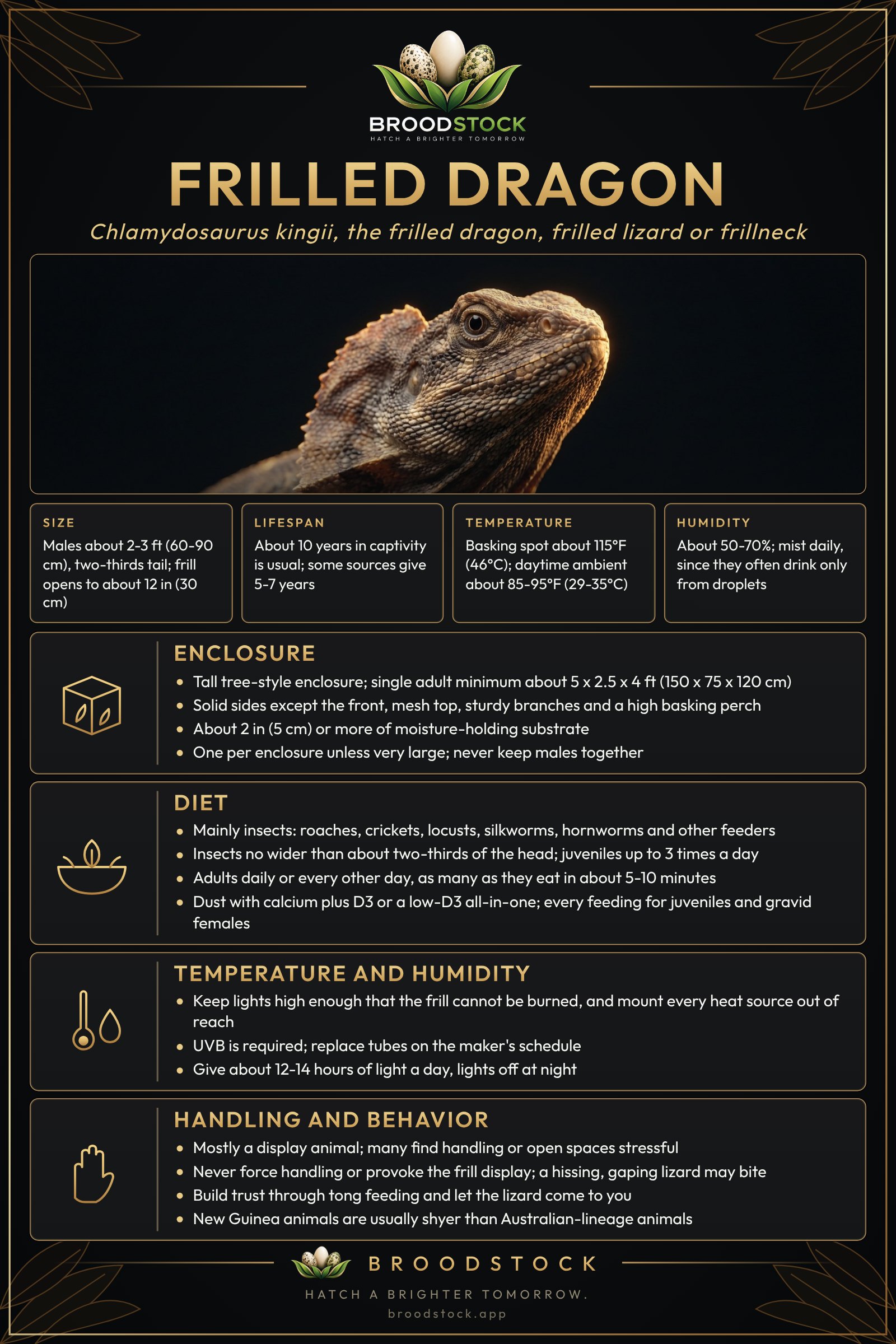
Print it or save it
The care sheet is a one-page summary you can print or keep on your phone. The full care text is below.
Keeping Frilled Dragon? Broodstock tracks feeding, weights, sheds, enclosures and equipment for every animal you keep, and it is free to start.
Scientific name
Chlamydosaurus kingii, known as the frilled dragon, frilled lizard or frillneck. It is a tree-dwelling agamid from northern Australia (Kimberley to Cape York and south to about Brisbane) and southern New Guinea (Trans-Fly region). The hobby recognises two forms: New Guinea animals, which are smaller and often wild-caught or farmed via Indonesia, and Australian-lineage animals, which are larger and available only as captive-bred descendants of older European stock. Record which form an animal is.
Adult size
Males reach about 2-3 ft (60-90 cm) in total length, roughly two-thirds of it tail. Australian-lineage males get to about 30-36 in (75-90 cm) and females about 22-28 in (55-70 cm), while New Guinea males measure about 24-26 in (60-65 cm) and females about 16-22 in (40-55 cm). Large adults weigh about 1.3 lb (600 g) or more, and the frill can spread to about 12 in (30 cm) across.
Lifespan
About 10 years in captivity is the usual figure, though some give 5-7 years. Wild males reportedly live about 6 years and females about 4.
Enclosure
Use a tall, tree-style enclosure, since height matters more than floor area. One guide gives a minimum of about 5 x 2.5 x 4 ft (150 x 75 x 120 cm) for a single adult; another gives 3 x 2 x 4 ft (90 x 60 x 120 cm) for a single New Guinea animal. A pair or trio needs about 4 x 2.5 x 5 ft (120 x 75 x 150 cm) or more, and many keepers go up to 6 ft (180 cm) tall. A 20-gallon tall tank is a workable start for juveniles up to about 12 in (30 cm).
Cover all sides except the front with solid panels so the lizard feels secure, and use a mesh top for ventilation. Fit plenty of sturdy vertical, diagonal and horizontal branches, a high basking perch, and live or artificial foliage. Lay about 2 in (5 cm) or more of moisture-holding substrate: soil, coco fibre and sand mix, or cypress mulch.
House one per enclosure unless it is very large. A dominant cagemate stresses and starves a submissive one, and males should never share an enclosure.
Temperature
Set a basking spot at about 115°F (46°C) on a high branch, with the lights far enough away that the frill cannot be burned. Daytime ambient is about 85-95°F (29-35°C). Nights run about 70-80°F (21-27°C), commonly in the mid-70s°F (about 24°C).
Humidity
Aim for about 50-70%, with several guides targeting about 70%. Frilled dragons often drink only from droplets, so mist daily: about 3 times a day for juveniles and 1-2 times a day for adults, and also provide a shallow water dish. Sunken eyes and skin that stays tented when pinched signal dehydration.
UVB
UVB is required. One guide recommends a T5 HO 6% or ReptiSun 5.0 tube (about 34 in for a 5 ft enclosure), housed in a reflective fixture over the basking side so that the lizard's head sits about 11-12 in (28-30 cm) beneath it. Older guides mention mercury vapour or fluorescent UVB. Replace tubes on the maker's schedule.
Lighting
Give about 12-14 hours of light a day; in one guide the schedule is about 13 hours in summer and 11 in winter. A 6500K daylight LED or T5 should be added. Switch lights off at night.
Heating
Over the high basking branch, mount a cluster of halogen flood bulbs on a dimming thermostat, spaced wide enough to warm the whole body. Where background or night heat is needed, use ceramic heat emitters or radiant heat panels on a thermostat. Every heat source must be mounted out of the lizard's reach.
Diet
Feed mainly insects: roaches, crickets, locusts or grasshoppers, silkworms, hornworms, black soldier fly larvae, superworms and mealworms. Juveniles eat up to 3 times a day, with insects no wider than about two-thirds of the head. Adults eat daily or every other day, taking as many insects as they will eat in about 5-10 minutes. Some will eat a little finely chopped greens or fruit and many refuse it, so a small bowl is optional. Some keepers give large adults a pinky or fuzzy mouse about every two weeks (practices vary).
Supplements
Dust insects with calcium plus D3, or with a low-D3 all-in-one such as Repashy Calcium Plus LoD. Do this at every feeding for juveniles and gravid females, and about every other feeding for yearlings and adults.
Shedding
Shedding is not well documented. The skin comes off in patches. Poor sheds usually point to low humidity or dehydration, so mist more and provide a humid area.
Handling
Treat it mainly as a display animal. Some captive-bred frillies are calm, yet handling or open spaces stress many of them. Never force handling, and never provoke the frill display: a lizard that is frilling, gaping and hissing is stressed and may bite. Build trust through tong feeding and let the lizard approach you. New Guinea animals are usually shyer than Australian-lineage ones.
Brumation
Wild frilled dragons do not truly brumate. In the long dry season they climb high into big trees, eat little and lower their metabolism.
Health signs to watch
Dehydration is the most common problem, and they need misting, not just a bowl. Wild-caught or farmed imports often carry parasites and are stressed, so quarantine them and run a fecal test on arrival. Basking lights mounted too low can burn the frill. Pinched or damaged toes and tails can become necrotic, and lost tails do not regrow. A dominant cagemate may bully the others.
Without UVB and calcium, metabolic bone disease develops. Small or young females can become egg bound.
Welfare
Australia and Papua New Guinea ban export of wildlife, and Indonesia lists the frilled lizard as protected, yet most animals in the trade have come out through Indonesia. The species is hard to breed, and some 'captive-bred' animals are likely wild-caught, so buy from breeders you can verify. Imported animals commonly arrive stressed, dehydrated and heavily parasitised.
This is an advanced species. It needs a tall, hot, humid enclosure with daily misting, and many individuals never enjoy handling.
Keep every animal's care in one place
Log feedings, weights and sheds, set reminders, and let Ranger, the built-in AI manager, help with the rest. Free to start, no card needed.