Broodstock / Care sheets / Frog-eyed Gecko
Frog-eyed Gecko Care Sheet
Teratoscincus scincus, also sold as the common wonder gecko or Russian frog-eyed gecko
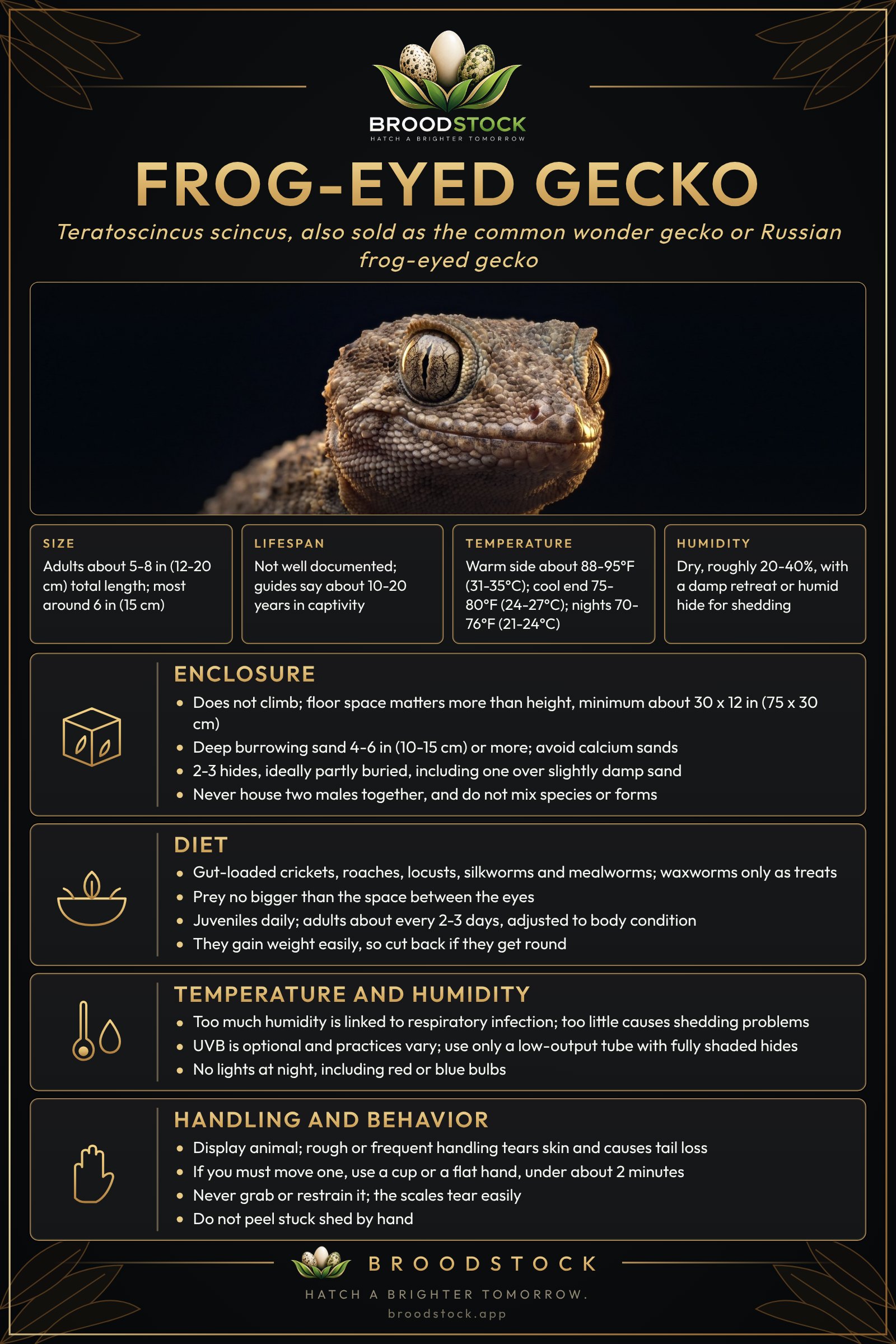
Print it or save it
The care sheet is a one-page summary you can print or keep on your phone. The full care text is below.
Keeping Frog-eyed Gecko? Broodstock tracks feeding, weights, sheds, enclosures and equipment for every animal you keep, and it is free to start.
Scientific name
The species is Teratoscincus scincus, sometimes sold as the common wonder gecko or Russian frog-eyed gecko. Its former subspecies T. s. rustamowi is now treated as a separate species (T. rustamowi). Two related species are also marketed as 'frog-eyed geckos': T. roborowskii (China) and T. keyserlingii (Iran, UAE). Keepers advise against mixing these forms in one enclosure, so confirm which species an animal is.
Adult size
This stocky little ground-dweller has an oversized head, huge eyes, and a stubby, thick tail clad in big overlapping scales. Adults are about 5-8 in (12-20 cm) in total length, most around 6 in (15 cm), and females run slightly smaller than males. Nobody has published a dependable weight range for captives.
Lifespan
Lifespan is not well documented. Published care sheets say about 10-20 years in captivity, with one quoting 12-20, and one vet-reviewed page lists both 10 and 20. Plan on 10 or more years with good care.
Enclosure
This burrowing desert gecko does not climb, so floor area and substrate depth matter more than height. For one adult or a sexed pair, the minimum floor is about 30 x 12 in (75 x 30 cm), and 30 x 18 in (75 x 45 cm) or a tank 3 ft (90 cm) long is preferred.
Substrate should be 4-6 in (10-15 cm) or more of sand that holds burrows, or sand mixed with soil or clay (roughly 70% sand, 30% soil is one recipe). One breeder uses 6 in of desert bedding topped with 2 in of loose sand. Avoid calcium sands. Provide 2-3 hides, ideally partly buried (one guide suggests 3 in PVC pipe set at an angle into the sand), including one over slightly damp sand. Enclosures made of wood or opening at the front hold heat well, provided they are well ventilated.
Two males must never share an enclosure, and different species or forms should not be mixed.
Temperature
The warm-side ground or basking surface should reach about 88-95°F (31-35°C). A breeder of the related T. keyserlingii maintains a 100°F (38°C) hot spot over a day ambient of 90°F (32°C), while one T. scincus keeper holds days at 86-88°F (30-31°C). The cool end sits at about 75-80°F (24-27°C), and nights at about 70-76°F (21-24°C). Compared with T. roborowskii, T. scincus handles slightly higher temperatures.
Humidity
Keep the main enclosure dry, at roughly 20-40% (one guide says under 30%). Offer moisture deep in the substrate or under a hide, such as a slightly damp corner or a light misting of the cool-end sand about twice a week, so the gecko can choose a humid burrow. Too much humidity is linked to respiratory infection, and too little causes shedding problems. Keepers differ on how much to mist.
UVB
UVB is not strictly required for this nocturnal species. Some keepers consider low-level UVB beneficial, while others keep them without it (practices vary). If you use it, choose a low-output 5-6% linear tube over part of the enclosure only, with plenty of fully shaded hides, run on the day timer and replaced every 6-12 months.
Lighting
Run about 12 hours of light and 12 of dark on a timer. Use no lights at night, including red or blue bulbs.
Heating
Place overhead heat at one end (halogen or incandescent spot, or a ceramic emitter) on a dimming thermostat, so the sand surface underneath reaches the target. A low-wattage heat mat under one end, on a thermostat, is also used. Check sand surface readings with an infrared thermometer, and use probes for air temperature.
Diet
This is an insectivore and a very eager feeder. Offer gut-loaded crickets, dubia or other roaches, locusts, silkworms and mealworms (in an escape-proof dish), with waxworms only as occasional treats. Prey should be no bigger than the space between the eyes. Feed juveniles daily and adults about every 2-3 days, or 3-5 nights a week, adjusting to body condition. Because weight goes on easily, keep an eye on the tail and body, and reduce food once they look round. Include a shallow water dish.
Supplements
Dust insects with calcium at most feedings (without D3 if UVB is provided, with D3 if not), plus a reptile multivitamin about once a week. Some breeders use an all-in-one calcium plus multivitamin (Repashy Calcium Plus) at every feeding, so practices vary. Keepers commonly leave a small dish of plain calcium in the enclosure, particularly for females that are breeding.
Shedding
They shed in pieces like other geckos. Stuck shed usually means the enclosure lacks a moist retreat, so increase misting of the damp area or the humid hide rather than raising whole-tank humidity. Never pull shed skin off by hand, as the scales tear very easily.
Handling
This is a display animal, not one for regular handling. Skin tears and tails drop when the gecko is handled roughly or often. If you must move one, coax it into a cup or let it walk onto a flat hand, keep any session under about 2 minutes, and never grab or restrain it. When threatened, it may squeak or hiss, raise itself and rub its tail scales together to make a rattling sound.
Health signs to watch
Skin and scales are very fragile: they tear or fall off with grabbing or stress, and the tail drops readily (regrown tails are plainer). Many individuals become obese. Humidity set too high, or temperatures too low, usually precedes a respiratory infection. Missing calcium or D3 leads to metabolic bone disease, and a lack of a moist retreat leads to stuck shed. Many animals are still wild-caught imports, so quarantine new arrivals and have fecals tested.
Welfare
Imports still make up most of the frog-eyed geckos sold, and they are often stressed and parasitized, so captive-bred animals are the better choice. Handling tears their skin and makes their tails drop, which suits keepers who prefer to watch rather than hold. A bare tank will not do: they need deep, dry substrate they can dig in, plus a moist retreat. Monitor body condition closely, because obesity develops easily. Several Teratoscincus species and forms are sold under the same name.
Keep every animal's care in one place
Log feedings, weights and sheds, set reminders, and let Ranger, the built-in AI manager, help with the rest. Free to start, no card needed.