
Broodstock / Care sheets / Fruit Fly
Fruit Fly Care Sheet
Drosophila melanogaster (smaller, about 1/10 in or 2-3 mm) and Drosophila hydei (larger, about 0.14-0.2 in or 3.5-5 mm)
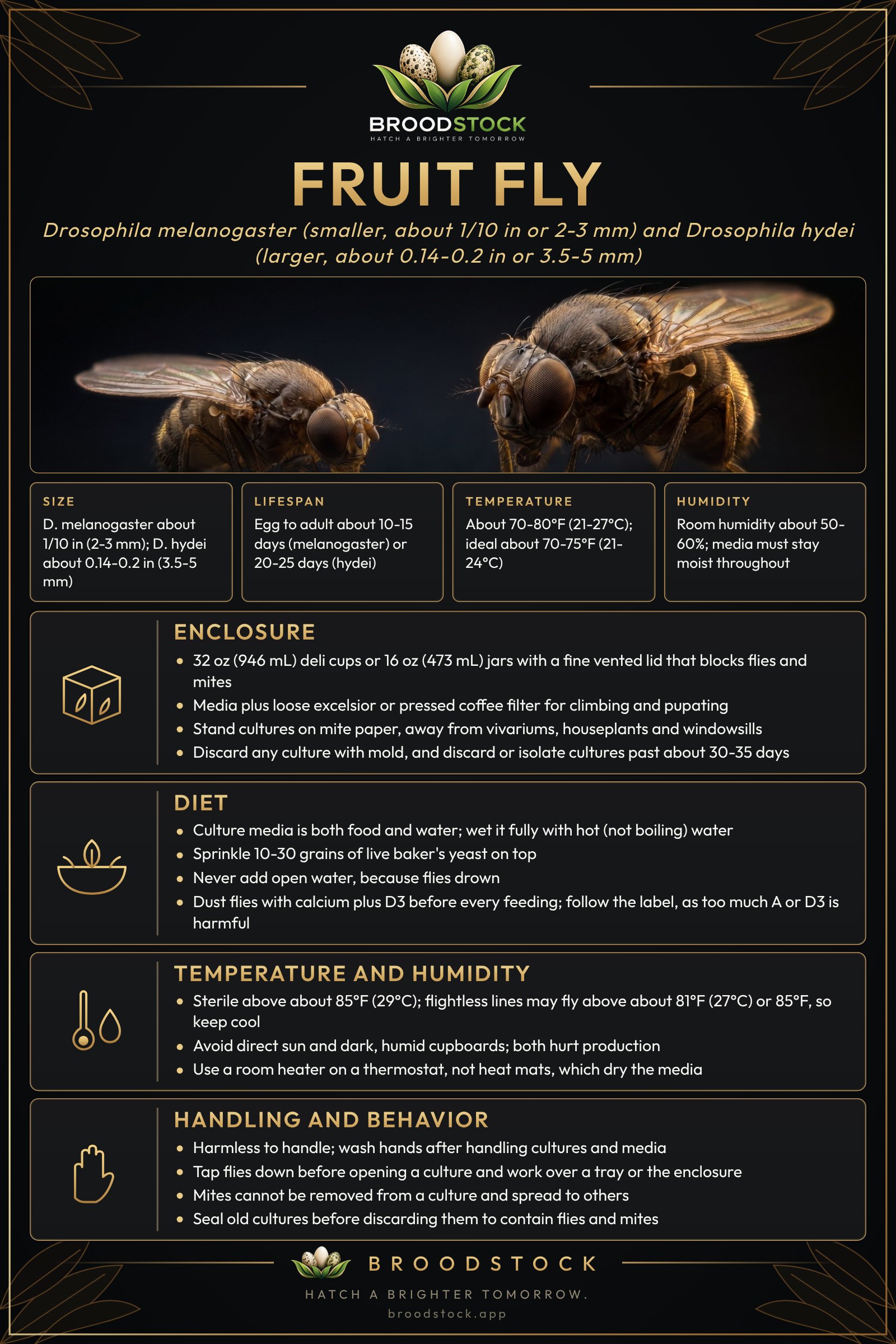
Print it or save it
The care sheet is a one-page summary you can print or keep on your phone. The full care text is below.
Keeping Fruit Fly? Broodstock tracks feeding, weights, sheds, enclosures and equipment for every animal you keep, and it is free to start.
Scientific name
Two species are used: Drosophila melanogaster, the smaller at about 1/10 in or 2-3 mm, and Drosophila hydei, the larger at about 0.14-0.2 in or 3.5-5 mm. Feeder lines carry inherited mutations that stop flight: flightless, wingless (apterous), vestigial-wing and 'Turkish glider' lines of melanogaster (the last glides but cannot fly upward), and flightless and golden lines of hydei.
Adult size
D. melanogaster adults are about 1/10 in (2-3 mm), and D. hydei adults about 0.14-0.2 in (3.5-5 mm). Hydei suit slightly larger froglets, chameleon hatchlings and small geckos, while melanogaster suits the smallest animals.
Lifespan
At room temperature, D. melanogaster takes about 10-15 days from egg to adult and D. hydei about 20-25 days. A melanogaster culture usually produces well until about day 30-35, whereas a hydei culture often keeps producing past day 35-40.
Enclosure
Use 32 oz (946 mL) deli cups or 16 oz (473 mL) jars with a fine vented lid (fiber or cloth filter) that lets air in but keeps flies and mites out. Each culture holds a layer of media with a loose ball of excelsior (shredded aspen) or several layers of coffee filter pressed into it, giving flies and larvae room to climb and pupate. Mark every cup with the species, line and date it was started. Stand cultures on mite paper, away from vivariums, houseplants and windowsills.
Temperature
Aim for about 70-80°F (21-27°C), with about 70-75°F (21-24°C) ideal. Above about 85°F (29°C) flies can become sterile. Some flightless lines (vestigial-wing melanogaster, flightless hydei) can also produce flying flies when warm. One source puts that threshold above about 81°F (27°C) and another above 85°F, so keep them cool to be safe. Production slows below about 65°F (18°C). Sterility sets in at lower temperatures for hydei than for melanogaster.
Humidity
Room humidity of about 50-60% works. The media must stay moist all the way through. Dry pockets slow production, and dry media is a leading cause of crashes, especially in warm, dry rooms. Storing cultures somewhere dark and very humid invites mold.
UVB
UVB is not needed. No care guide calls for UV lighting for fruit fly cultures.
Lighting
Ordinary room light is enough. Avoid direct sun, which overheats cultures. Also avoid storing them in a dark, humid cupboard, where mold grows and output drops.
Heating
Usually no heat is needed, because a room at normal temperature is ideal. Avoid shelves near heaters or lights, and remember that top shelves run warmer. If a room must be warmed, use a thermostat-controlled heater for the room instead of heat mats under cultures, which dry the media.
Diet
The culture media serves as both food and water. Recipes build on instant potato flakes with sugar and brewer's yeast, often with vinegar and a mold inhibitor, and commercial mixes are widely used. Wet the media fully with hot (not boiling) water so no dry spots remain, then sprinkle 10-30 grains of live baker's yeast on top, which feeds the larvae and holds back mold. Never add open water, because flies drown. If the media dries, mist it lightly (some keepers use diluted white vinegar).
Supplements
Fruit flies are low in calcium, so a diet of mostly unsupplemented flies is inadequate. Before every feeding, dust them with a calcium plus vitamin D3 product or an all-in-one supplement made for the animal being fed. Amphibian keepers also rotate in a vitamin A source, because amphibians need retinol, not beta-carotene. Follow the label, since too much vitamin A or D3 is harmful. Expired supplements are sometimes mixed into the culture media by keepers.
Shedding
Inside the media, larvae molt, and afterward they crawl up the excelsior or the walls to pupate in small brown cases. The keeper does not need to do anything.
Handling
They are harmless. Escaped flightless flies are a minor nuisance, so tap flies down before opening a culture and work over a tray or the enclosure. Insect allergy and fruit fly-specific disease risks are not well documented. Wash your hands after handling cultures and media.
Brumation
This does not apply. Cooler rooms slow production, but there is no reliable cold storage method for cultures, so plan for continuous production.
Health signs to watch
Mites (tiny tan to brown dots) are the main problem. They cannot be removed from a culture, they shorten its life and they spread to other cultures. Begin with clean cultures, use mite paper, and place cultures well away from enclosures and plants. Cultures older than about 30-35 days should be kept separate or thrown out. Throw away any culture showing black mold or other mold, particularly one that has not started producing.
Other causes of crashes are dry media, overheating (sterility), overcrowding, and contamination by wild flying fruit flies, which can turn a flightless culture into fliers within a few generations.
Welfare
Flightless lines must stay pure and apart from wild fruit flies, and cultures need to be cool enough that no flying flies appear. Before discarding old cultures, seal them so the flies and mites stay contained. In the US, Drosophila melanogaster is on the USDA APHIS list of species needing no plant pest permit for interstate movement within the contiguous states (not Alaska, Hawaii or US territories). D. hydei was not on that list, so check the rules before shipping it.
Keep every animal's care in one place
Log feedings, weights and sheds, set reminders, and let Ranger, the built-in AI manager, help with the rest. Free to start, no card needed.