
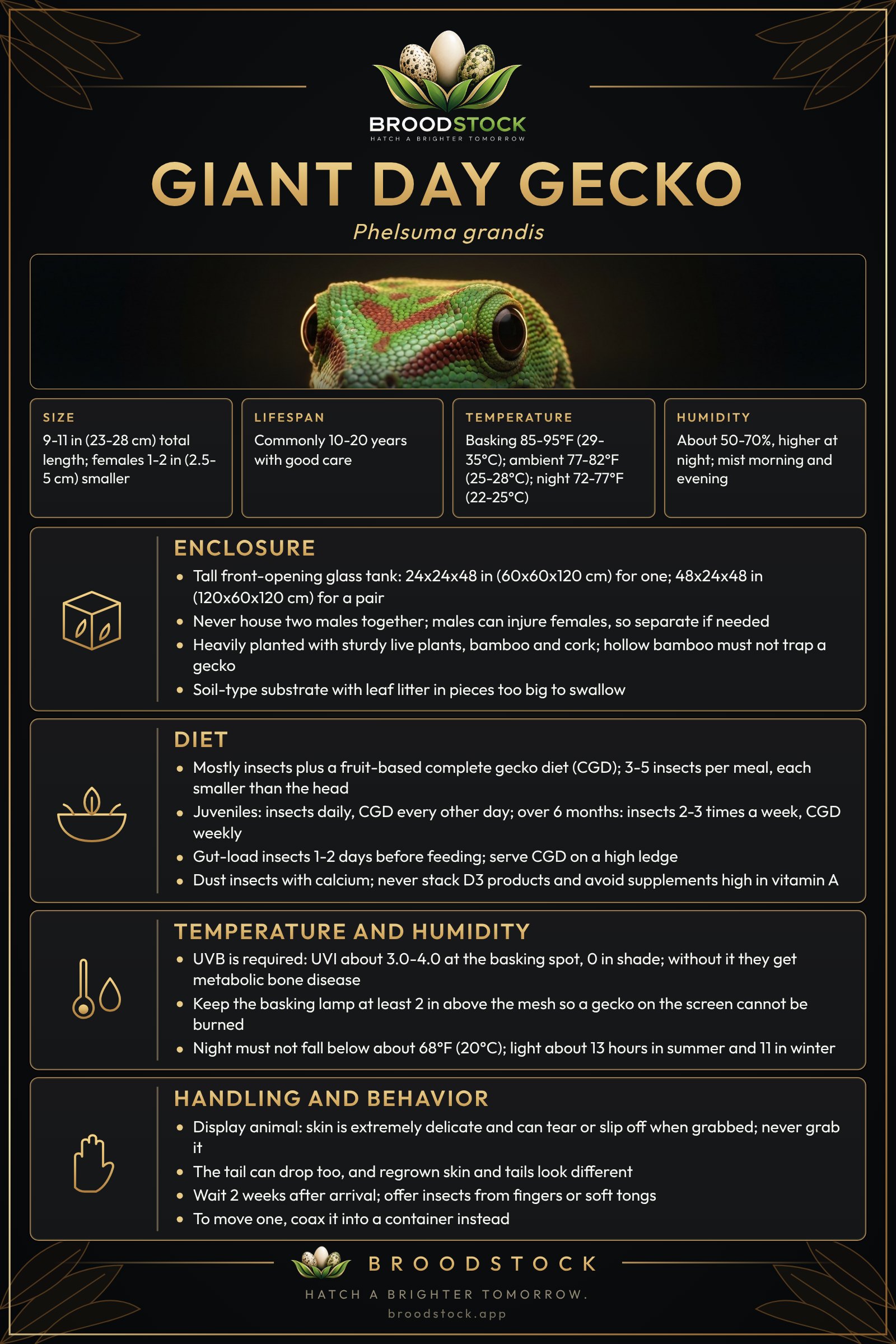
Print it or save it
The care sheet is a one-page summary you can print or keep on your phone. The full care text is below.
Keeping Giant Day Gecko? Broodstock tracks feeding, weights, sheds, enclosures and equipment for every animal you keep, and it is free to start.
Scientific name
Phelsuma grandis
Adult size
Adults usually measure about 9-11 in (23-28 cm) in total length, sometimes slightly more, which makes this one of the largest day geckos. Females are normally 1-2 in (2.5-5 cm) shorter than males. Typical adult weight is not well documented. Older references treated it as a subspecies of P. madagascariensis.
Lifespan
Good care commonly gives 10-20 years, with 15-20 cited by one guide and a captive average of about 15. An older care sheet gave an average of only 6-8 years, probably reflecting poorer husbandry.
Enclosure
Use a tall, front-opening glass enclosure with good ventilation. One adult needs at least 24x24x48 in (60x60x120 cm), and a pair needs about 48x24x48 in (120x60x120 cm).
Plant it heavily with sturdy live plants (sansevieria, dracaena, pothos, philodendron, bromeliads), and add smooth vertical bamboo, cork and magnetic ledges. Check that hollow bamboo openings are wide enough that a gecko cannot become stuck. For substrate, use a moisture-holding soil type with leaf litter, in pieces too large to swallow.
Keep a gecko alone, as a male-female pair, or as females only. Never house two males together. Males can also injure females, so separate them when needed. These geckos are fast and jumpy, so open doors with care.
Temperature
The basking surface should reach 85-95°F (29-35°C); one guide uses 85-90°F, others about 95°F. Keep the daytime cool zone or ambient air at 77-82°F (25-28°C), though some guides allow up to the mid 80s°F. Nights run 72-77°F (22-25°C) (one guide gives 73-77°F), and the temperature should not fall below about 68°F (20°C).
Humidity
An average of about 50-70% suits them (some guides allow 40-75%), and it should be higher at night. Mist in the morning and evening, since most giant day geckos drink droplets off leaves and glass rather than from a bowl, though a ledge bowl should still be present. Under about 50% humidity, stuck shed becomes more likely, while very wet, stagnant air breeds bacteria.
UVB
UVB is required, because this is a diurnal basking species. Target a UVI of about 3.0-4.0 at the basking spot near the top (Ferguson Zone 3), dropping to 0 in shade. A gecko kept without UVB develops metabolic bone disease (secondary hyperparathyroidism).
Over mesh, one guide gives these distances in a reflector fixture: Arcadia ShadeDweller 4-6 in (10-15 cm), and Arcadia Forest 6% or ReptiSun 5.0 T5 HO 7-9 in (17-23 cm). A vet-written guide uses 10-12 in for T5 HO, so confirm with a Solarmeter 6.5 instead of trusting distance alone. Replace tubes every 12 months, or as the maker says.
Lighting
Run about 13 hours of light in summer and 11 hours in winter, changing gradually; 12/12 also works. Over at least half the enclosure, add a bright 5000-6500K LED or plant light, which keeps the plants alive and brings out color. Turn lights off at night.
Heating
Use an overhead basking lamp on the mesh. One guide suggests two bulbs of roughly 40 W incandescent in ceramic-socket domes, and others use a single 50 W basking bulb. Put a dimmer or thermostat on it, with the probe at the basking surface. Mount the lamp at least 2 in above the mesh so a gecko clinging to the screen cannot be burned. Add night heat only when the room drops below the night range.
Diet
Feed mostly insects plus a fruit-based complete gecko diet of the crested gecko type, such as Repashy or Pangea. One guide feeds juveniles (0-6 months) insects daily and CGD every other day, and animals over 6 months insects 2-3 times a week and CGD once a week. Elsewhere, adults are given insects twice a week.
Offer about 3-5 insects per meal, each smaller than the head: crickets, roaches, locusts, small hornworms and silkworms, plus flightless fruit flies for young ones. Gut-load insects 1-2 days beforehand. Put CGD on a high ledge instead of the floor.
Supplements
Every insect meal should be dusted with calcium. Practices vary with the UVB setup: with good UVB, one guide uses calcium without D3 (e.g. Arcadia CalciumPro Mg), while others use calcium plus D3 and a weekly multivitamin. Never stack D3 products, and avoid supplements high in vitamin A. Fortification is already built into CGD.
Females that are laying should have a small dish of calcium available.
Shedding
These geckos shed in patches and often eat the skin. Stuck shed is common when humidity falls under about 50%, or when stress or skin infection is present. Mist the gecko, then free pieces with great gentleness. Never pull, as the skin tears easily. Stuck shed that persists calls for a vet visit and a review of your husbandry.
Handling
This is a display animal. Its skin is extremely delicate and can tear or slip off when grabbed, which works as a defense against predators, and the tail can drop as well. Regrown skin and tails look different. Leave a new arrival alone for 2 weeks. Interact by offering insects from your fingers or soft tongs, or let it lick a dab of CGD off a finger. Grabbing it is never acceptable. If one must be moved, coax it into a container.
Brumation
No brumation is needed. A gradual seasonal shift in day length, about 13 h in summer to 11 h in winter, is enough in captivity.
Health signs to watch
Quarantine any new animal. See a reptile vet for any of these: metabolic bone disease (weakness, tremors, trouble climbing, swollen limbs, soft or rubbery jaw, deformities); torn or sloughed skin from grabbing or fights; stuck shed; lasting dark, dull color (stress or illness); weight loss or refusing food; burns; a female straining or unable to lay (egg binding); or a laying female whose neck calcium sacs shrink.
Welfare
Handle as little as possible, because the skin is so fragile. Laying drains calcium, so a laying female needs calcium available.
The species is established in Florida and Hawaii, and invasive on Mauritius and Reunion, where it threatens native day geckos. Never release unwanted animals.
Keep every animal's care in one place
Log feedings, weights and sheds, set reminders, and let Ranger, the built-in AI manager, help with the rest. Free to start, no card needed.