
Print it or save it
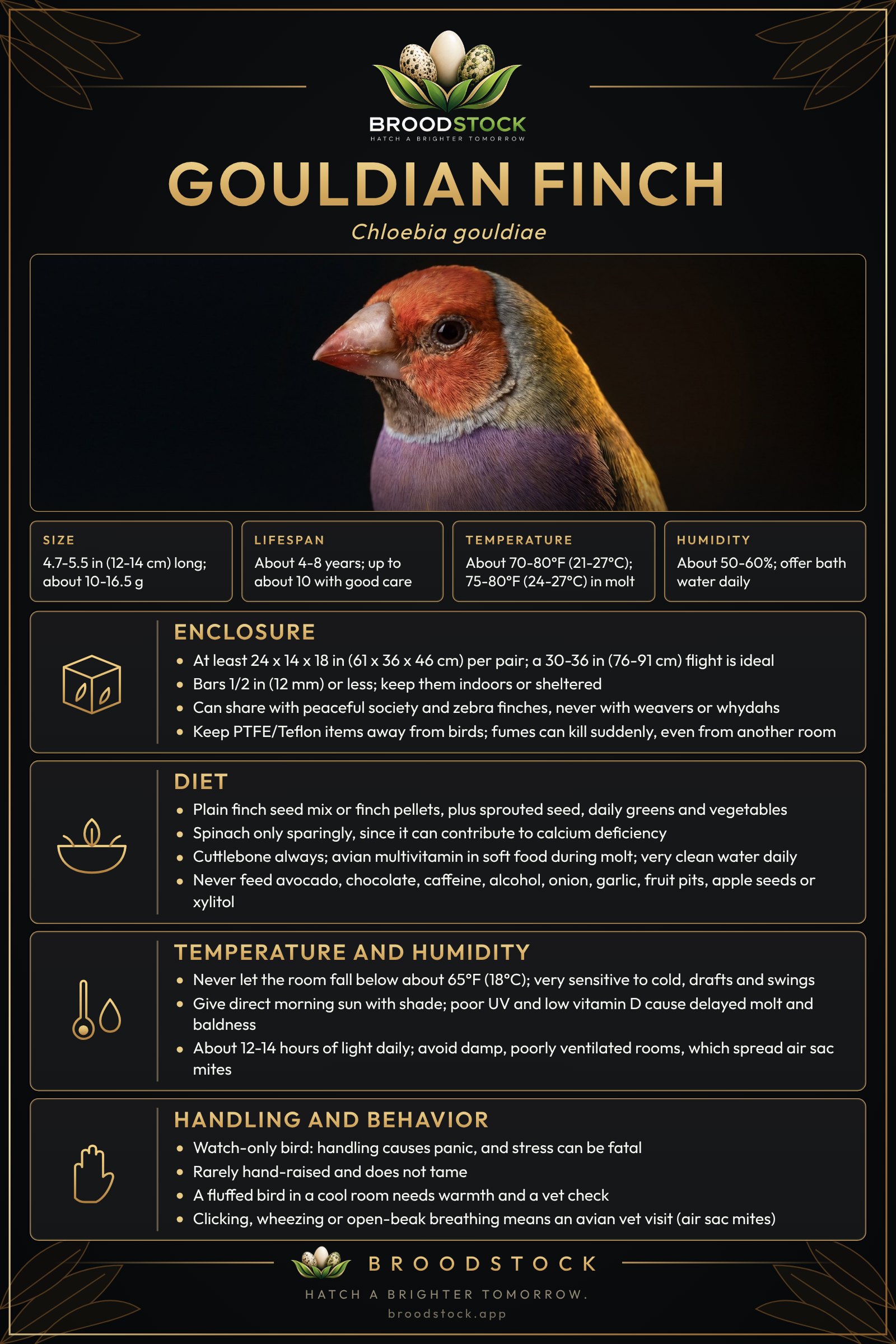
The care sheet is a one-page summary you can print or keep on your phone. The full care text is below.
Keeping Gouldian Finch? Broodstock tracks feeding, weights, sheds, enclosures and equipment for every animal you keep, and it is free to start.
Scientific name
Chloebia gouldiae
Adult size
Length is about 4.7-5.5 in (12-14 cm). Weight runs 10-16.5 g and is usually near 15 g, with cocks at 10-16.3 g and hens at 14.3-16.5 g.
Lifespan
Captive birds typically live about 4-8 years, and up to about 10 with good care.
Enclosure
Allow at least about 24 x 14 x 18 in (61 x 36 x 46 cm) for each pair. The ideal is a 30-36 in (76-91 cm) flight or a planted aviary. Bars should be 1/2 in (12 mm) or narrower.
If you keep several pairs together, use only established pairs and watch for pairs competing for nest sites. Gouldians can share space with peaceful society and zebra finches, but not with weavers or whydahs. Keep them indoors or sheltered.
Keep PTFE/Teflon-coated items (non-stick pans, some heat lamps, heating elements, irons) well away from birds. Their fumes can kill birds without warning, even when the source is in a different room.
Temperature
Hold the room at about 70-80°F (21-27°C), and aim for 75-80°F (24-27°C) during molt. The room must never drop below about 65°F (18°C). Heat is well tolerated when shade and water are available, but these finches are very sensitive to cold, drafts and sudden swings. If a bird sits fluffed up in a cool room, warm it and have a vet look at it.
Humidity
Aim for about 50-60%. Damp, humid, badly ventilated rooms should be avoided, since they favour the spread of air sac mites. Give bath water daily.
UVB
Sunlight matters more to this species than to most finches. Poor UV exposure and low vitamin D are among the causes of delayed molt and baldness, and aviaries that catch morning sun help. Provide direct morning sun in a flight that also has shade.
Indoors, evidence for UVB bulbs in birds is mixed. A bird-specific full-spectrum/UVB lamp on the normal day cycle is optional, and flickering fluorescent tubes should be avoided. The diet must also supply vitamin D3. How to choose a lamp type and its distance is not well documented.
Lighting
Provide about 12-14 hours of light each day.
Heating
Heat the whole bird room, using a thermostat to hold it at or above 65°F (18°C). Heat sources with a PTFE/Teflon coating (non-stick pans, some heat lamps, heaters, irons) must stay away from birds, because their fumes quickly kill small birds.
Diet
Base the diet on a plain finch seed mix (for instance equal parts canary, white, red and Japanese millet) or finch pellets. Add sprouted and half-ripe seed, plus greens and vegetables daily. Use spinach only sparingly, since it can contribute to calcium deficiency. Give very clean water daily.
Offer egg food at about 16% protein during molt. Outside breeding, avoid an overly rich diet.
Never give these to the birds: avocado, chocolate, caffeine, alcohol, onion or garlic, fruit pits or apple seeds, xylitol, and salty, fatty or sugary human food.
Supplements
Keep cuttlebone available at all times, along with small amounts of grit and charcoal. Put an avian multivitamin in soft food during molt. Iodine supports the molt, but only as part of a balanced molt diet, never on its own. Birds kept indoors without sun must be given vitamin D3.
Shedding
Juveniles are drab greenish-grey and molt into adult colours at about 4-6 months. That first molt is highly stressful, so keep them warm and well fed. Adult birds molt once a year, taking 3-4 months. It begins around July in the Southern Hemisphere and around January to February in the Northern Hemisphere.
Patchy baldness on the head usually means a delayed or failed molt, caused by stress, poor nutrition, low sunlight or air sac mites.
Handling
This is a watch-only bird. Handling causes panic, and the stress can be fatal. They are rarely hand-raised and do not tame.
Health signs to watch
See an avian vet for any of these: clicking, wheezing or open-beak breathing (air sac mites; Gouldians are among the most prone finches, worse in humid, crowded rooms and during molt and breeding); a fluffed bird in a cool room (cold stress); head baldness or failed molt; crusty face or legs (scaly mites); diarrhea or wet vent (keep water and dishes very clean); feather loss from pecking by cagemates; a hen straining or on the floor (egg binding). For this species, stress alone can be deadly.
Welfare
Gouldians are more fragile than most Australian finches. They lack down, so shelter them from drafts, rain and temperature swings. Keep mite and worm control strict, as they are especially prone to air sac and scaly leg mites.
Wild populations are declining, and pure wild-type birds are harder to find. Blue-backed birds are widely reported to be weaker, with poorer disease resistance and higher losses in outdoor aviaries.
Keep every animal's care in one place
Log feedings, weights and sheds, set reminders, and let Ranger, the built-in AI manager, help with the rest. Free to start, no card needed.