
Print it or save it
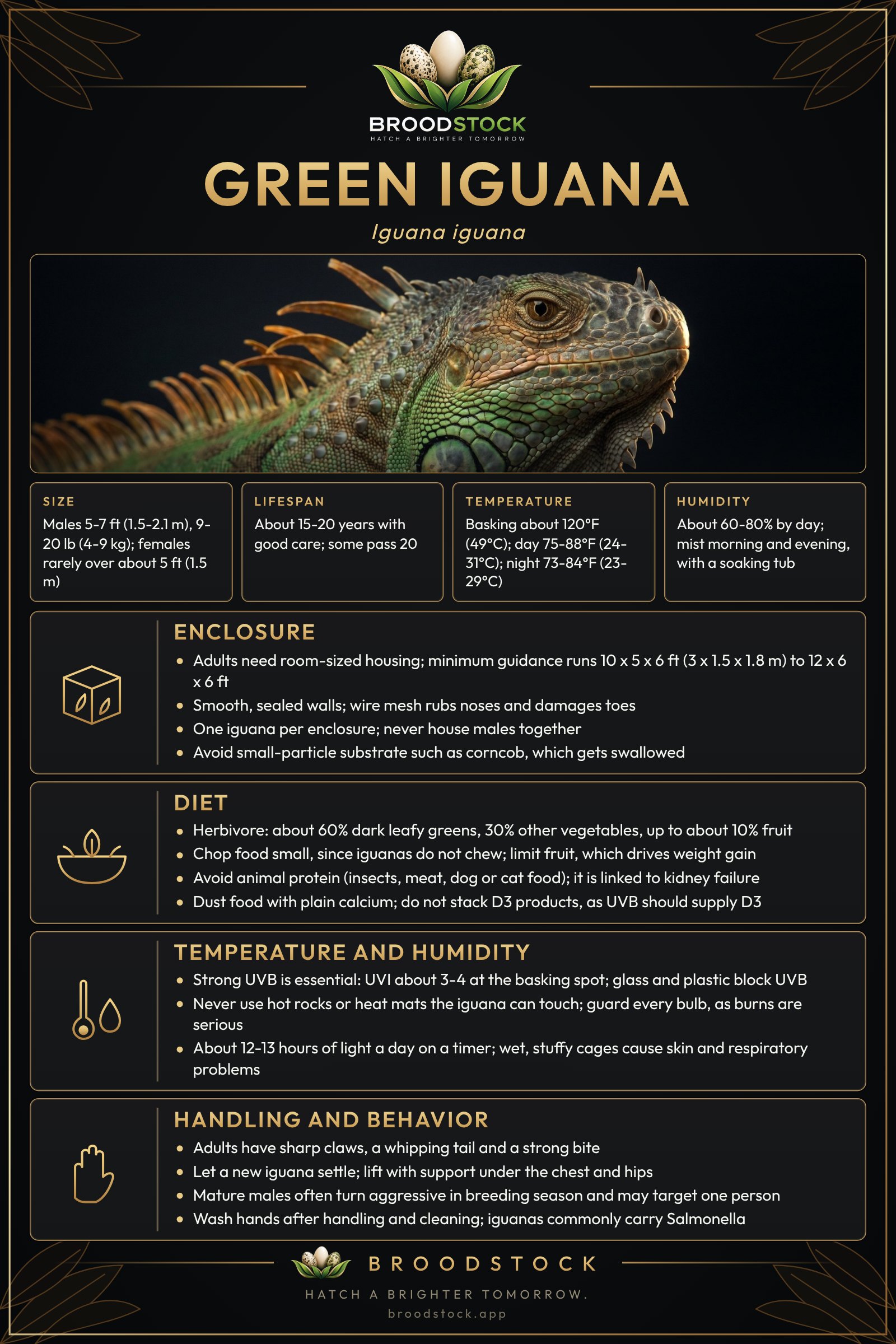
The care sheet is a one-page summary you can print or keep on your phone. The full care text is below.
Keeping Green Iguana? Broodstock tracks feeding, weights, sheds, enclosures and equipment for every animal you keep, and it is free to start.
Scientific name
Iguana iguana. A large, mostly plant-eating, tree-dwelling lizard from Central and South America (Sinaloa and Veracruz in Mexico south to Paraguay and southeastern Brazil) and many Caribbean islands. It has been introduced and become invasive in southern Florida, Hawaii and other places.
Red, blue and 'axanthic' colour forms are still Iguana iguana. The Lesser Antillean iguana (I. delicatissima) is a different, endangered species. Every Iguana species has been on CITES Appendix II since 1977, so shipping across borders needs permits.
Adult size
Green iguanas get very large. Males commonly reach 5-7 ft (1.5-2.1 m) in total length, mostly tail, and weigh about 9-20 lb (4-9 kg). Females seldom exceed about 5 ft (1.5 m). Hatchlings are about 7-10 in (17-25 cm) long and about 0.4 oz (12 g), and the tiny baby seen in a shop reaches adult size within a few years.
Lifespan
With good care, expect about 15-20 years, and some live past 20. Many captive iguanas die much younger because of mistakes with diet, UVB and housing.
Enclosure
Adults need housing the size of a room. Guidance on the minimum ranges from 10 x 5 x 6 ft (3 x 1.5 x 1.8 m) to 12 x 6 x 6 ft (3.6 x 1.8 x 1.8 m), and height matters because they live in trees. Many keepers convert a room or build a custom enclosure. A juvenile enclosure of about 4 x 2 x 4 ft (1.2 x 0.6 x 1.2 m) is outgrown at about 3 ft (90 cm), and a 20-gallon tank suits only hatchlings up to about 18 in (45 cm).
Walls should be smooth and sealed, because wire mesh rubs noses and damages toes. Add sturdy horizontal and diagonal branches and shelves near the basking zone, a soaking tub large enough for the whole body, and live nontoxic plants if possible.
Substrate options are newspaper, outdoor carpet, or large-particle moist cypress mulch or coconut husk. Avoid small particles such as corncob or small bark, which get swallowed.
House one iguana per enclosure, and never keep males together. Do not let them roam loose unsupervised, because of chilling, injuries and Salmonella spread.
Temperature
The basking surface should be about 120°F (49°C), with the basking spot placed above the lizard. Daytime ambient air runs about 75-88°F (24-31°C), with the cool end in the low to mid 80s°F (27-29°C). Nights are about 73-84°F (23-29°C), though one vet hospital sheet gives 80-85°F (27-29°C). Nights should not drop much below the low 70s°F (22°C).
Humidity
Aim for about 60-80% by day (one vet sheet gives 65-75%); higher at night is fine. Mist in the morning and evening and provide a soaking tub. Many keepers also run a supervised soak of about 20 minutes, 1-2 times a week. Fill foggers and misters with distilled or RO water. Condensation running down the walls signals too little ventilation, and wet, stuffy cages lead to skin and respiratory problems.
UVB
UVB is essential, because strong UVB prevents metabolic bone disease. One guide recommends a T5 HO tube (Arcadia Dragon 14%, Arcadia Desert 12% or Zoo Med ReptiSun 10.0) covering about half the enclosure length in a reflective fixture, aiming at a UVI of about 3-4 at the basking spot. With mesh between lamp and lizard, mount it about 12-16 in (30-41 cm) away depending on the tube, and further away without mesh.
Check output with a Solarmeter 6.5. UVB cannot pass through glass or plastic. Replace tubes on schedule; older vet guidance says every 6-9 months.
Lighting
Run lights about 12-13 hours a day on a timer, and off at night. Add a bright 6500K LED or T5 daylight fixture over most of the enclosure. Natural sunshine in warm weather is valuable when it comes through mesh, never glass.
Heating
Use overhead heat only: two or more halogen flood bulbs for a juvenile and four or more for an adult, above a wide basking shelf and controlled by a dimming thermostat. For background and night heat, mount a radiant heat panel on the ceiling with a thermostat. Never use hot rocks or heat mats the iguana can touch, since they have caused serious burns. Put a guard over every bulb so the iguana cannot reach it.
Diet
Iguanas are herbivores. Feed roughly 60% calcium-rich dark leafy greens (collard, turnip, mustard and dandelion greens, escarole, bok choy and similar), roughly 30% other vegetables (squash, green beans, bell pepper, sweet potato, okra and similar) and up to about 10% fruit. Edible flowers such as hibiscus and dandelion can be added. Cut food into pieces small enough to swallow, since iguanas do not chew.
Juveniles eat daily or twice daily, and adults eat daily or every other day. Avoid animal protein (insects, meat, dog or cat food), as high-protein diets are linked to kidney failure. Fruit drives weight gain and loose stools, so limit it.
Practices vary on spinach and similar high-oxalate greens. Some lists include them, others advise limiting them because they bind calcium, and most keepers keep them occasional.
Supplements
Calcium is the key. Dust food with plain calcium (no phosphorus) or a herbivore all-in-one such as Repashy SuperVeggie. One vet hospital schedule gives juveniles calcium 4-5 times a week plus a multivitamin twice a week, and adults calcium weekly plus a multivitamin once or twice a month. UVB, not powder, should be the main source of vitamin D3, and D3 products must not be stacked.
Shedding
Sheds come off in patches. Beyond humidity advice, shedding is not well documented. Stuck shed on toes, tail tip and dorsal spines usually points to low humidity, so mist more and offer soaks instead of pulling off skin.
Handling
Hatchlings seldom bite but are nervous, so let a new iguana settle before handling it much. An adult comes with sharp claws, a tail that whips and a strong bite. Mature males often turn aggressive in breeding season and may single out one person, so expect that and plan safe handling. Support the chest and hips when you pick one up. Wash hands after every handling session and after cleaning, and never wash iguana items in kitchen sinks.
Brumation
Not applicable: green iguanas are tropical and are never brumated, and no cooling period is used in captivity.
Health signs to watch
Metabolic bone disease (soft jaw, swollen limbs, twitching, fractures) results from poor UVB or calcium. Protein-rich diets and chronic dehydration lead to kidney disease. Burns come from heat rocks, mats and unguarded bulbs, and swallowed substrate or artificial plants can block the gut. Cagemates and falls cause injuries.
Adult females can form and lay eggs without a male. Egg binding (lethargy, straining, not eating) needs a vet promptly. Also watch for coccidia and other parasites. Iguanas commonly carry Salmonella without showing signs.
Welfare
Abandonment is common, and green iguanas rank among the reptiles most often given up. Cheap babies grow into adults of 5-7 ft (1.5-2.1 m) that need room-sized housing, strong UVB, daily fresh greens and 15-20 years of care, and mature males can become aggressive. Released and escaped pets have built invasive populations.
In Florida the green iguana has been a Prohibited species since April 29, 2021. Owners already keeping pets had until July 28, 2021 to apply for a no-cost permit and PIT-tag (microchip) their animals, and outdoor caging had to meet FWC standards (180 days, to October 26, 2021). Other states and countries have their own rules, so check before buying, selling or shipping.
For Salmonella, the CDC advises that children under 5, people with weak immune systems and homes with babies under 1 should not have reptiles. Wash hands after handling, keep iguanas out of kitchens, and never let them roam food areas.
Keep every animal's care in one place
Log feedings, weights and sheds, set reminders, and let Ranger, the built-in AI manager, help with the rest. Free to start, no card needed.