
Print it or save it
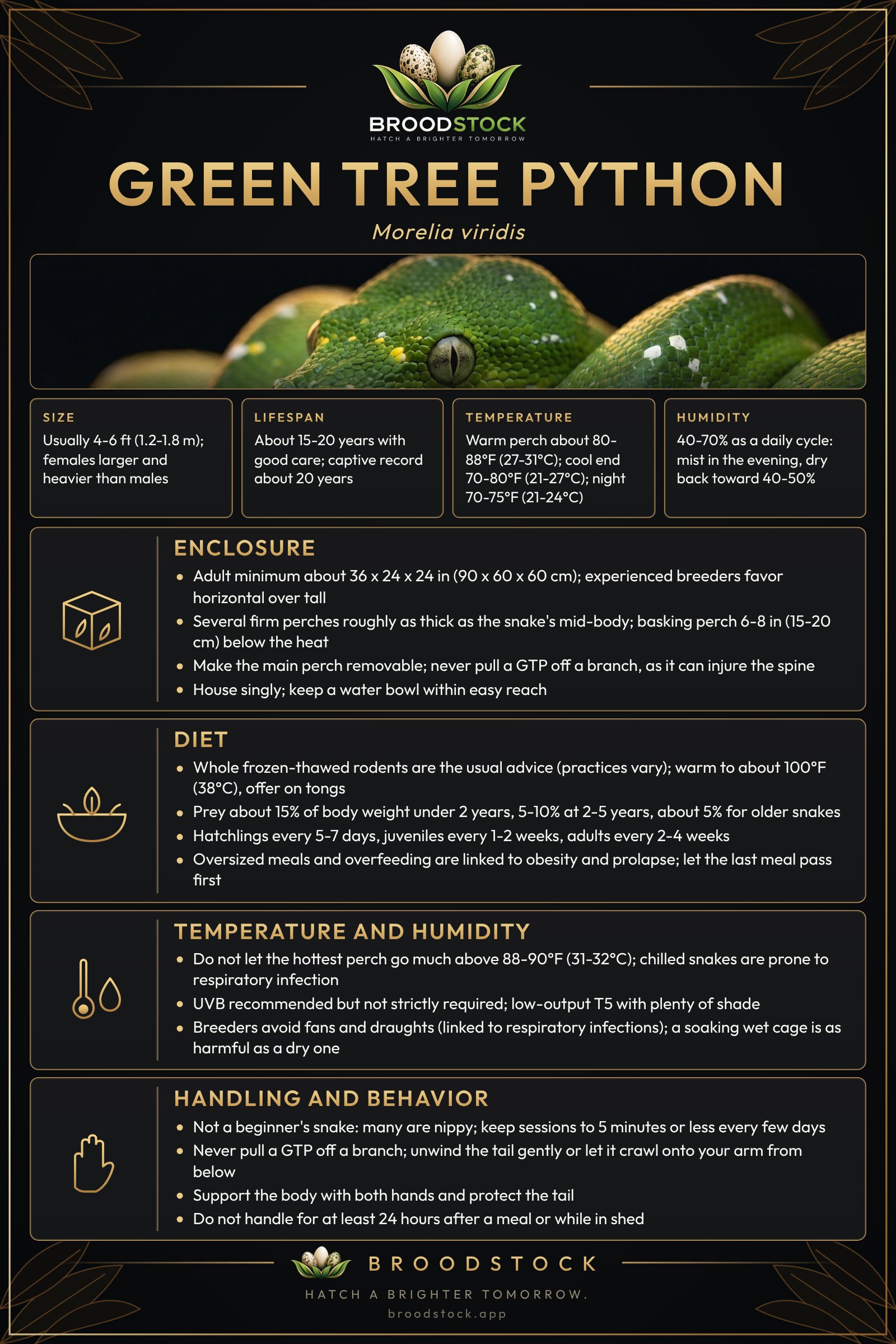
The care sheet is a one-page summary you can print or keep on your phone. The full care text is below.
Keeping Green Tree Python? Broodstock tracks feeding, weights, sheds, enclosures and equipment for every animal you keep, and it is free to start.
Scientific name
Morelia viridis
Adult size
Adults usually reach about 4-6 ft (1.2-1.8 m). One guide gives an average of 40-51 in (1-1.3 m), with females to about 63 in (1.6 m), and large females can reach about 6.5 ft (2 m). Females are bigger and heavier than males.
Captive adults typically weigh about 2.4-3.1 lb (1,100-1,400 g) for males and up to about 3.5 lb (1,600 g) for females, with exceptional females at about 4.9 lb (2,200 g). Wild snakes are lighter. Hatchlings measure about 10-12 in (25-30 cm) and only about 0.2-0.3 oz (6-9 g; one zoo clutch averaged 8.5 g).
Lifespan
Expect about 15-20 years with good care; the captive record is about 20 years. Some sheets quote 12+ years, so 20+ is possible but not typical.
Enclosure
This is an arboreal species, but the shape of the cage matters more than its height. An adult needs at least about 36 x 24 x 24 in (90 x 60 x 60 cm), front-opening. A common breeder layout is 36-48 in long, 18-24 in deep and about 24 in tall (90-120 x 45-60 x 60 cm). Experienced breeders favor a horizontal cage over a tall one, because GTPs sit on the highest perch whatever the temperature, so a tall cage can leave the gradient unused and the snake far from its water.
Perches are the key furniture. Fit several sturdy, firmly fixed horizontal and diagonal branches, each about as thick as the snake's mid-body (one keeper guide gives half to the full girth). Avoid dowels and soft woods that mildew. Set one perch end about 6-8 in (15-20 cm) below the heat source as the basking perch, and another within about 12 in (30 cm) of the floor as a hunting perch. Make the main perch removable, so you can move the snake on it instead of pulling it off.
Add foliage for cover and a water bowl the snake reaches easily. Use 2-4 in (5-10 cm) of soil/coco fiber mix or cypress mulch as substrate, or simply damp newspaper, and spot clean daily.
Hatchlings go in individual tubs (about 13 x 8 x 4.5 in, 33 x 20 x 11 cm) with a simple perch, water and heat. Keep each snake housed alone.
Temperature
The warm (basking) perch should be about 80-88°F (27-31°C). Two guides give 80-86°F (27-30°C), while experienced breeders run a perch-height gradient of about 78-88°F (26-31°C), with the hot end around 84-88°F (29-31°C). The hottest reachable perch must not go much above 88-90°F (31-32°C). The cool end is 70-80°F (21-27°C).
Nights run about 70-75°F (21-24°C) and should not fall below about 70°F (21°C), because chilled GTPs are prone to respiratory infection. Some breeders run their nights warmer. Measure at perch height, with one probe on the basking branch and another in the shaded middle of the cage.
Humidity
Think of humidity as a daily cycle of about 40-70%, not a constant. Mist in the evening (and morning if needed), so it peaks after misting, then let the cage dry back toward about 40-50% before the next misting. It should rise at night and fall during the day.
Ventilation has to allow that drying. Constant wetness, condensation or mildew means too little airflow or too much misting, while bad sheds together with fast drying mean too much airflow. Breeders steer clear of fans and draughts, since respiratory infections have been tied to them. Too wet does as much harm as too dry.
UVB
UVB is recommended but not strictly required when feeding whole prey, and keepers differ on it. Ferguson Zone 1 (a crepuscular or shade dweller) gives a basking-zone UVI of about 0.6-1.4, while one guide aims higher, at UVI 2.0-3.0 at the basking perch, with plenty of shade. Fit a low-output T5 with a reflector over the warm side, covering half to two-thirds of the cage.
That guide gives distances to the snake's back. Arcadia ShadeDweller MAX: 6-8 in (15-20 cm) over mesh or 8-10 in (20-25 cm) without mesh. Zoo Med ReptiSun 5.0 or Arcadia Forest 6% T5 HO: 9-11 in (23-28 cm) over mesh or 12-15 in (30-38 cm) without (Dubia gives 10-12 in over mesh, 13-15 in without). To hit the lower Zone 1 target, hang the tube higher and verify the reading with a Solarmeter 6.5. Swap the tube out every 12 months.
Lighting
Use a timer for 12 hours on and 12 off, with full darkness at night. A 6500K LED or plant light over most of the cage is recommended.
Heating
Heat from above, over the basking perch. Options are several low-wattage halogen floods (one guide suggests at least four 35 W in two domes) or two higher-wattage incandescent bulbs, on a dimming or proportional thermostat. Many breeders prefer a radiant heat panel at one end, on a proportional thermostat. Shield every heater that the snake might touch or wrap itself around. If nights fall below range, use a radiant panel or other lightless heat on a thermostat. Some PVC and plastic cages hold heat poorly.
Diet
Feed whole frozen-thawed rodents (mice, rats, African soft-furred rats, hamsters, gerbils), with occasional quail or chicks. Warm prey to about 100°F (38°C) and offer it on tongs, ideally around dusk. Frozen-thawed is the usual recommendation; some keepers feed live, and practices vary. In the wild, GTPs eat mainly small rodents, sometimes lizards.
Prey for this species should be small, at about 15% of body weight under 2 years, 5-10% at 2-5 years and about 5% for older snakes, and never wider than the snake's thickest point. Hatchlings eat every 5-7 days, juveniles every 1-2 weeks and adults every 2-4 weeks, adjusted to body condition. Let the last meal pass before feeding again. In this species, obesity and prolapse have been tied to overfeeding and oversized meals.
Fresh water must always be available, and many GTPs also drink droplets after misting.
Supplements
Supplements are optional, since whole prey covers the diet. Now and then (not every meal), dust prey lightly with an all-in-one calcium plus multivitamin. Use a low-D3 product (Repashy Calcium Plus LoD or Arcadia RevitaliseD3) when UVB is present, and one with standard D3 when it is not. Do not stack D3 products. Gut-loading does not apply.
Shedding
Before a shed the eyes cloud and the colour dulls. Dry or patchy sheds usually mean humidity is too low or ventilation too strong. Mist more (some keepers mist twice daily with warm water during a shed), then check the tail tip and eye caps afterwards.
For stuck shed, give a short soak in shallow warm water in a secure tub, then help gently. Never peel dry skin. How often this species sheds is not well documented.
Handling
This is not a beginner's handling snake. Many are nippy, and one guide names Biak-type lines as more defensive. Those that tolerate it do well with short sessions (5 minutes or less every few days, built up slowly), and some breeders avoid handling neonates during their first year. Use the removable perch to move the snake where possible.
Never pull a GTP off a branch. Gently unwind the tail or let the snake crawl onto your arm, coming from below instead of above. Hold the body with both hands and keep the tail safe. Do not handle for at least 24 hours after a meal or while in shed.
Brumation
Green tree pythons do not brumate.
Health signs to watch
Prolapse (rectal or cloacal tissue outside the vent) is the classic GTP problem. Breeders suggest causes including chronic mild dehydration with constipation, oversized meals, obesity, stress and poor muscle tone. Tissue left exposed dries out and is damaged fast, so keep it moist and see a reptile vet that same day.
Dehydration hits hatchlings and juveniles most, with wrinkled skin and sunken eyes as signs; a tall cage where the snake never comes down to water raises the risk. Also watch for respiratory infection (wheezing, mucus, open-mouth breathing; linked to cold and draughts), mouth rot, blister disease from wet dirty cages, regurgitation, constipation, obesity, mites and internal parasites, which are common in imported, wild-caught snakes, so get a fecal test. Pulling a snake off a perch can injure its spine. Weigh regularly, and see a reptile vet for any of the above.
Welfare
This is an intermediate-to-advanced species. It is listed on CITES Appendix II, so international trade needs permits. Indonesia is the only range country that exports, and only captive-bred animals, yet a study for the CITES Animals Committee found that many exports labeled captive-bred are wild-caught. Look up the rules in your state or country before you buy or sell. Buy captive-bred from a known breeder, since imports are often wild-caught, heavily parasitized and stressed.
Chronic dehydration and prolapse are the two big preventable killers. Watch hydration closely in neonates and juveniles, keep meals small and spaced, avoid obesity, and get the daily wet-dry humidity cycle and ventilation right rather than keeping the cage wet. Pulling a GTP off its perch risks a spine injury, so never do it. Like all reptiles they can carry Salmonella, so wash hands after handling snakes, prey or cage items. Expect losses in neonates (non-feeders and dehydration), so plan time for tease-feeding.
Keep every animal's care in one place
Log feedings, weights and sheds, set reminders, and let Ranger, the built-in AI manager, help with the rest. Free to start, no card needed.