
Broodstock / Care sheets / Hermann's Tortoise
Hermann's Tortoise Care Sheet
Testudo hermanni (T. h. hermanni, western; T. h. boettgeri, eastern)
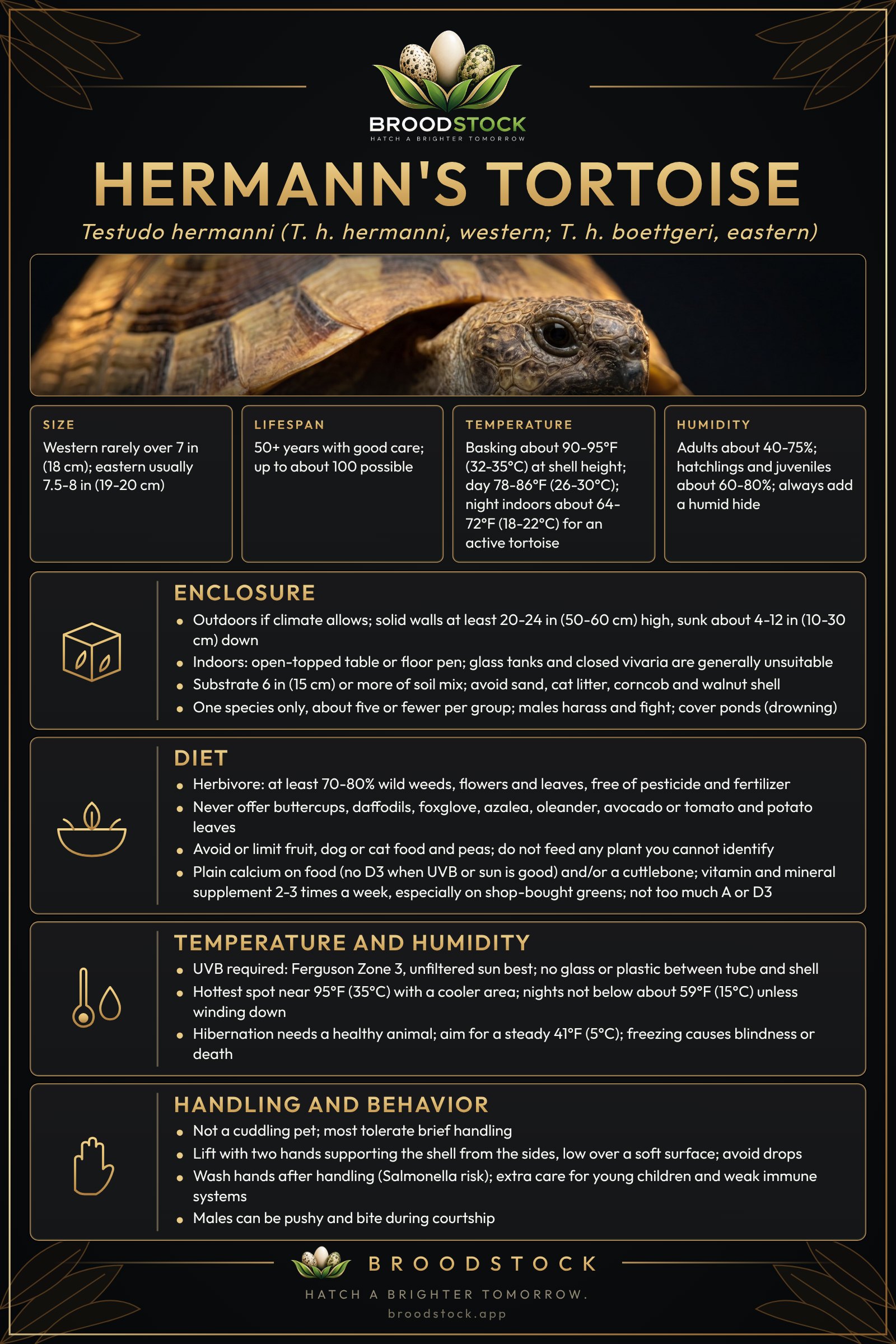
Print it or save it
The care sheet is a one-page summary you can print or keep on your phone. The full care text is below.
Keeping Hermann's Tortoise? Broodstock tracks feeding, weights, sheds, enclosures and equipment for every animal you keep, and it is free to start.
Scientific name
Testudo hermanni (T. h. hermanni, western; T. h. boettgeri, eastern)
Adult size
This is a small to medium tortoise, with females larger and broader than males. The western form (T. h. hermanni) rarely tops 7 in (18 cm), with typical adults near 5.5 in (14 cm) for males and 6.5 in (16.5 cm) for females. The eastern form (T. h. boettgeri) usually measures 7.5-8 in (19-20 cm) and exceptionally reaches about 11 in (28 cm), at which size it can weigh about 6.6-8.8 lb (3-4 kg).
Typical adult weights are not well documented. ADW lists 2-2.5 kg (4.4-5.5 lb), which fits large eastern females, and western animals are much lighter. Hatchlings measure about 1.2-1.3 in (31-33 mm).
Lifespan
These tortoises are long-lived: 50+ years with good care is expected, and up to about 100 is possible (LafeberVet says well into their 50s, possibly to 100). Wild lifespan is poorly documented, with about 30 years cited. Your tortoise may outlive you, so plan for that.
Enclosure
Outdoors is best whenever the climate allows; studies and vets rate an outdoor pen with a greenhouse or cold frame as the most suitable setup. Indoor housing is needed for cold or wet spells and for hatchlings. Make the outdoor pen as large as possible. Minimums vary widely, from about 12-24 sq ft (1.1-2.2 m²) (LafeberVet) to about 100 sq ft (10 m²) per tortoise (British Chelonia Group).
Build solid walls at least 20-24 in (50-60 cm) high and sunk about 4-12 in (10-30 cm) into the ground, with capped corners, since they climb and dig. Provide sun and shade, planted cover, a paved basking area, a shallow sunken water dish and a dry, raised, waterproof shelter. Add a well-ventilated greenhouse or cold frame with an exit hole so the tortoise can escape overheating (glass blocks UVB). Cover ponds, which pose a drowning risk.
Indoors, use an open-topped tortoise table or floor pen. Glass tanks and closed vivaria are generally unsuitable because ventilation is poor. One US care sheet asks for at least 22 sq ft (2 m²) indoors for an adult. For substrate, use 6 in (15 cm) or more of a diggable soil-based mix, and avoid sand, cat litter, corncob and walnut shell, which risk impaction.
In groups, keep one species only, with no more than about five per group and several hides, basking spots and feeding stations. Males harass females and fight, so keep single-sex groups or one male with several females.
Temperature
The basking spot should be about 90-95°F (32-35°C) at shell height (LafeberVet's Hermann's sheet). Some US care sheets go as high as 100-105°F (38-40°C), which is hotter than vet sources advise, so keep the hottest spot near 95°F (35°C) and always provide a cooler area to retreat to. The daytime gradient is about 78-86°F (26-30°C), with a cool end of about 68-77°F (20-25°C).
An active tortoise indoors needs nights of about 64-72°F (18-22°C), and nights should not fall below about 59°F (15°C) unless it is winding down for hibernation. Outdoors, adults cope with cool nights, but add shelter heat if nights drop below about 50°F (10°C). To keep a tortoise awake over winter, give 12-14 hours of light, 64-79°F (18-26°C) by day and 57-64°F (14-18°C) at night (figures vary).
Humidity
Adults need low to moderate humidity overall, about 40-75% (LafeberVet), because this is a Mediterranean species and constant damp can predispose to respiratory disease. Add a humid hide of damp sphagnum or soil. Hatchlings and juveniles need more, about 60-80%, with a humid hide, since dry rearing is linked to pyramiding (Wiesner & Iben 2003: dry conditions gave taller pyramids in sulcata tortoises).
Always have fresh water in a shallow dish the tortoise can climb out of, changed daily. Soak hatchlings daily and adults once or twice a week for 10-30 minutes in shallow warm water (about 75°F (24°C)), always supervised because of drowning risk.
UVB
UVB is required. Ferguson Zone 3 (open or partial-sun basker) means about UVI 1.0-2.6 over the sunny part of the enclosure, with a maximum of about 2.9-7.4 at the basking spot, dropping to 0 in shade. Unfiltered outdoor sun is the best source.
Indoors, use a high-output T5 HO 10-12% tube (e.g. Arcadia T5 HO 12% or ReptiSun 10.0) covering about half the enclosure length in a reflector, roughly 12-18 in (30-46 cm) above the shell (about 17-18 in (43-46 cm) suggested for a 12% T5 HO), with no glass or plastic in between. Measure with a Solarmeter 6.5 if possible, and replace every 6-12 months or as the maker directs.
Lighting
In the active season give about 12-14 hours of light (one US sheet: 14 h in summer, 10 h in winter), using bright white daylight lighting plus a light-emitting basking bulb, all off at night. In autumn, shorter days and lower heat begin the hibernation wind-down, while 13-14 hours of light with heat prevents hibernation.
Heating
Indoors, use overhead light-emitting basking bulbs (at least two halogen floods make a wide warm patch) at least 8 in (20 cm) from the shell, on a thermostat or dimmer. If night background heat is needed, use room heat, a ceramic emitter or a heat mat on the back wall, on a thermostat. Outdoors, a heated shelter or greenhouse corner covers cold snaps. Keep a separate digital max/min thermometer.
Diet
These are herbivores that need high fiber and calcium and low protein, fat and sugar. At least 70-80% of intake should be wild weeds, flowers and leaves such as dandelion, sow thistle, milk thistle, plantain, chickweed, bindweed, charlock and ice-plant sedum (not biting stonecrop, Sedum acre, which is poisonous), with clover and vetch in moderation, plus hibiscus, nasturtium, honeysuckle, rose, bramble and lilac leaves. Grazing an outdoor pen is ideal. Wash foraged plants, and use only pesticide- and fertilizer-free ones.
Wild Hermann's eat largely legumes, grasses and even buttercups, but do not copy that, because buttercups are toxic and must not be offered. When weeds are scarce, give a wide variety of mixed salad leaves, with a fibrous tortoise pellet (grass hay as first ingredient) as an extra. Avoid or limit fruit (sugar; a rare treat at most), high-protein foods (dog or cat food, peas), and too much of any one vegetable such as brassicas. In a 2018 survey of 1,075 keepers, summer diets with under 80% grasses and weeds went along with more pyramiding.
Toxic plants to keep out of pens and food: buttercups (Ranunculus), daffodils and other bulbs, foxglove, lily of the valley, lupin, sweet pea, larkspur, azalea, oleander, hydrangea, ivy, euphorbias, avocado, and nightshade-family leaves (tomato, potato). Do not feed any plant you cannot identify.
Serve food daily on a tile or dish in a bright spot, not under the lamp or on loose substrate.
Supplements
Calcium is the key supplement. Use plain calcium carbonate lightly on food or scattered daily (no D3 when UVB or sun is good), and/or a cuttlebone; laying females need much more. Also give a vitamin and mineral supplement 2-3 times a week, especially on shop-bought greens (UK vets alternate a calcium powder such as Calcidust with a vitamin/mineral product such as Nutrobal; a US sheet suggests a light dusting of Repashy SuperVeggie). Aim for a dietary calcium to phosphorus ratio of about 2:1 or higher. Do not overdose vitamin A or D3, as iatrogenic hypervitaminosis A is a recognized problem.
Shedding
Skin flakes off in small patches. Shell scutes are not shed; they grow at their edges and add growth rings. Retained shed on toes, tail, eyes or mouth (dysecdysis) points to dehydration or poor husbandry. Soak, check humidity, and see a vet if it persists.
Handling
This is not a cuddling pet, though most tolerate brief handling. Lift with two hands supporting the shell from the sides, stay low over a soft surface and avoid drops. Many learn to come when food is offered. Wash hands after handling because of Salmonella risk, with extra care around young children and people with weak immune systems. Courting males may push and bite.
Brumation
Hibernation is natural for this species, with wild adults sleeping about 4-5 months (about November to March-April). European keepers routinely hibernate healthy adults, and UK vets support it, but it must be done safely. Unwell or underweight animals are kept awake over winter instead. Practices vary for juveniles: some keepers skip the first winter, and UK vets (BSAVA) advise waiting until the 2nd-4th winter and then hibernating for only about 6 weeks.
Before starting, arrange a health check in late summer or autumn, with a vet exam and fecal parasite screen, and record weight and length. Do not hibernate an animal that was ill in the past year, is thin, or has eyes, nose or mouth that are not clean. To wind down, stop feeding so the gut empties (about 2-6 weeks, longer for big adults), keeping the tortoise warm for the first week or so to finish digesting. Then lower temperatures by about 9°F (5°C) per week and shorten the light. Bathe it in shallow warm water daily or every other day, so it goes in well hydrated with a full bladder. Once its body temperature is about 55°F (13°C), transfer it to the hibernation quarters.
Aim for a steady 41°F (5°C); about 39-46°F (4-8°C) is acceptable (BSAVA 41-46°F (5-8°C), RVC 36-48°F (2-9°C)). Freezing temperatures cause blindness or death, while warmth above about 50°F (10°C) burns fat and liver glycogen the tortoise needs on waking. Many UK vets favor the fridge method for its steady temperatures: a larder fridge without a freezer compartment, run and checked for weeks beforehand, with a digital max/min probe at the tortoise's level. The tortoise sits in a ventilated box with shredded paper or dry soil/sand and a small water container for humidity, and the door is opened about 30 seconds daily for air. The box method uses a rodent-proof, insulated outer box holding an inner box of shredded paper (no hay or straw), in a frost-free garage or shed with a max/min thermometer; it is riskier because of temperature swings and rats. Letting it bury itself in the garden without management is not advised.
Adults hibernate about 8-12 weeks. BSAVA and LafeberVet give about 3 months as the maximum, and Langford Vets 16 weeks at the very most; juveniles about 6 weeks. Unmanaged hibernations of 5-6 months in cold climates cause metabolic stress. Weigh weekly on the same scale. Expect to lose about 1% of starting weight per month; faster loss is a warning sign (Langford Vets advises waking it). Wake and check the tortoise if total loss passes about 5-10% (BSAVA 5%, RVC 8-10%, Langford 10%; figures vary, so the stricter one is safer), if it urinates, if it is restless, or if the temperature leaves range.
To wake it, let it warm at room temperature for a few hours, then give normal heat and light. Give warm baths (water to the chin) for at least 10-30 minutes once or twice daily for about a week so it drinks and empties its bladder. Offer moist foods first, then the normal diet, and check eyes, nose and mouth for discharge or cheesy plaques. It must drink, urinate and eat within about 7 days of waking. If it does not, see a vet promptly. Should cold weather come back, keep the tortoise awake indoors and do not let it settle again.
Health signs to watch
Watch for respiratory disease (nasal discharge, bubbles, watery eyes, open-mouth breathing), caused by Mycoplasma and other bacteria. Herpesvirus (TeHV-1, TeHV-3) can be fatal, often appears in spring and spreads through mixing species or new arrivals. Other problems: mouth infection (stomatitis, cheesy plaques), often after hibernation; post-hibernation anorexia and frost blindness (circling, not feeding); metabolic bone disease (soft shell) from low calcium, poor UVB or excess protein; pyramiding; liver lipidosis (overfed, inactive, unhibernated females); egg retention when there is no good nest site; bladder stones, kidney disease, roundworms and other internal parasites.
Never use ivermectin in chelonians, as it is toxic. Arrange an annual vet check, quarantine new tortoises for at least 3-6 months, and act if a tortoise refuses food for more than about a week outside the pre-hibernation fast.
Welfare
Legal status: CITES Appendix II and EU/UK Annex A. Any commercial sale in the EU and UK needs an Article 10 certificate. For captive-bred animals under 60 mm it is transaction-specific, and once over 60 mm (formerly 100 mm) it is specimen-specific with an ISO microchip.
In the US, 21 CFR 1240.62 covers tortoises as well as turtles. It bans selling, holding for sale or giving away (commercially or publicly) any with a carapace under 4 in (10 cm), plus viable eggs, except for bona fide scientific, educational or exhibition use (not as pets), transfers not connected with a business, and export-only shipments. CITES paperwork and state rules also apply.
Never mix tortoise species, because of herpesvirus and other disease. Errors in hibernation (freezing, too warm, too long, unfit animals) are a major cause of blindness and death. Males that keep pursuing females injure them.
Keep every animal's care in one place
Log feedings, weights and sheds, set reminders, and let Ranger, the built-in AI manager, help with the rest. Free to start, no card needed.