
Broodstock / Care sheets / Hornworm
Hornworm Care Sheet
Manduca sexta (tobacco hornworm), the caterpillar of a large sphinx (hawk) moth
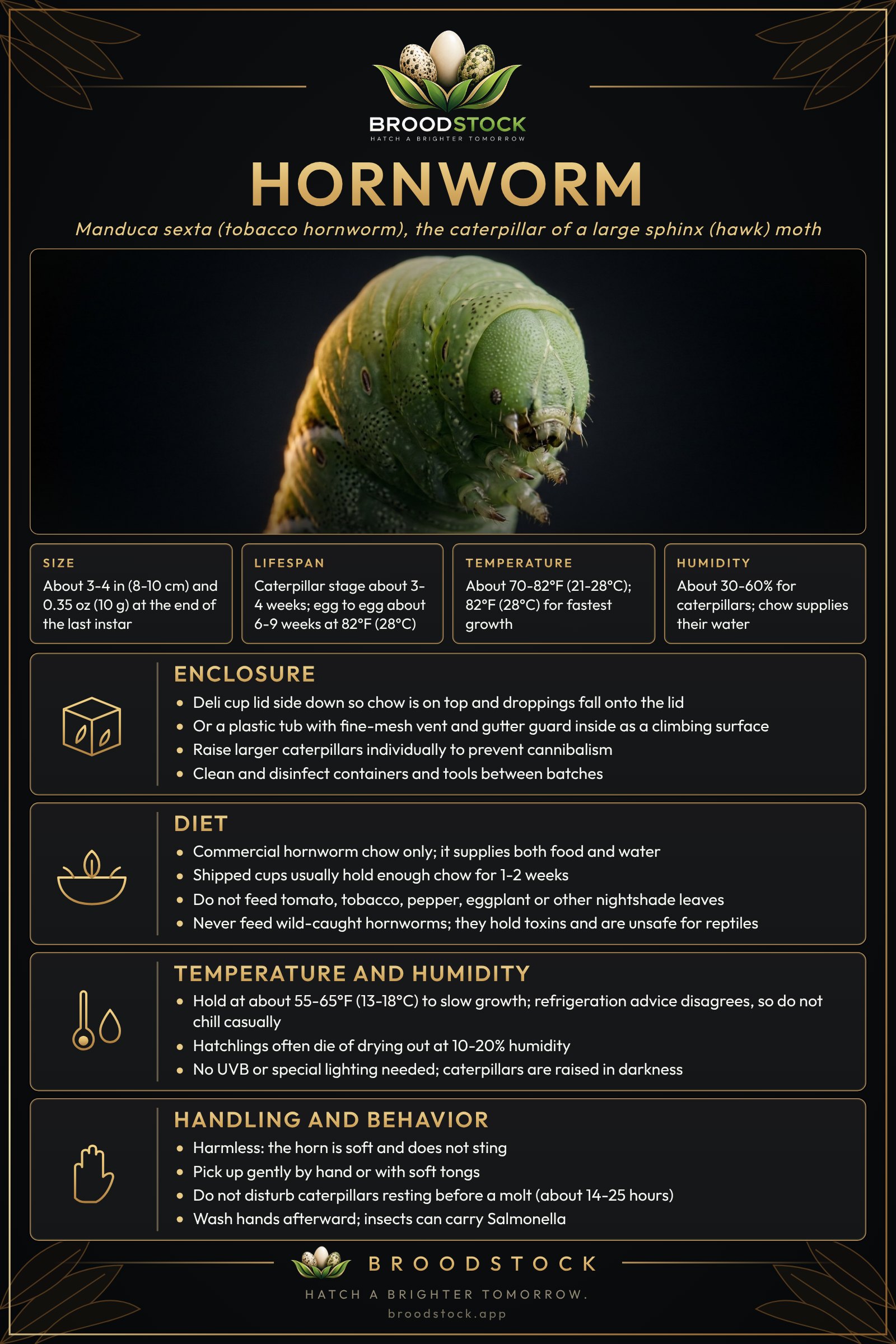
Print it or save it
The care sheet is a one-page summary you can print or keep on your phone. The full care text is below.
Keeping Hornworm? Broodstock tracks feeding, weights, sheds, enclosures and equipment for every animal you keep, and it is free to start.
Scientific name
The species is Manduca sexta (tobacco hornworm), which is the caterpillar of a big sphinx (hawk) moth. Almost all feeder hornworms are captive-bred M. sexta raised on artificial chow, which tints them blue-green.
Adult size
By the end of the last instar, caterpillars reach about 3-4 in (8-10 cm) and about 0.35 oz (10 g). Growth is rapid, and within days one can become too big for a small reptile. Moth size is not well documented.
Lifespan
At about 82°F (28°C), eggs hatch in 3-5 days. The caterpillar stage lasts about 3-4 weeks (around 25 days to pupation), the wandering prepupal stage about 3-8 days and the pupa about 2-5 weeks, and moths live about 5-10 days. A full egg-to-egg cycle takes about 6-9 weeks.
Enclosure
For feeder cups, keep the deli cup lid side down: the chow sits on top, and droppings fall onto the lid, which cleans easily. A DIY setup is a plastic tub with a fine-mesh vent and plastic gutter guard fixed inside as a climbing surface, with chow placed where the caterpillars hang. To stop cannibalism, labs keep bigger caterpillars one to a container.
Temperature
For growth, hold them at about 70-82°F (21-28°C); about 82°F (28°C) gives the fastest growth, and lab caterpillars survive about 72-95°F (22-35°C). Holding at about 55-65°F (13-18°C) slows growth. Advice on refrigeration conflicts: one major seller says never refrigerate (it kills them), another says 2 days at about 45°F (7°C) halts growth, and a lab protocol holds last-instar caterpillars at 39°F (4°C) for 3-4 days. Practices vary, and short, careful chilling is the most anyone recommends.
Humidity
Caterpillars do well at about 30-60%. At 10-20% humidity, hatchlings and first-instar caterpillars often dry out and die. Pupae are held at about 40-60% humidity. The chow supplies the caterpillars' water.
UVB
UVB is not needed. Labs raise caterpillars in the dark, and no care guide calls for UV lighting.
Lighting
Caterpillars need no special lighting, and labs raise them in darkness.
Heating
In a warm room this is usually unnecessary. To warm them, put a heat mat or cable on a thermostat under part of the tub and verify the temperature with a thermometer. Cardboard and dry substrate should stay clear of any heat source.
Diet
Feed commercial hornworm chow only, a wheat germ based artificial diet that provides both food and water; shipped cups usually hold enough for 1-2 weeks. Buy or mix more when needed. Do not feed tomato, tobacco, pepper, eggplant or other nightshade leaves, because those plants make wild hornworms unsafe as feeders. A water dish is unnecessary.
Supplements
The chow works as the gut-load. Hornworms are mostly water, low in fat and soft bodied, so they make a good hydrating feeder. Sellers describe them as high in calcium, but independent nutrient figures are not well documented, so dust with calcium as you would other feeders.
Shedding
Caterpillars go through five instars and stay still for about 14-25 hours before each molt, so do not disturb them then. In one lab study, molts that failed (stuck molts) caused more deaths than anything else. Wetting the caterpillar can help free stuck skin. When the last instar ends, they stop eating, pass uric-acid coated (frosted) droppings, darken along the back and wander in search of a place to pupate.
Handling
Hornworms are harmless, since the horn is soft and cannot sting. Lift them gently by hand or with soft tongs. Insects can carry Salmonella from contaminated feed or containers, so wash hands afterward.
Brumation
Growth slows when caterpillars are held cool, at about 55-65°F (13-18°C). Wild tobacco hornworms overwinter as pupae in soil, but how to use pupal diapause in captivity is not well documented.
Health signs to watch
Remove droppings daily, because caterpillars eat their own frass, which makes them unsuitable to feed off. Check the chow for mold and replace it as needed. Between batches, clean and disinfect containers and tools (labs use dilute bleach, then 70% alcohol). Losses come from stuck molts, hatchlings drying out in low humidity, cannibalism in crowded containers and chilling.
Welfare
Never feed wild-caught hornworms, including the tomato hornworms found in gardens, since they store toxins from the tomato, tobacco and other nightshade plants they eat and are unsafe for reptiles. Use only captive-bred hornworms raised on chow. Do not refrigerate casually.
Hornworm moths are crop pests, so never release caterpillars or moths. To dispose of them, sellers advise sealing them in a container and freezing for at least 24 hours first. Manduca sexta was not found on the USDA APHIS no-permit list that was checked, so check federal and state rules before moving live stock across state lines.
Keep every animal's care in one place
Log feedings, weights and sheds, set reminders, and let Ranger, the built-in AI manager, help with the rest. Free to start, no card needed.