
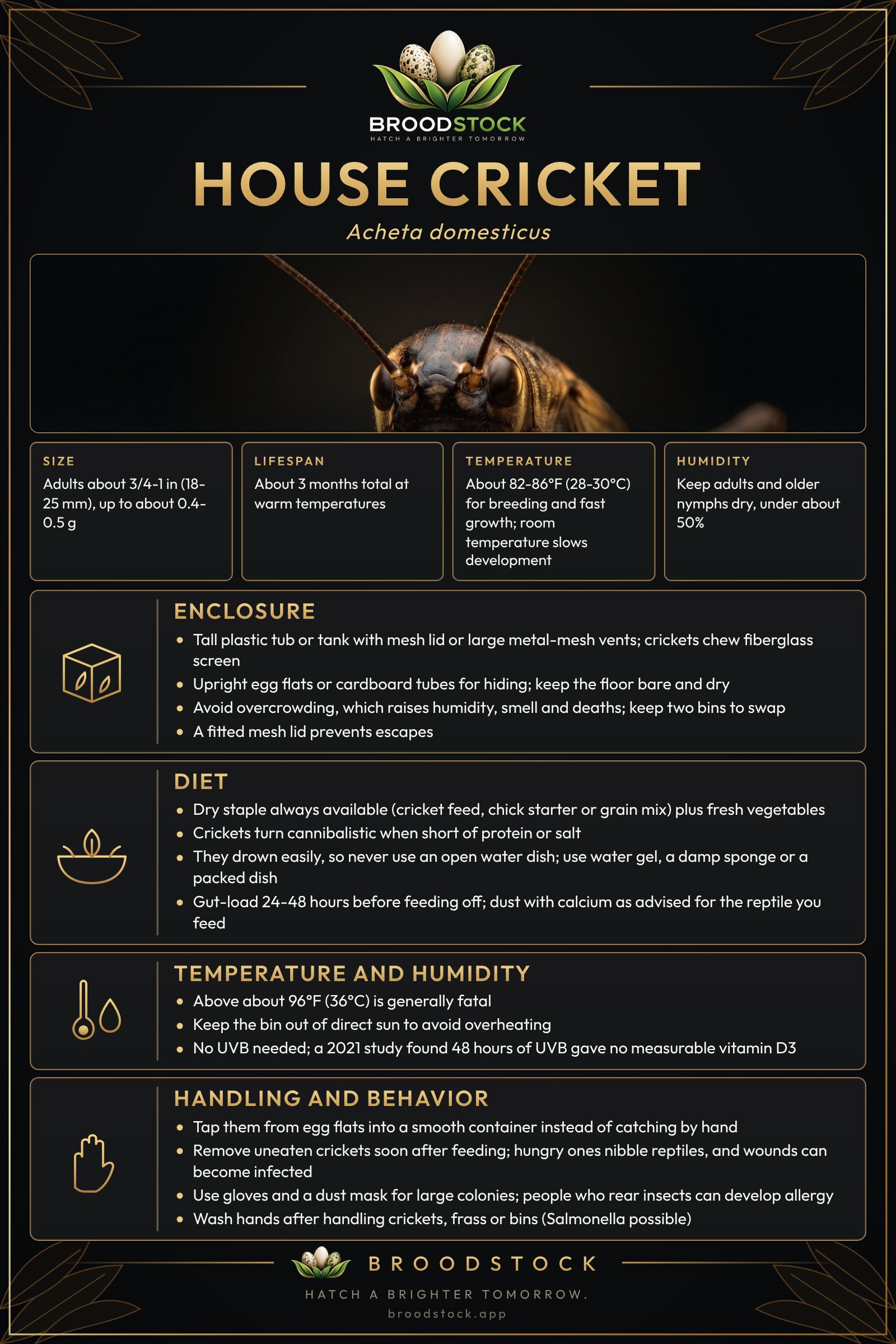
Print it or save it
The care sheet is a one-page summary you can print or keep on your phone. The full care text is below.
Keeping House Cricket? Broodstock tracks feeding, weights, sheds, enclosures and equipment for every animal you keep, and it is free to start.
Scientific name
Acheta domesticus. A brown cricket that has long served as feeder and bait, bred commercially in North America and Europe. Since 2009-2010 many US farms have lost colonies to Acheta domesticus densovirus (AdDNV), and some have partly switched to other species such as the banded cricket.
Adult size
Adults measure about 3/4-1 in (18-25 mm) and weigh up to about 0.4-0.5 g. Newly hatched crickets, called 'pinheads', measure just a few millimetres.
Lifespan
The whole life lasts about 3 months at warm temperatures: roughly 6 weeks as nymphs and up to about 2 months as adults, and most adults are dead by 2 months at 86°F (30°C). Cooler conditions extend it.
Enclosure
Use a tall plastic tub or tank with a mesh lid or large metal-mesh vents for airflow, because crickets chew through fiberglass screen. Stand egg flats or cardboard tubes upright for hiding, so frass falls through. Leave the floor bare and dry. A fitted mesh lid prevents escapes, and for open tubs a smooth band of tape or petroleum jelly near the top helps. Allow enough room, since overcrowding raises humidity, smell and deaths. Run a second bin as well, so one can be swapped in during cleaning.
Temperature
For breeding and fast growth, hold them at about 82-86°F (28-30°C). Room temperature (72-76°F / 22-24°C) is workable but slows development, and breeding stops below that. Heat beyond about 96°F (36°C) is generally fatal. Some sellers warn that below about 80°F (27°C) can cause colony collapse, while others hold them at room temperature without problems; practices vary.
Humidity
Keep adults and older nymphs dry, under about 50%, because damp bins from spilled water or crowding kill crickets. Eggs in the laying dish need near-saturated humidity, and pinheads do best at about 80-90% during their first week.
UVB
UVB is not needed. Light is not critical, and a 2021 study found that 48 hours of UVB gave feeder crickets no measurable vitamin D3, so it does not make them better food.
Lighting
Light is not critical. A normal day-night cycle or even continuous light does no harm. Keep the bin out of direct sun so it does not overheat.
Heating
Use a heat mat or heat cable on a thermostat under or beside part of the bin, or simply a warm room. Heaters should not touch the plastic, cardboard must stay away from heat sources, and sunny windows should be avoided. Use a thermometer placed where the crickets sit to read the temperature.
Diet
Keep a dry staple available at all times: commercial cricket feed, chick starter, or a grain mix with some dry dog or cat food for protein. Add fresh vegetables such as carrot, sweet potato, squash or dark greens, and remove them before they spoil. A shortage of protein or salt makes crickets cannibals.
They drown easily, so never use an open water dish. Use water gel or crystals, a damp sponge, or a dish packed with cotton or pebbles, and replace it every couple of days.
Supplements
Gut-load them for roughly 24-48 hours ahead of feeding off. Their calcium-to-phosphorus ratio is very low. Research recommends a gut-load diet with about 5% calcium for adults (about 3% for nymphs), yet even high-calcium gut-loading lifts calcium only part way, and it returns to near baseline within a day of fasting. Feed crickets out soon after gut-loading, and still dust them with calcium as advised for the reptile you feed.
Shedding
Nymphs molt about 8 times at 86°F (up to 10 at room temperature), roughly doubling in size each time, and adults never molt again. A freshly molted cricket stays white and soft for a few hours, which makes it easy prey for tankmates, so supply plenty of hides and protein.
Handling
Tap crickets from egg flats into a smooth container or tube instead of catching them by hand. Take uneaten crickets out of the enclosure soon after the feeding session, or offer them in a smooth dish. Hungry crickets nibble reptiles and amphibians, especially at night or when the animal is shedding or sick, and the wounds can become infected. If a few must stay, give them greens or cricket food to eat instead.
People who rear insects can develop an allergy, crickets included, and frass dust is an exposure. Use gloves and a dust mask for large colonies and work in a ventilated room. Cricket cultures carry high bacterial loads, so wash hands after handling crickets, frass or bins (Salmonella and other bacteria are possible).
Brumation
Crickets have no diapause. Cooler temperatures slow growth and lengthen life but stop breeding.
Health signs to watch
Sudden mass die-offs come from Acheta domesticus densovirus (AdDNV), which has bankrupted cricket farms and targets house crickets specifically. Cricket iridovirus also causes colony losses, and related insect iridoviruses have been found in pet lizards and the feeder insects given to them, so infected prey is a likely route to reptiles and amphibians. Hold new batches apart, choose healthy suppliers, and give bins a full clean and dry between batches.
Other common killers are wet bins, mold on food, ammonia from crowding, drowning, overheating and cannibalism. A strong rotten smell or sudden deaths means you should clean out and check conditions at once.
Welfare
Never release feeders. In Florida, the house cricket is on the FDACS list of deregulated feeder arthropods (July 2026 list), so no state permit is needed to keep or move it. It has been sold there for decades, and FDACS has long treated it as low risk. According to USDA APHIS, moving house crickets between US states takes no permit, and Oregon and California likewise list it as permit-free.
Hawaii prohibits imports of animals, insects included, that are not on its approved lists, so check with the Hawaii Department of Agriculture. Rules change, so check with your state agriculture department before shipping.
Keep every animal's care in one place
Log feedings, weights and sheds, set reminders, and let Ranger, the built-in AI manager, help with the rest. Free to start, no card needed.