
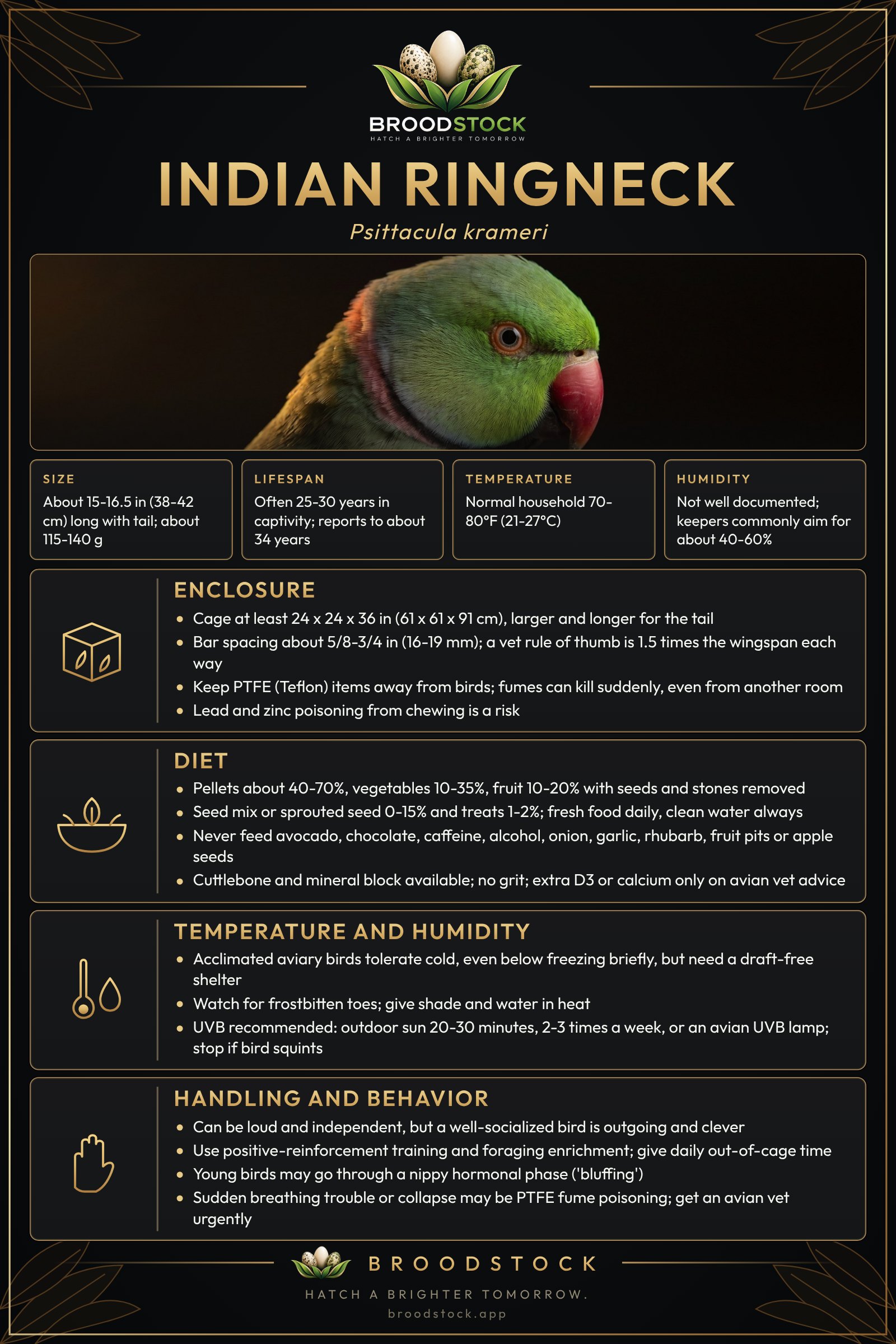
Print it or save it
The care sheet is a one-page summary you can print or keep on your phone. The full care text is below.
Keeping Indian Ringneck? Broodstock tracks feeding, weights, sheds, enclosures and equipment for every animal you keep, and it is free to start.
Scientific name
Psittacula krameri
Adult size
Length is about 15-16.5 in (38-42 cm), including a tail of up to about 10 in (25 cm). Weight runs about 115-140 g, averaging about 137 g.
Lifespan
Captive ringnecks often live 25-30 years, and reports reach about 34 years. Anyone placing young birds needs to plan long-term homes.
Enclosure
Vets have not documented this well. Keepers commonly use a cage of at least 24 x 24 x 36 in (61 x 61 x 91 cm), made larger and longer to make room for the tail, with bar spacing about 5/8-3/4 in (16-19 mm). Vets commonly suggest the cage be at least 1.5 times the wingspan in each direction.
Temperature
Normal household temperatures of about 70-80°F (21-27°C) suit them indoors. Acclimated aviary birds tolerate cold well, even below freezing for short spells, but they need a draft-free shelter and should be watched for frostbitten toes. Give shade and water in heat. No ringneck-specific limits are published.
Humidity
This is not well documented for ringnecks. Normal household humidity suits most parrots, and keepers commonly aim for about 40-60%. Bathing dishes or overhead misting should be offered on a regular basis.
UVB
UVB is recommended. Direct outdoor sun gives vitamin D for calcium use, but window glass blocks UVB. Supervised time outside in a secure cage or aviary is ideal: about 20-30 minutes, 2-3 times a week, at 65-85°F (18-29°C).
Indoors, mount an avian UVB fluorescent tube or compact bulb above the cage for at least 3-4 hours a day, with shade available, at the maker's distance and replaced every 6 months. Switch it off if the bird squints or rubs its face. Vitamin D3 also comes from pellets.
Lighting
Outside breeding, give about 12 hours of uninterrupted darkness a day. Reproductive behaviour, excess laying and heavy moults are all driven by long days. For birds kept indoors, cover the cage at dusk or move them into a dark room.
Heating
Keep the room draft-free at normal household temperature. Never use non-stick pans, heat lamps, heaters or other appliances with a PTFE (Teflon) coating near birds. Overheated PTFE gives off fumes that can kill birds suddenly, even in another room.
Diet
Build the diet on pellets: about 40-70% pellets, 10-35% vegetables, 10-20% fruit (seeds and stones removed), 0-15% seed mix or sprouted seed and 1-2% treats. Give fresh food daily and clean water always.
Never feed avocado, chocolate, caffeine (coffee, tea), alcohol, onion or garlic, rhubarb, or fruit pits and apple seeds. Avoid salty, fatty or sugary human foods.
Supplements
Keep calcium sources available at all times: cuttlebone, a mineral block and dark leafy greens, especially for laying hens. Vitamin D3 comes from sunlight, UVB light or pellets. With those in place, extra vitamin and mineral supplements are unnecessary, so give D3 or calcium products only on avian vet advice, since excess is harmful. Parrots hull their seed and do not need grit, and sick birds may overeat it and become impacted.
Shedding
Ringnecks moult once or twice a year. Excessive moulting can be set off by long days.
Handling
Ringnecks can be loud and independent, with a hands-off reputation. A well-socialized bird given regular positive interaction is outgoing and clever, though usually not a cuddler. They whistle too, and many speak clearly. Train with positive reinforcement, add foraging enrichment and allow time out of the cage every day. Keepers often describe a nippy hormonal phase in young birds ('bluffing'), though vet sources do not document it well.
Health signs to watch
Get an avian vet urgently for a hen straining, fluffed on the floor, tail bobbing or with a swollen abdomen (egg binding), and for sudden breathing trouble or collapse (possible PTFE fume poisoning).
Also watch for chlamydiosis (psittacosis, which can spread to people); avian polyomavirus (often fatal in birds under about 4 months, and adults can shed it for up to 90 days without signs); PBFD; aspergillosis; bacterial infections; sneezing and eye discharge, which are common in young birds; reproductive disease (chronic laying, oviduct impaction, prolapse); lead and zinc poisoning from chewing; feather plucking; and obesity. Arrange a vet check every 6-12 months, and quarantine and screen new birds before adding them to a breeding collection.
A hen that keeps laying needs the nest box and nest material removed, shorter days and an avian vet.
Welfare
Ringnecks are very long-lived, so young birds need long-term homes. Chronic or out-of-season laying drains calcium, so do not let a hen keep laying.
Colour mutations such as blue, yellow and albino are widely available, and none have been confirmed to cause health problems in the material available.
Keep every animal's care in one place
Log feedings, weights and sheds, set reminders, and let Ranger, the built-in AI manager, help with the rest. Free to start, no card needed.