
Broodstock / Care sheets / Isopods
Isopods Care Sheet
Terrestrial isopods (woodlice, suborder Oniscidea), which are crustaceans, not insects
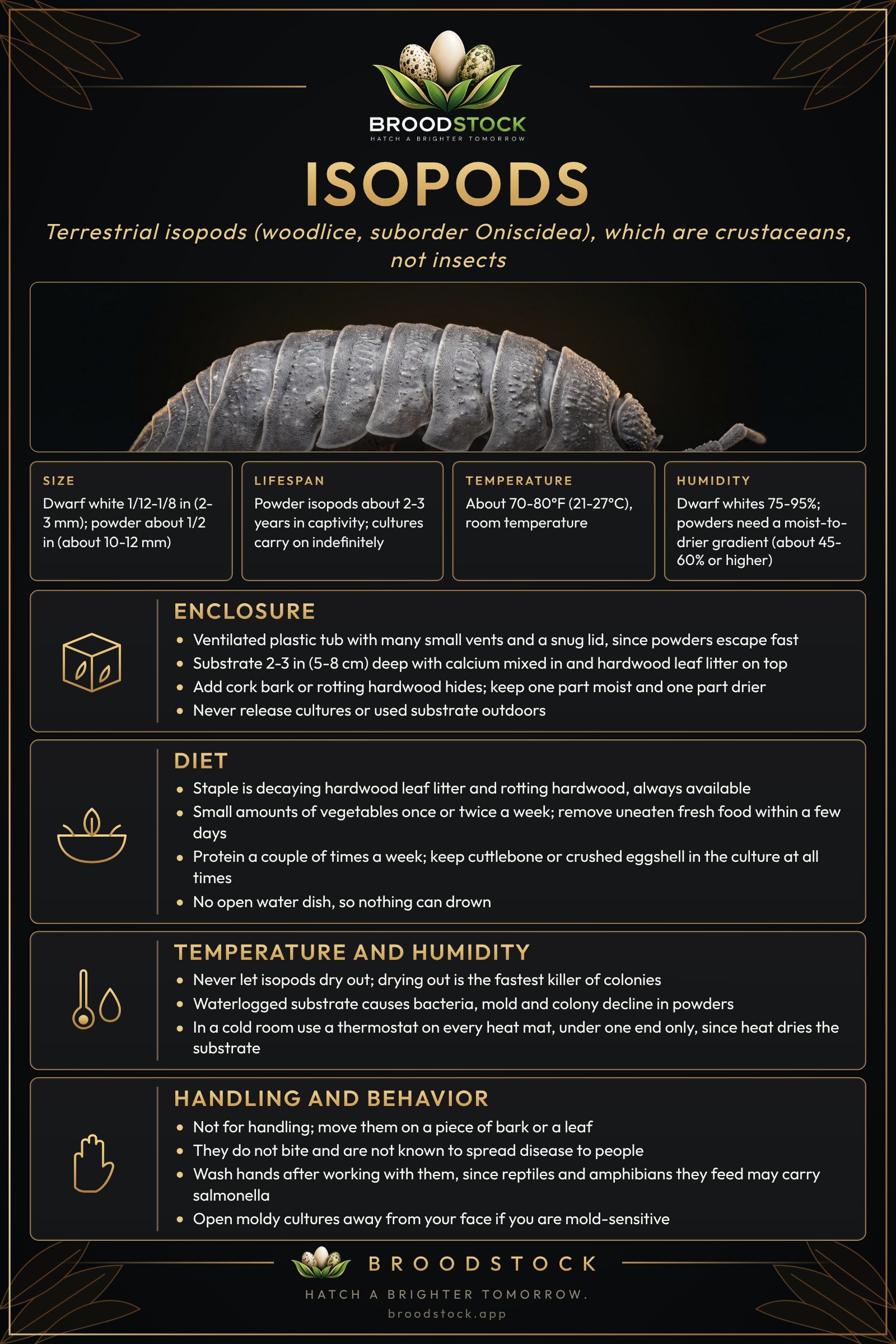
Print it or save it
The care sheet is a one-page summary you can print or keep on your phone. The full care text is below.
Keeping Isopods? Broodstock tracks feeding, weights, sheds, enclosures and equipment for every animal you keep, and it is free to start.
Scientific name
Terrestrial isopods (woodlice, suborder Oniscidea) are crustaceans, not insects. The two main hobby species for feeding and cleanup are the dwarf white isopod (Trichorhina tomentosa) and the powder blue or powder orange isopod (Porcellionides pruinosus). The powder isopod is cosmopolitan and native to Europe, and it may really be a group of close species. Its color forms are sold as powder blue, orange, pink and others.
Adult size
Dwarf whites reach about 1/12-1/8 in (2-3 mm). They are white and cannot roll into a ball.
Powder blue and orange isopods grow to about 1/2 in (about 10-12 mm). Females run a little bigger than males.
Lifespan
In the wild, Porcellionides pruinosus lives about 11-14 months. In captivity it reaches about 2-3 years. The dwarf white lifespan has not been well documented. Because generations overlap, a culture can carry on indefinitely.
Enclosure
Keep the culture in a ventilated plastic tub. A starter colony needs at least about shoebox or 6-quart size. Drill many small vent holes rather than one big one, and fit a snug lid. Powder isopods are fast and good at escaping, and dwarf whites are tiny.
Fill the tub with 2-3 in (5-8 cm) of substrate: coco fiber with some earthworm castings, or an ABG-style mix, with a calcium source mixed in. Cover that with a thick layer of decaying hardwood leaves (oak, magnolia). Add hides made of cork bark or rotting hardwood.
Let one part of the tub stay moist and another part drier, so the isopods can choose. Do not disturb or rearrange the substrate often.
Temperature
Room temperature of about 70-80°F (21-27°C) works. Dwarf whites tolerate about 65-85°F (18-29°C). For powder isopods, the tolerated span is roughly 60-82°F (15-28°C).
Humidity
Isopods breathe through moist gill-like structures and lose water quickly, so never let them dry out.
Dwarf whites need high humidity of about 75-95% and substrate that stays damp all the time. Powder isopods handle dryness better and like a gradient. Keep about one-third to one-half of the tub moist and the rest drier, at about 45-60% or higher. In powders, waterlogged substrate leads to bacteria, mold and colony decline.
UVB
Isopods do not need UVB. They are nocturnal detritivores that shelter from light.
Lighting
No special lighting is needed. Ordinary room light or darkness is fine, but keep cultures out of direct sun. Hobby cultures need no light schedule.
Heating
Most rooms need no added heat. In a cold room, find a warmer spot or put a heat mat on a thermostat under one end of the tub so the other end stays cooler. Heat dries out the substrate, so check moisture more often. For fire safety, put a thermostat on every heat mat and set mats on non-flammable surfaces.
Diet
The staple is decaying hardwood leaf litter and rotting hardwood, and it should always be available.
Once or twice a week, add small amounts of vegetables such as squash, zucchini, carrot, sweet potato and cucumber. Fruit is accepted, but it molds and draws pests. A couple of times a week, give protein (fish flakes, dried shrimp, commercial isopod foods) to support growth.
Take out uneaten fresh food within a few days. Water comes from the damp substrate and moist food. Leave out any open water dish, so nothing can drown.
Supplements
Isopods need calcium to molt, so leave cuttlebone, crushed limestone, crushed eggshell or oyster shell in the culture at all times. They eat calcium constantly, so sellers consider them partly gut-loaded already. Before feeding them off, a day or two on vegetables and a calcium source is enough. Isopods are only a supplemental feeder, so keep dusting the main feeder insects with calcium as usual.
Shedding
Isopods molt in two halves. The back half goes first, and the front follows about 2-3 days later. An isopod that looks half pale is molting and is not sick. A calcium source is needed to harden the new shell, and the animals are vulnerable while molting. Young isopods molt repeatedly over several months before they reach adult size.
Handling
Do not handle them, because they are small and delicate. Move them on a piece of bark or a leaf, or sift the substrate and tip it out. Biting is not something they do. They are not known to spread disease to people, and they are not a household pest.
As with any animal culture or vivarium, wash your hands after working with them. This matters most when the culture, or the reptiles and amphibians it feeds, may carry salmonella. If you are mold-sensitive, open moldy cultures away from your face.
Brumation
Indoor cultures need no diapause. Cooler rooms slow growth and reproduction, so a cooler spot can hold back a culture that is producing too fast. Avoid cold extremes for the tropical dwarf white. How these species overwinter has not been well documented.
Health signs to watch
Colonies mostly crash because of drying out, which kills fastest. Other causes are waterlogged substrate (bacteria and mold), fresh food that rots from overfeeding, and too little ventilation.
A little mold on leaves is normal. Mold spreading over uneaten food means you gave too much. Mites point to an unhealthy culture, usually from too much food or too much moisture.
Watch for dead adults on the surface, white or stuck half-molts (low calcium or low humidity) and falling numbers. Keep a spare culture going, and source new stock from reputable vendors.
Welfare
Never release cultures or used vivarium substrate outdoors, especially fancy color forms or species outside their native range. Porcellionides pruinosus is already cosmopolitan, and dwarf whites are a tropical species introduced across the tropics, but escape and invasive risk is still real.
Powder isopods escape quickly, so keep lids snug and vents small. No US federal or state permit requirement was found for these species, but rules on shipping invertebrates can vary, so check local and state rules before shipping or importing. Isopods are fed live and are harmless to the animals that eat them. Any left over then work as cleanup crew.
Keep every animal's care in one place
Log feedings, weights and sheds, set reminders, and let Ranger, the built-in AI manager, help with the rest. Free to start, no card needed.