
Broodstock / Care sheets / Java Sparrow
Java Sparrow Care Sheet
Padda oryzivora (sometimes listed as Lonchura oryzivora)
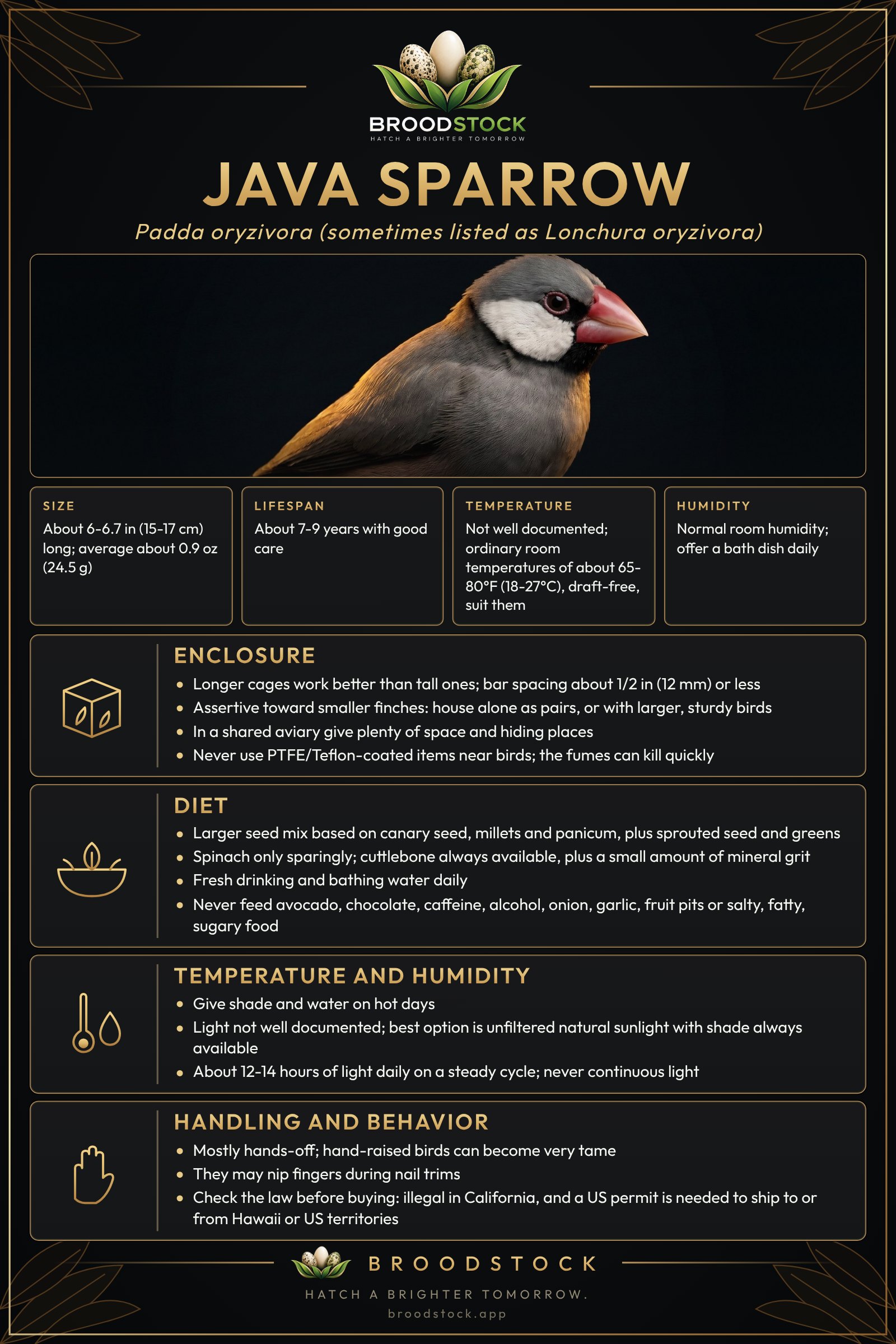
Print it or save it
The care sheet is a one-page summary you can print or keep on your phone. The full care text is below.
Keeping Java Sparrow? Broodstock tracks feeding, weights, sheds, enclosures and equipment for every animal you keep, and it is free to start.
Scientific name
Padda oryzivora, also listed by some authorities as Lonchura oryzivora.
Adult size
Length is about 6-6.7 in (15-17 cm), and average weight is about 0.9 oz (24.5 g). It ranks among the largest estrildid finches.
Lifespan
With good care, 7-9 years is typical.
Enclosure
Check the law before anything else. Java sparrows are federally listed injurious wildlife (Lacey Act, 50 CFR 16.12). Importing them into the US, or shipping them to or from Hawaii, Puerto Rico or other US territories, needs a USFWS permit, and permits are issued only for zoo, education, medical or science use. Shipment between mainland states is allowed under a 2017 court ruling, yet the rules could change. Possession is also illegal in California (listed as detrimental under 14 CCR 671), and the species is invasive in Hawaii and Puerto Rico. Check federal, state and country rules before buying, selling or shipping. Birds must never be released.
A cage that is long works better than one that is tall. Bar spacing should be about 1/2 in (12 mm) or less.
Java sparrows are assertive toward smaller finches. House them alone as pairs, or with larger, sturdy birds (small doves are suggested). In a shared aviary, provide plenty of space and hiding places. Expect them to chew and strip any plants.
Never run non-stick pans, irons, or any heat lamps and heaters with a PTFE/Teflon coating near birds. The fumes can kill birds quickly, even from another room.
Temperature
Temperature needs are not well documented for this species. As with other finches, ordinary room temperatures of about 65-80°F (18-27°C) without drafts suit them. Give shade and water on hot days.
Humidity
Normal room humidity is fine. They bathe often, so offer a bath dish every day.
UVB
UVB needs are not well documented for this species. The best choice is unfiltered natural sunlight, such as an outdoor flight or an open window (glass blocks UV), with shade always on offer. Avian vet evidence on UVB lamps for birds is mixed, so a lamp is optional. If you use one, pick a bird-specific full-spectrum/UVB lamp, follow the maker's distance advice and run it on the normal day cycle. Make sure the diet provides vitamin D3.
Lighting
Give about 12-14 hours of light a day on a steady cycle. Never leave lights on continuously.
Heating
Do not use heat sources that carry a PTFE/Teflon coating near birds. That covers non-stick pans, irons, and some heat lamps and heaters. Small birds die quickly from those fumes.
Diet
Java sparrows need larger seed than small finches do. Use a mix built on canary seed, millets and panicum. Some breeders also add budgie mix and dehusked rice. Often offer sprouted seed and green seed heads, plus leafy greens (kale, bok choy, endive, silverbeet). Give spinach only sparingly.
Many Javas refuse egg food and live food outside breeding, and small mealworms are often accepted only while chicks are being fed. Change drinking and bathing water daily.
Never feed avocado, chocolate, caffeine, alcohol, onion, garlic, fruit pits, apple seeds, or any human food that is salty, fatty or sugary.
Supplements
Keep cuttlebone available at all times, along with a small amount of mineral grit. They chew the cuttlebone heavily, which also helps the beak. Laying hens commonly get extra calcium. Birds that live indoors without UV on a seed-based diet should get an avian vitamin supplement with A and D3.
Shedding
Young birds keep brown juvenile plumage for several months and then slowly molt into adult grey. Adults molt once a year, usually after breeding.
Handling
These birds are mostly hands-off, although hand-raised Javas (the Japanese tradition) can become very tame and bonded to people. Nail trims may earn you a nip on the fingers.
Health signs to watch
Take the bird to an avian vet for any of these: a fluffed, sleepy appearance; tail bobbing or noisy breathing (air sac mites, respiratory infection); crusty growths on the face or legs (mites); a hen straining or sitting on the floor (egg binding); diarrhea or weight loss (worms, gut infections).
Birds kept in aviaries need worming and parasite control on a regular basis. Because of their aggression, watch for injuries in mixed groups. Exposure to PTFE fumes can lead to sudden death.
Welfare
Wild Java Sparrows are listed as Endangered (IUCN) and sit on CITES Appendix II, with trapping a major threat, so buy only captive-bred birds. In the US they are federally listed injurious wildlife, with no import and no shipping to or from Hawaii or US territories without a permit. They are illegal in California and invasive in several places. Never release birds, and check local law before keeping or shipping.
They are aggressive toward small finches.
Keep every animal's care in one place
Log feedings, weights and sheds, set reminders, and let Ranger, the built-in AI manager, help with the rest. Free to start, no card needed.