
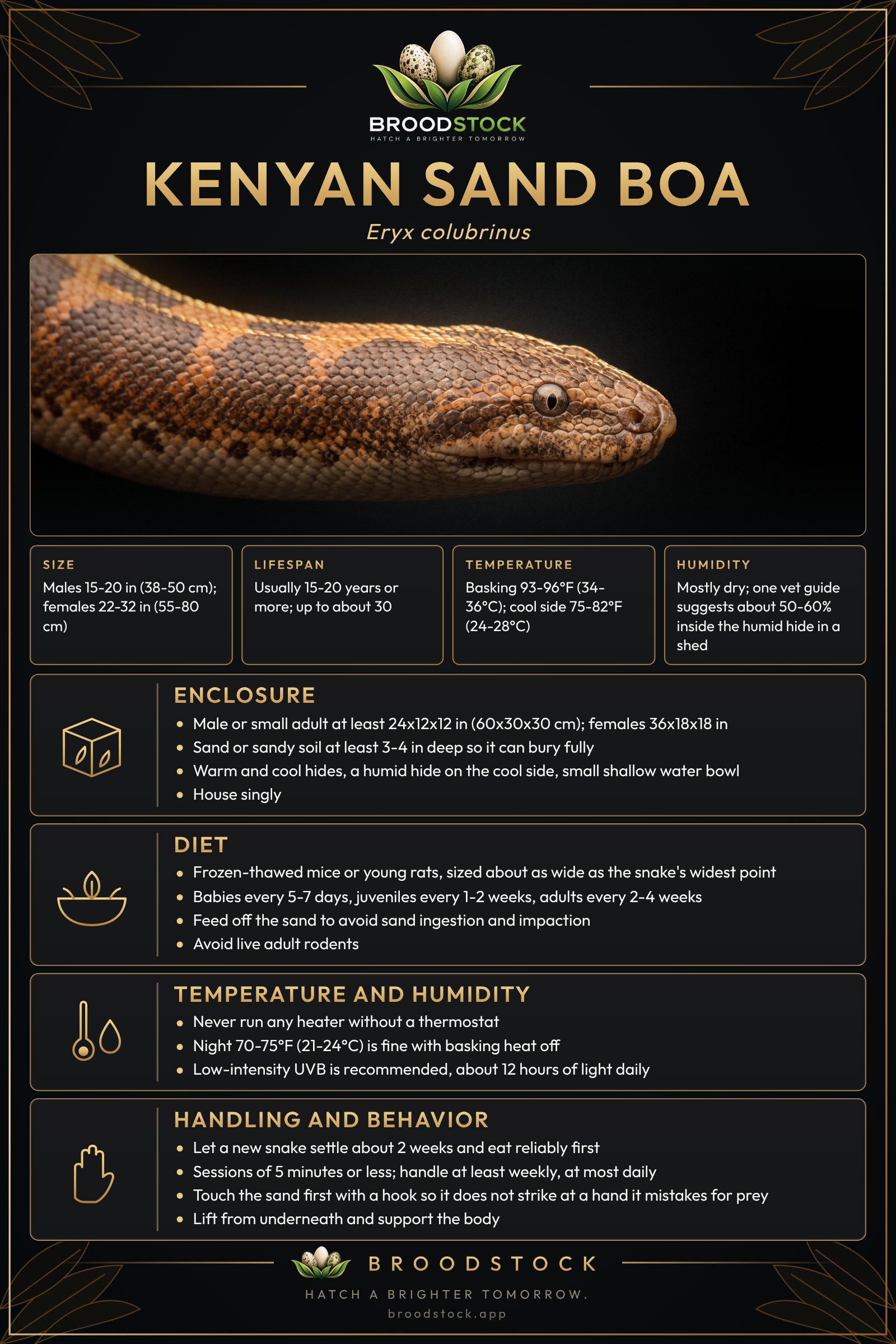
Print it or save it
The care sheet is a one-page summary you can print or keep on your phone. The full care text is below.
Keeping Kenyan Sand Boa? Broodstock tracks feeding, weights, sheds, enclosures and equipment for every animal you keep, and it is free to start.
Scientific name
Eryx colubrinus
Adult size
The sexes differ strongly in size. Males are usually 15-20 in (38-50 cm). Females are usually 22-32 in (55-80 cm) and rarely reach about 36 in (90 cm).
Lifespan
They commonly live 15-20 years or more, and well-kept captives can reach about 30.
Enclosure
A male or small adult needs at least 24x12x12 in (60x30x30 cm). Adult females need 36x18x18 in, and larger is better. Floor space counts for more than height.
Use sand or sandy soil (for example 60% topsoil / 40% play sand) at least 3-4 in deep, so the snake can bury itself fully. Spot clean daily and replace the substrate every 3-4 months. Provide warm and cool hides or cork flats, a humid hide on the cool side, and a small shallow water bowl. Keep each snake on its own.
Temperature
Basking surface: 93-96°F (34-36°C). Cool side: 75-82°F (24-28°C). At night, 70-75°F (21-24°C) is fine when the basking heat is off.
Humidity
Keep the enclosure mostly dry, with low ambient humidity and an occasional light mist. Put a humid hide (damp sphagnum or lightly moist substrate) on the cool side. The snake uses it most around sheds. An exact ambient target is not well documented. One vet guide suggests about 50-60% inside the humid hide during a shed.
UVB
UVB is recommended but not strictly required. Provide low-intensity UVB over about half the enclosure on the warm side, aiming for a UVI of about 2.0-3.0 at the basking spot. One option is an Arcadia ShadeDweller at 7-9 in (18-23 cm) through mesh, or 10-12 in (25-30 cm) without mesh. Another is a T5 HO 6% or ReptiSun 5.0 at 10-12 in (25-30 cm) through mesh, or 13-15 in (33-38 cm) without. Replace the lamp every 6-12 months.
Lighting
Run about 12 hours of light a day all year, with heat and UVB on the same timer.
Heating
Hang one or more halogen flood bulbs over a flat basking rock or platform. Two 75 W bulbs is a typical start, and you then adjust to reach the basking range. Use a dimming thermostat or timer, and measure the basking surface with an infrared thermometer.
Under-tank heating is acceptable if a thermostat controls it. Every heater needs a thermostat; none should ever run without one.
Diet
Feed frozen-thawed rodents (mice, young rats); variety is fine. Offer one or two items sized about as wide as the snake's widest point. Babies eat every 5-7 days, juveniles every 1-2 weeks, and adults every 2-4 weeks, with large females toward the shorter end.
Feed off the sand, using tongs, a plate or a separate tub, so the snake does not swallow sand. Avoid live adult rodents.
Supplements
Supplements are optional on a whole-prey diet. If you use one, lightly dust the prey now and then, before thawing, with a 50/50 calcium plus multivitamin. Under UVB, use a low-D3 product such as Repashy Calcium Plus LoD or Arcadia RevitaliseD3. With no UVB, use a standard-D3 product such as Repashy Calcium Plus. Do not dust every meal.
Shedding
Signs of a coming shed are dull color, cloudy blue eyes and hiding. Keep the humid hide damp, and skip feeding until the shed is finished. Afterward, check that the eye caps and tail tip came off. Repeated stuck sheds mean the setup is too dry. See a vet if eye caps stay on or the skin under retained shed looks inflamed.
Handling
Give a new snake about 2 weeks to settle and eat reliably before you handle it. Begin with sessions of 5 minutes or less, and handle at least weekly but no more than daily. Pick the snake up from below, with the whole body supported.
These snakes ambush prey from under the sand, so first touch the sand with a hook or paper-towel tube. That way the snake will not strike at a hand it takes for prey.
Brumation
This tropical East African species does not truly brumate.
Health signs to watch
Quarantine new snakes, get a fecal exam and schedule an annual vet check.
See a vet for wheezing, open-mouth breathing or mucus (respiratory infection, often from damp or cold setups); red or cheesy gums (mouth rot); mites; belly blisters (wet or dirty substrate); regurgitation; and weight loss. Sand impaction is a risk if the snake is fed on sand. Overfeeding often leads to obesity. Boas can get inclusion body disease, so quarantine and watch for star-gazing or loss of righting.
Welfare
Feed neonates one at a time, and separate each snake that eats. Two babies on the same pinky can end with one swallowing the other. Keep fresh water available at all times.
Keep every animal's care in one place
Log feedings, weights and sheds, set reminders, and let Ranger, the built-in AI manager, help with the rest. Free to start, no card needed.